
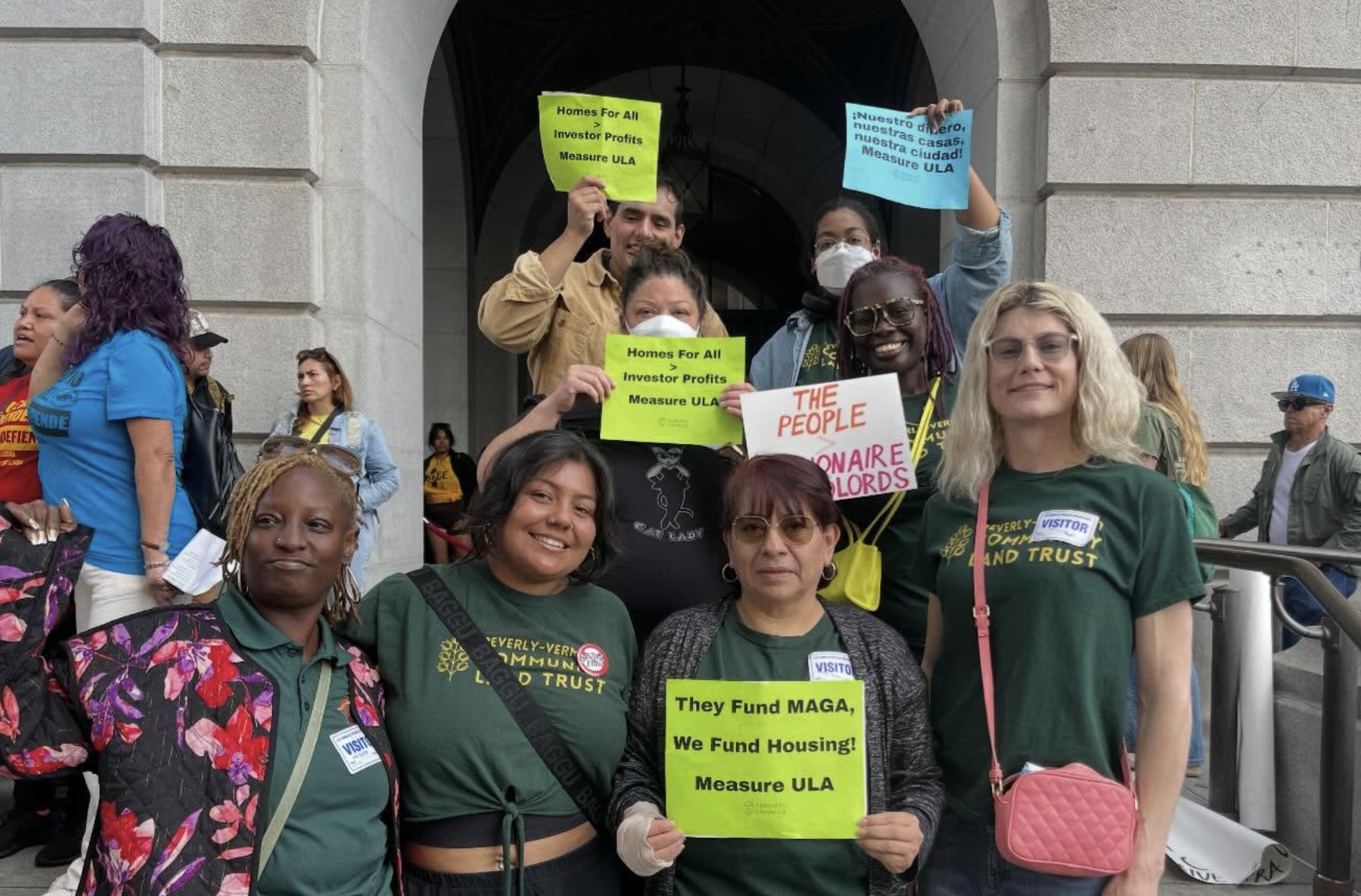
The Ad Hoc Committee on Measure United to House Los Angeles met Friday morning at City Hall and delivered two very different messages about the future of the city’s largest affordable housing funding stream. First, the committee members voted unanimously to move hundreds of millions of dollars into housing production. Then came a coordinated push to scale that funding back.
In a 3-0 vote, the committee approved $360.97 million for 80 affordable housing projects totaling 5,241 units under the Homes for LA program, marking the largest single allocation of Measure ULA funds to date. The vote, led by Councilmember Ysabel Jurado and joined by Councilmembers John Lee and Imelda Padilla, included only minor technical fixes. There was no debate or controversy, just money moving toward housing.
Moments later, the committee heard from the “Mend It, Don’t End It” coalition, a group advocating changes to Measure ULA that would significantly reduce the revenue it generates. Their proposal includes exempting commercial and multifamily properties from the tax for 15 years and placing a cap on total revenue, arguing that scaling back the measure would improve its performance and potentially head off a statewide effort to ban similar taxes.
Joe Donlin, executive director of United to House LA, offered a blunt summary of that presentation in a statement released after the meeting. “The material covered today by the ‘Mend It, Don’t End It’ coalition can be helpfully divided into the good, the bad, and the weird,” he wrote. On the good: agreeing that ULA’s programs can run faster and more effectively. On the bad: the real estate lobby’s refusal to accept that LA voters asked the top tier of their industry to pay its fair share. And on the weird: the unexamined assumption that weakening ULA would produce a deal with opponents who have already said no deal exists.
That argument runs directly counter to what opponents of ULA have already said publicly. Backers of the statewide ballot initiative, including the Howard Jarvis Taxpayers Association and the California Business Roundtable, have made clear they are not negotiating over Los Angeles policy. Their goal is to eliminate transfer taxes like ULA statewide, regardless of local changes. Lena Sullivan of the KeyValley House Coalition told the committee that the United to House LA coalition had already tried to find out whether a deal was possible, and got their answer. The initiative’s funders refused to meet with them months ago, and have since stated both publicly and privately that they have no plans to pull their ballot measure regardless of what the City Council does. Housing advocates warned the committee that weakening the measure would not stop that effort and would instead signal that the policy is politically vulnerable.
Public commenters echoed that concern, urging councilmembers not to conflate implementation challenges with a need to rewrite the law itself. “ULA is already working, and it’s helping lots of people,” one speaker told the committee. “With the help of free legal counsel. And this is real. This is happening right now.” Another speaker grounded the stakes in lived experience: “The truth is that we lived under threats and we lived under harassment. We live under fear of eviction under a system which treats housing as a business and not as if it is a need for human beings. That’s why ULA exists.”
The contrast between the funding vote and the policy proposals highlighted a central tension in City Hall’s approach to ULA. On one hand, the measure is producing substantial revenue and beginning to deliver housing at scale. Since taking effect, ULA has generated more than $1 billion, with hundreds of millions already approved for affordable housing and tenant protections. Friday’s vote adds another $360 million to that pipeline. On the other hand, pressure from real estate and business interests continues to focus on reducing or limiting that revenue.
There is a widely acknowledged need to improve how quickly ULA funds are deployed. City agencies have faced administrative hurdles, restrictive guidelines, and early implementation challenges that have slowed the rollout of some programs. The committee has the authority to address those issues through technical adjustments, and Friday’s funding approval showed that process working as intended. Projects moved forward without reopening the measure or altering its core structure.
What the committee cannot do without going back to voters is change the fundamental tax framework that generates the revenue in the first place. That distinction has become increasingly important as proposals framed as “fixes” begin to target the measure’s underlying funding mechanism rather than its implementation.
The committee also delayed a comprehensive report on ULA revenues, expenditures, and outcomes through early 2026. The analysis, being prepared by multiple city agencies, is expected to provide a clearer picture of how the measure is performing amid a volatile real estate market shaped by rising interest rates, post-pandemic shifts, and ongoing legal challenges. Critics have pointed to reduced transaction volume as evidence that ULA is suppressing development, while supporters argue those trends reflect broader market conditions and that the measure’s revenue remains strong.
For now, the most concrete data point is the one approved Friday: hundreds of millions of dollars are moving into affordable housing production. The question facing City Hall is whether to build on that progress or scale it back in response to external pressure. The funding package now heads to the full City Council for final approval, and the revenue report will return to committee at a later date. Meanwhile, the debate over whether to defend or dilute Measure ULA is likely to intensify as the statewide ballot fight approaches.