
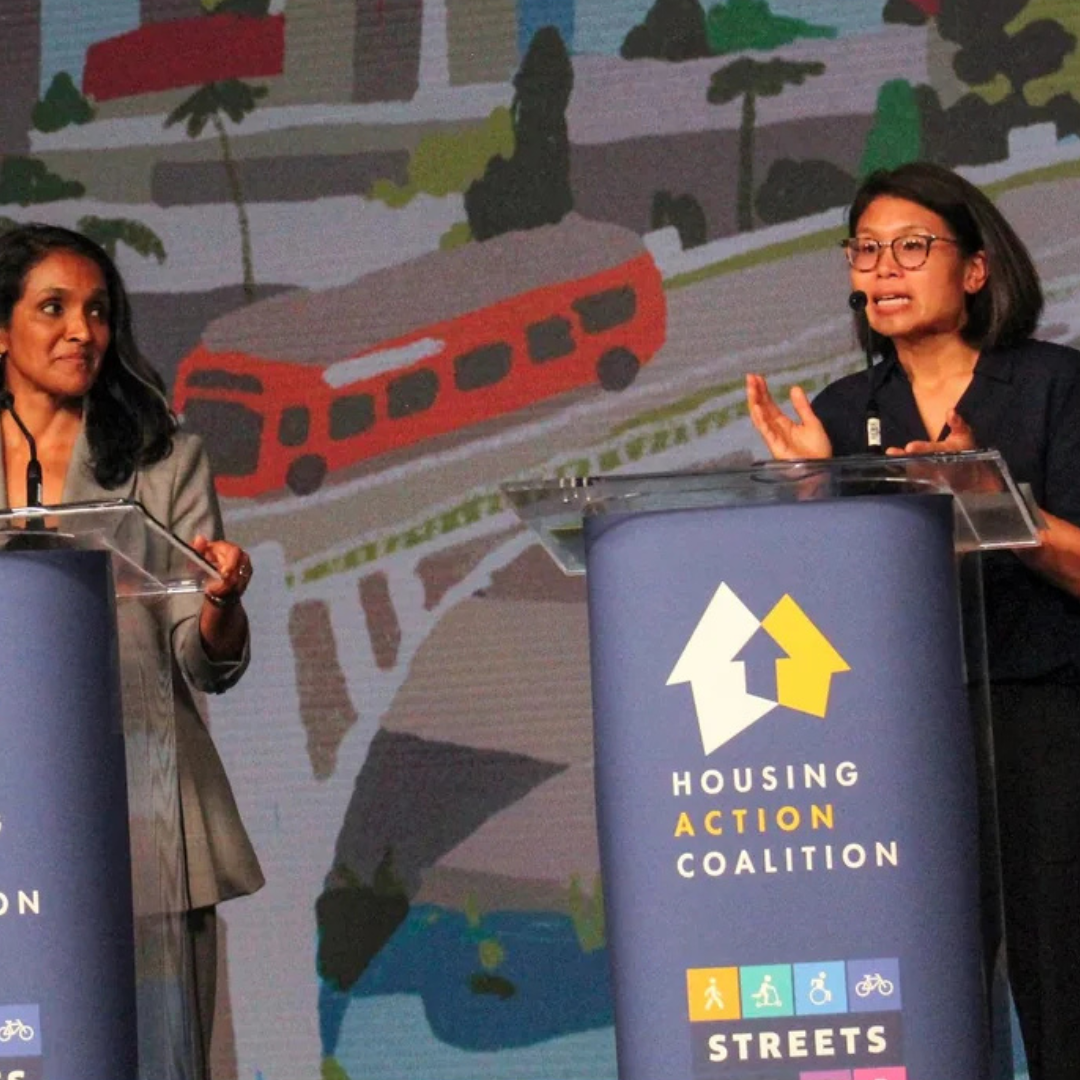
At the first mayoral debate of the 2026 race on March 23, one of the clearest lines of disagreement between the candidates was not just about how to build more housing, but about whether Los Angeles should weaken Measure ULA to try to do it.
Framed by moderators as a question about whether to “keep, repeal, or reform” the voter approved measure, the exchange revealed a growing divide in city politics. Councilmember Nithya Raman argued that ULA is “an incredible resource” but said it must be reformed, proposing a 15 year exemption for new multifamily construction. Billionaire businessman Adam Miller went further, calling ULA “terribly drafted” and blaming it for reducing housing supply. In contrast, community organizer Rae Huang rejected exemptions outright, warning against “giving tax breaks to developers” and arguing the city should protect and expand the measure as passed.
The underlying assumption driving the calls for reform was clear. Both Raman and Miller framed ULA as a meaningful barrier to housing production, particularly for new multifamily buildings. That claim has shaped much of the policy conversation over the past year, including proposals at City Hall to carve out exemptions and weaken the measure.
But just days before the debate, a new analysis from BAE Urban Economics directly challenged that premise. Looking at nearly three years of real estate transactions and applying the same financial models developers use to determine feasibility, the report finds that ULA plays a minimal role in whether projects get built. Instead, development outcomes are driven overwhelmingly by broader market conditions including interest rates, insurance costs, and rent levels.
Across 190 transactions representing more than 13,000 housing units, the study shows that most projects fall into two categories. They are either already financially viable or they are not viable regardless of ULA. Removing the tax does little to change that equation. The report also finds that in many cases, feasibility is less about ULA and more about timing. Projects that do not pencil in early years often become profitable simply by being held longer, meaning the difference between building and not building is driven more by market cycles than by the transfer tax itself.
Perhaps most importantly for the policy debate, the analysis concludes that exemptions would have little effect on overall housing production. Instead, they would largely benefit projects that are already feasible or that would become feasible over time, functioning as a subsidy rather than a catalyst for new housing.
That finding lands squarely in the middle of the divide on display at the debate. Raman’s proposal to exempt new construction for 15 years is premised on the idea that ULA is preventing projects from penciling. Mayor Karen Bass has similarly supported targeted exemptions, including proposals tied to wildfire recovery and broader efforts to soften the measure’s impact. Both approaches reflect a belief that weakening ULA is necessary to restore housing production.
But the BAE analysis suggests that approach is unlikely to deliver the results its proponents promise. Instead, it aligns most closely with the position articulated by Huang on the debate stage. Rae has been the only major candidate to consistently oppose efforts to gut ULA, arguing that the measure is a critical funding source for affordable housing and tenant protections and that weakening it would reduce those resources without meaningfully increasing supply.
That distinction matters because ULA is not just another housing policy. It is the largest local funding source for affordable housing and homelessness prevention in the country. At a moment when the city is struggling to fund eviction defense, build permanent supportive housing, and keep people housed, the question is not only how to build more units but how to sustain the programs that prevent displacement and homelessness in the first place.