
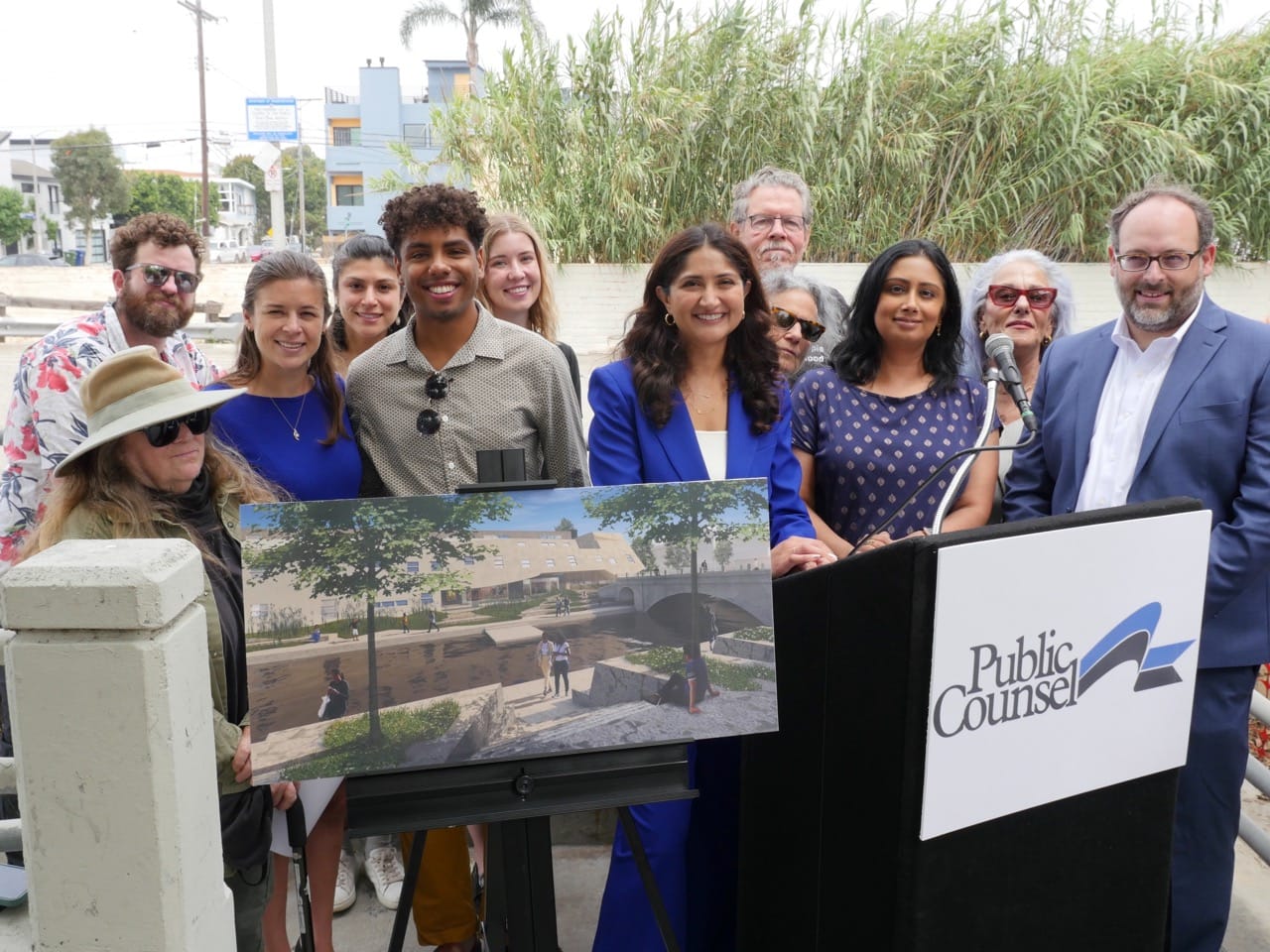
The City of Los Angeles has suffered another legal defeat in its ongoing effort to block Venice Dell, the 120-unit affordable and supportive housing development planned for a city-owned parking lot near the Venice Canals. On October 15, Superior Court Judge Curtis Kin issued a tentative ruling denying the City’s motion for a new trial, finding that the Transportation Commission had already complied with his earlier judgment and that the City’s arguments offered no basis for reconsidering it.
The ruling comes just two weeks after another judge ordered the City to begin processing the Ellis Act paperwork necessary to move the project forward, citing evidence that officials deliberately obstructed the development after Councilmember Traci Park and City Attorney Hydee Feldstein Soto took office.
The latest decision concerns the Board of Transportation Commissioners’ December 2024 vote blocking the use of Municipal Parking Lot 731 for Venice Dell. Park celebrated that vote and declared the project dead, but in May, Kin ruled that the commission had exceeded its authority. The City Council had already approved the development, and the commission’s responsibility for public parking did not give it the power to veto affordable housing on the property.
After the court entered judgment in August, the commission delayed complying with the order to receive confidential legal advice from the City Attorney’s office. On August 25, the City filed notice of its intention to seek a new trial, arguing that the court had made legal errors and that irregularities in the proceedings had prevented a fair hearing.
Two days later, however, the commission voted to vacate its December 2024 decision, complying with Kin’s judgment after another closed-session briefing from City attorneys. Mayor Karen Bass’s representative urged commissioners to reverse their vote, and the Mayor’s office publicly stated that Bass did not support the City’s effort to obtain a new trial.
The City nevertheless proceeded with its motion, formally filed September 4.
Kin rejected the effort on two grounds. First, he found that the commission’s compliance had rendered the motion moot. Having already reversed the decision the court found unlawful, the commission had eliminated the controversy the City was asking him to revisit. The judge noted that the City Attorney’s office had advised commissioners in two separate closed sessions before they complied. If the City believed the original ruling improperly restricted the commission’s authority, he reasoned, the commission could have waited until the new trial motion was heard. Instead, it accepted the judgment.
Even if the motion were not moot, Kin found that the City had failed to establish grounds for a new trial. Rather than identifying a legal error warranting reconsideration, the City largely repeated arguments the court had already heard and rejected.
“Having considered such arguments and rejected them previously, the Court finds no reason to alter its analysis and determinations now, simply because the City repackages and repeats them,” Kin wrote.
The judge also rejected the City’s claim that he had misinterpreted an earlier Venice Dell lawsuit concerning the Transportation Commission’s authority. He reiterated that the commission could review the public parking structure associated with the development but could not deny the housing project outright. An earlier court had similarly concluded that the City Charter does not give the commission authority to decide whether city-owned parking lots can be transferred for development.
The ruling adds to a growing series of courtroom losses for a City that has spent years obstructing a project it approved in 2021. Venice Dell would provide 120 affordable homes, including 68 supportive units for people experiencing homelessness, on land the City selected for affordable housing development in 2016. The project received unanimous California Coastal Commission approval in December 2024 and has secured more than $42 million in conditional state funding.
Since Park and Feldstein Soto took office in December 2022, however, the City’s posture toward the project has shifted dramatically. Arguments once advanced by outside groups seeking to block Venice Dell have increasingly been adopted by City officials, while Park has pushed proposals to replace the development with a mobility hub or move the housing to another site. The City Attorney’s office has continued defending these delays in court, seeking more than $2 million in outside legal funding for Venice Dell litigation.
The consequences extend beyond legal expenses. In September, Judge Steven Ellis granted a preliminary injunction in the developers’ separate breach-of-contract lawsuit, finding they had demonstrated a strong likelihood of proving that the City violated its development agreement and its duty of good faith and fair dealing. He ordered the City to begin processing the Ellis Act application for four existing rental units on the site, a step necessary to secure financing and eventually begin construction.
That ruling underscored the stakes of continued obstruction. The project’s state funding award expires unless permanent financing is secured by September 2027, and the developers must apply for tax credits and tax-exempt bonds months earlier. Additional delays could jeopardize funding that took years to secure.
Kin’s October 15 ruling does not resolve the remaining litigation or clear every obstacle to construction, but it represents another rejection of the City’s efforts to undo decisions already made in favor of Venice Dell.