
Los Angeles police are using the city’s anti-camping law against street vendors near MacArthur Park, exposing how easily a law enacted to displace unhoused people can be turned against anyone whose presence is considered undesirable.
LA Public Press reported this week that officers from LAPD’s Rampart Division have issued written warnings and citations to vendors for setting up within 500 feet of the park. Three vendors received warnings on July 1 alleging violations of Los Angeles Municipal Code Section 41.18. Another vendor received a criminal citation under the city’s vending ordinance, which does not prohibit vending within 500 feet of a park.
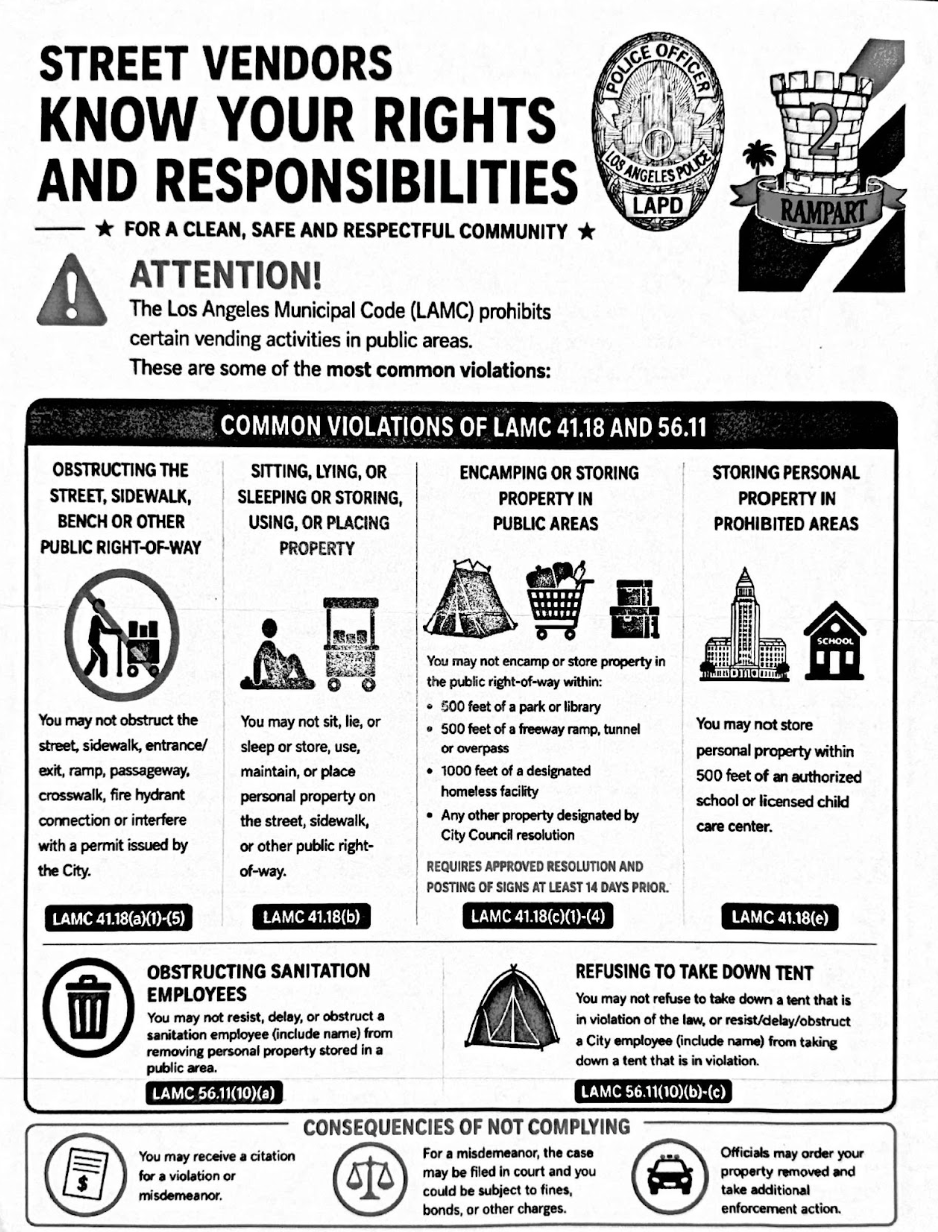
Officers have also distributed a flyer claiming that vendors who store property within 500 feet of MacArthur Park are violating 41.18. A cart, grill, cooler, display or container apparently becomes illegal “stored property” simply because a vendor uses it to work in a part of the city where police have been authorized to enforce the ordinance.
The citations appear to violate California’s Safe Sidewalk Vending Act, known as SB 946. The 2018 law legalized and decriminalized sidewalk vending statewide and sharply limited how cities may regulate it. Local rules restricting where vendors can work must be directly related to objective health or safety concerns. Violations of local vending rules generally may be punished only through administrative fines, not criminal infractions or misdemeanors.
California has strengthened those protections since 2018. SB 972 food reforms, passed in 2022, modernized food-permitting rules and further limited the criminalization of sidewalk food vendors. SB 635 vendor protections, passed in 2025 and effective this year, added privacy and immigration protections to local vendor permitting and enforcement. But the central protection implicated by the MacArthur Park citations remains SB 946: cities cannot use unsupported location restrictions or criminal penalties to accomplish indirectly what state vending law prohibits them from doing directly.
Those state protections produced a major local victory in 2024. After vendors and community organizations sued Los Angeles for violating SB 946, the city agreed to eliminate exclusionary vending bans, cancel hundreds of citations and refund fines. Among the restrictions removed was a 500-foot ban around schools and similarly excessive distancing rules near other locations. Rampart officers are now using an entirely different section of the Municipal Code, one intended to remove unhoused people, to recreate the kind of exclusion zone the city already agreed it could not impose through its vending program.
That makes the immediate response straightforward. The City Attorney should ensure that every improperly issued citation and warning is identified and canceled without requiring vendors to appear in court. LAPD should retract the misleading flyer, issue written citywide guidance and preserve all records showing how this enforcement began. Vendors should receive notice in the languages they speak, and relief should not depend on proving immigration status, housing status or possession of every possible permit.
But the invalidity of these citations is only part of the story. Rampart’s attempt to apply 41.18 to vendors exposes a fundamental defect in the ordinance itself.
Although it’s usually described as an anti-camping law, the word “camping” does not capture the scope of what 41.18 actually prohibits. In designated areas, it makes it illegal for any person to sit, lie or sleep, or to “store, use, maintain, or place personal property” on a street, sidewalk or other public right of way. Around a designated park or library, that prohibition can extend as far as 500 feet.
That language reaches far beyond tents or encampments. Read literally, it can encompass a vendor using a cart, a worker setting down tools, a person sitting beside a backpack, a group of nannies with children and toys at a playground or a family placing belongings on the sidewalk while waiting for a ride. The ordinance does not explain how long property must remain somewhere before it is “stored,” or how police should distinguish prohibited placement from the countless ordinary ways people use public space every day.
The ordinance can survive in practice only because it is not enforced against everyone its language covers. Police are left to decide whose sitting counts as prohibited sitting, whose belongings count as illegal property and whose presence is incompatible with the intended use of a neighborhood. For years, those decisions have overwhelmingly targeted unhoused Angelenos, and that discretion is not racially neutral. Black Angelenos make up only about 8% of the city’s population but accounted for 43% of 41.18 arrests in an analysis by the Los Angeles City Controller. That disparity reflects both police choices and the broader racial inequities built into homelessness itself. Black people make up only 9% of Los Angeles County’s population but 31% of its unhoused residents. Enforcement aimed at homelessness therefore disproportionately criminalizes Black Angelenos and other communities of color.
The MacArthur Park citations show how readily the same discretion can be extended to street vendors. Unhoused residents and mutual aid organizers warned from the beginning of the fight against 41.18 that authority this broad would not remain confined to one population. Once police can remove people and property based on little more than their presence within a designated area, the line between who belongs and who becomes a target is drawn through a combination of officer discretion, complaints from housed residents and the enforcement priorities encouraged or tolerated by the district’s councilmember.
Rampart’s use of 41.18 reflects a broader political turn against street vending. During last week’s mayoral debate, Mayor Karen Bass said, “I do not believe that you should have a food vendor in front of a restaurant, period,” compared vendors outside businesses to encampments and described moving vendors into brick-and-mortar locations as the long-term goal. As LA Podcast observed, the framing echoed Spencer Pratt’s primary-season attacks on vendors as threats to established businesses. Pratt recognized the similarity himself, praising Bass afterward and saying she had borrowed from his playbook. It also recalls the Trump movement’s use of street vending as a symbol of immigrant encroachment, most notoriously when a cofounder of Latinos for Trump warned in 2016 that immigration would produce “taco trucks on every corner.” In each version, vendors are treated not as workers and an essential part of Los Angeles culture, but as disorder, unfair competition or an obstacle to the controlled public space that officials and property owners want to create. Rampart’s citations give that political rhetoric material force.
State vending protections offer an essential defense against these citations, but they also create the risk that the city will treat vendors and unhoused people as distinct groups, protecting one while continuing to criminalize the other. Those categories are not clean. Some vendors are unhoused, and many more are one rent increase, missed week of work or family emergency away from losing their housing. Unhoused people also sell goods and participate in informal commerce. Drawing a firm line between vendors and unhoused people would reinforce divisions between communities whose identities and struggles often intersect.
Even the ordinance’s supposed safeguards do little to restrain its use. Section 41.18(c)(4) ostensibly requires specific documentation that a location presents a “particular and ongoing threat” before the City Council can prohibit sitting, lying, sleeping or storing property there. Yet councilmembers have presented and approved (c)(4) zones without producing the required evidence. Some provisions of 41.18 authorize blanket exclusion across large areas without any showing of harm, while the provision that does require evidence has been used without it. In practice, these distinctions do not meaningfully constrain the ordinance’s central function of giving the city a flexible tool for declaring public space off limits and displacing the people and property found there.
The MacArthur Park zone itself was approved in January 2022 through a resolution introduced by former Councilmember Gil Cedillo and later inherited by Councilmember Eunisses Hernandez. Hernandez’s office has called on LAPD to correct its conduct and remedy the improper citations. The zone, however, remains in place.
The map of prohibited public space is not fixed or inevitable. On August 18, after 16 months of pressure from mutual aid organizers, the City Council repealed twelve 41.18 zones inherited by Councilmember Hugo Soto-Martínez. It was the first time the Council removed any location from that map, demonstrating that every designation reflects an ongoing political decision about where people may exist and whose presence the city is willing to criminalize.
That decision carries particular urgency as Los Angeles prepares to host the 2028 Olympic and Paralympic Games. LAist recently reported that officials estimate roughly 1,600 unhoused people living near projected venues could be affected by Olympics security plans. Agencies have reportedly been told to prepare for security perimeters extending as far as a mile, even though there is still no clear plan for where displaced people will go or who will pay for their housing.
There is no evidence that Rampart’s citations were ordered as part of an Olympics operation, but they reveal the enforcement machinery already available to the city. Los Angeles does not need a new law to remove people and property from highly visible areas before the Games. It already has an ordinance broad enough to reach unhoused people, street vendors, informal workers and other poor or marginalized people across enormous sections of public space whenever officials decide those spaces must be cleared.
The problem is not that 41.18 occasionally captures people it was never meant to reach. Its text makes ordinary activity in public space punishable, its purported safeguards can be bypassed and its enforcement depends on discretionary judgments about who belongs. State protections may spare some vendors from its reach, but they cannot cure a local law whose basic function is exclusion.