
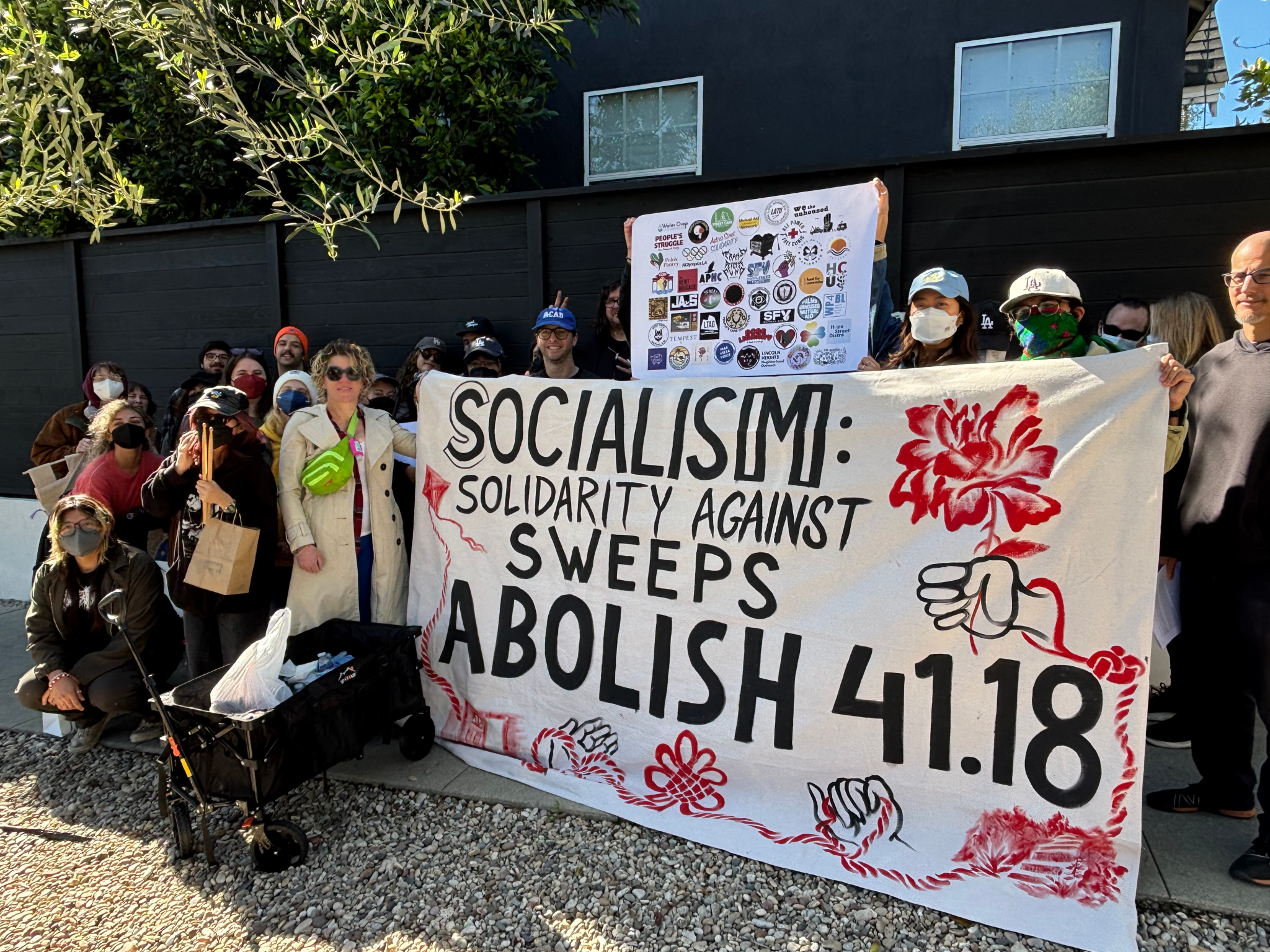
On August 18, the Los Angeles City Council voted 10-3 to repeal twelve enforcement zones established under LA Municipal Code 41.18 in Council District 13. This marks the first time the Council has removed locations from the city’s ever-expanding map of places where Angelenos can be cited or arrested for sitting, lying, sleeping or keeping belongings in public.
Section 41.18(c)(2) allows the Council to prohibit those activities, which amount to resting while poor, within 500 feet of designated overpasses, underpasses, freeway ramps, tunnels, bridges and other transportation infrastructure. The locations repealed by Councilmember Hugo Soto-Martínez’s motion include underpasses in Silver Lake and Echo Park and areas around Highway 101 overpasses in Hollywood. They were originally designated through a 2021 resolution introduced by Soto-Martínez’s predecessor, Mitch O’Farrell.
The August 18 vote did not repeal 41.18 or affect the law’s separate restrictions around parks, libraries, shelters, schools, day care centers and other designated locations. Hundreds of prohibitions remain across Los Angeles, and organizers have made clear that removing the CD13 zones is only a first step toward abolishing the law in its entirety.
The repeal nevertheless marks a significant break with City Hall’s approach to LAMC 41.18. Until now, the Council has rubber-stamped every motion establishing new zones and never removed one. Mutual aid organizers with the Abolish 41.18 campaign spent 16 months forcing that reversal. Kris Rehl, an organizer with LA Street Care, said organizers first approached Soto-Martínez’s office roughly two years before the repeal vote and issued a formal demand in April 2025. The office did not respond.
Soto-Martínez campaigned against 41.18 in his successful bid for City Council in 2022 and inherited the twelve zones from O’Farrell. As the Council was approving the law in July 2021, he compared it to stop-and-frisk and accused city leaders of advancing “draconian measures that only seek to criminalize our unhoused, not help them off the streets.” He wrote that “criminalization solves nothing” and called on the city to “stop trying to enforce our way out of a situation that demands real care.” Yet after taking office, he left O’Farrell’s zones in place while police continued enforcing the law in his district. During Soto-Martínez’s first full year in office, CD13 recorded 47 arrests under 41.18, more than five times the nine recorded the previous year, according to the city controller’s arrest data. Another 30 arrests were recorded in 2024.
By September 2025, organizers had begun taking that contradiction directly to Soto-Martínez’s political base. When the tenant organization Inquilinos Unidos honored Soto-Martínez and his staff as “housing champions” at a fundraiser, members of several mutual aid groups showed up outside to distribute flyers demanding that he repeal the 41.18 zones inherited from O’Farrell and end the sweeps continuing in his district.
The protest also put unhoused constituents themselves at the center of the contradiction. One CD13 resident told The LA Reporter that he had been displaced by a CARE+ sweep the week before and threatened with arrest by LAPD when he tried to return to the place where he had been staying. Organizers were demanding that Soto-Martínez replace the sweeps, which are scheduled through council offices, with less disruptive “spot cleanings” that remove trash without forcing people to dismantle and move their homes. “I’m here to tell you I was just threatened by the LAPD that I would be arrested if I didn’t move,” the constituent said.
The pressure continued into the election year. On February 21, 2026, organizers interrupted Soto-Martínez’s reelection canvass launch at Bellevue Recreation Center. More than 50 organizations had signed their demand for repeal, and organizers gave the councilmember three working days to make a written commitment.
Soto-Martínez responded that his office would conduct a “comprehensive analysis,” but provided no deadline for completing it or acting on the result. Organizers escalated, calling for a boycott of a March fundraiser. Nearly every scheduled performer ultimately withdrew, including comedian Hannah Einbinder.
The boycott produced another response on March 5, but still no commitment or timeline. Soto-Martínez said his office was investigating the legal process because removing 41.18 zones had never been done before. He also called for “robust community involvement,” comparing the repeal to his office’s extensive outreach before removing the Echo Park Lake fence. Rehl rejects the comparison. “The fence was wrong. Putting up the fence was harmful, but people are actively being criminalized by 41.18,” they said. “People weren’t being arrested or displaced on a daily basis because of the fence.” Engaging residents before removing a physical barrier is fundamentally different from asking housed residents for permission to stop the city from actively harming their poorer neighbors.
On May 26, one week before the June primary, approximately 30 organizers staged a mock sanitation sweep outside Soto-Martínez’s East Hollywood apartment. Members of LA Street Care, Aetna Street Solidarity and J-Town Action and Solidarity arrived with brooms dressed as sanitation workers, sounded a siren and drew a chalk body outline on the pavement to represent the deadly consequences of encampment sweeps. People who had personally experienced homelessness and 41.18 enforcement described having their property seized and being criminalized for living outside. “People were saying, ‘I was handcuffed because of your inaction,’” Rehl said.
The confrontational tactics were intentional. The campaign drew heavily from tactics used by ACT UP New York in the 1980s and 1990s to force government officials to confront the AIDS crisis. Rehl said the parallel was not merely tactical. Government institutions treated gay people and others living with AIDS as disposable, while public rhetoric portrayed them as disgusting, dangerous, drug users or deviants whose suffering was their own fault.
Unhoused people are dehumanized through a similar process, described as dirty, criminal, dangerous or “service resistant” until their displacement can be presented as public protection and “cleanliness.” In both cases, dehumanization makes it easier for officials and the public to tolerate mass suffering. People subjected to the harm disappear as human beings, while delay and abandonment are recast as neutral policy decisions.
Rather than focusing on people who supported 41.18, organizers increasingly targeted spaces filled with people who presumably shared Soto-Martínez’s stated opposition to criminalizing homelessness. The goal was to make the contradiction between his politics and his record impossible for his political base to ignore.
Soto-Martínez easily won reelection in June and introduced the repeal motion this month. The sequence matters. The motion followed more than a year of escalating pressure that moved from private demands to public protests, disruption of campaign events and a fundraiser boycott.
The organizers’ argument was also broader than the removal of these particular zones. They targeted the twelve designations because Soto-Martínez had the immediate power to remove them, not because sitting or sleeping should remain a crime anywhere else. “This isn’t about electoral politics,” Rehl said. “This is about liberating public space and meeting people’s needs.”
The city did not need another study to know whether 41.18 meets those needs. A 2023 review by LAHSA found the ordinance generally ineffective at moving people into permanent housing. Only 16.9 percent of the people studied received interim housing before an encampment was cleared, and just two people exited street outreach directly into permanent housing.
In 92.2 percent of cases, people did not receive housing before being displaced and either returned to the street or had an unknown destination. Previously served clients later returned to 81 percent of the cleared sites. The report also described how displacement can disrupt relationships with outreach workers, separate people from identification and medical records, and destroy belongings required to complete housing applications.
In other words, 41.18 does not resolve encampments. It breaks them apart and moves their residents somewhere else, often making it harder for them to obtain housing.
The Council vote also exposed the competing definition of success that has sustained 41.18 despite that record. Councilmembers Traci Park, Monica Rodriguez and Imelda Padilla cast the three votes against the repeal. Park used the vote as an opportunity to pander directly to her political base and repeat the set of talking points that has made her the Council’s most aggressive advocate for criminalizing homelessness.
Park described inheriting the worst homelessness crisis outside Skid Row, invoked Venice’s designation as the “most dangerous beach in America,” recounted damage to the Ballona Wetlands and framed herself as the official willing to restore order when others said nothing could be done. The conditions for unhoused people were indeed horrific, but Park converts their suffering into an argument for removing them. Her speech never asks whether the people subjected to enforcement became safer.
Her account also strips the conditions she inherited of their context. Park campaigned during the COVID-19 pandemic on visible homelessness that had grown during an emergency when federal health guidance advised cities not to clear encampments unless individual housing was available. The beach ranking she repeatedly cites came from the commercial adventure website Outforia, which combined crime with shark attacks, surf deaths, lightning, pollution and temperature. Venice edged Daytona Beach by one-hundredth of a point.
Park claimed that Inside Safe “housed more than 150 people” around the Venice Bridge Home and that a subsequent 41.18 zone “worked.” The latest published city cohort data combine three CD11 operations with 162 initial placements. Only 69 people were recorded in permanent housing, while 77 returned to homelessness, including people still working with service providers.
Park also collapses two different enforcement regimes into one success story. While the Bridge Home was open, the surrounding area was already covered by a Special Enforcement and Cleaning Zone. When the shelter closed on Park’s watch, the beds and the SECZ disappeared, and people returned to the corridor. Only then did Park establish a new 41.18 zone around Rose Avenue and Hampton Drive. The new zone did not house anyone or prevent the original encampment from returning. It replaced the shelter’s enforcement perimeter without replacing the shelter beds.
In her account of the Ballona Wetlands, Park leaves out the fact that she intervened to stop a funded $2.3 million plan to house and assist people living in RVs along Jefferson Boulevard. She then led a police-backed sweep that scattered most residents into surrounding areas and now cites the damage and cleanup costs as proof that enforcement was necessary. Making her constituents pay police and sanitation crews to threaten people and destroy their belongings does not vindicate the sweep. It shows the financial and human cost of rejecting a housing-based alternative.
Park said that after the city spends time and money on an operation, residents should expect an area to remain “safe, clean and accessible.” Here, Park finally defines success. It is not permanent housing, but territorial exclusion. Once the block is clear, the people removed disappear from the equation.
She also argued that taxpayers have spent billions and “have every right to expect something in return.” But unhoused Angelenos are constituents and taxpayers too. Her framing treats public space as something purchased by housed residents and casts the presence of poor people as a failure to deliver value to the paying customer.
Park called 41.18 zones “protections” against neighborhoods falling back into chaos. Calling 41.18 a protection assumes the conclusion. The law offers no protection to the people ticketed, arrested, displaced, separated from outreach workers or deprived of their property. It protects locations from people, not people from homelessness.
Park also used this debate about removing twelve zones as an opportunity to demand that LA criminalize people in even more places. The conservative Supreme Court’s 2024 Grants Pass decision permits cities to punish people for sleeping outside even when no shelter is available, and Councilmember Park wants LA to adopt “a citywide policy that aligns with what we’re allowed to do under Grants Pass.” She complained that her motions to extend enforcement around critical infrastructure, environmentally sensitive areas and high-fire-severity zones had languished in committee “even after the Grants Pass ruling.”
The repeal leaves hundreds of 41.18 zones in place, including zones inherited by councilmembers who have publicly criticized the criminalization of homelessness. Organizers are now calling on Eunisses Hernandez in Council District 1 and Ysabel Jurado in Council District 14 to remove zones created by their predecessors, Gil Cedillo and Kevin de León. The stakes are particularly high in their districts. CD1 includes MacArthur Park, where many unhoused people live and enforcement is intensifying, while CD14 includes Skid Row, the center of the city’s unhoused community and one of its most heavily policed neighborhoods.
“There’s still a lot more of this law that we need to repeal,” Rehl said. “But we have to start somewhere.” The CD13 vote demonstrated that councilmembers can remove 41.18 zones when organizers force them to confront the gap between what they say and what they actually do in office.
The August 18 vote leaves the machinery of 41.18 largely intact. But organizers forced the city to give back twelve pieces of public space and proved that the criminalization of every remaining zone is a political choice, not an inevitability.