
Republished from Carter Moon’s Substack. Subscribe here!
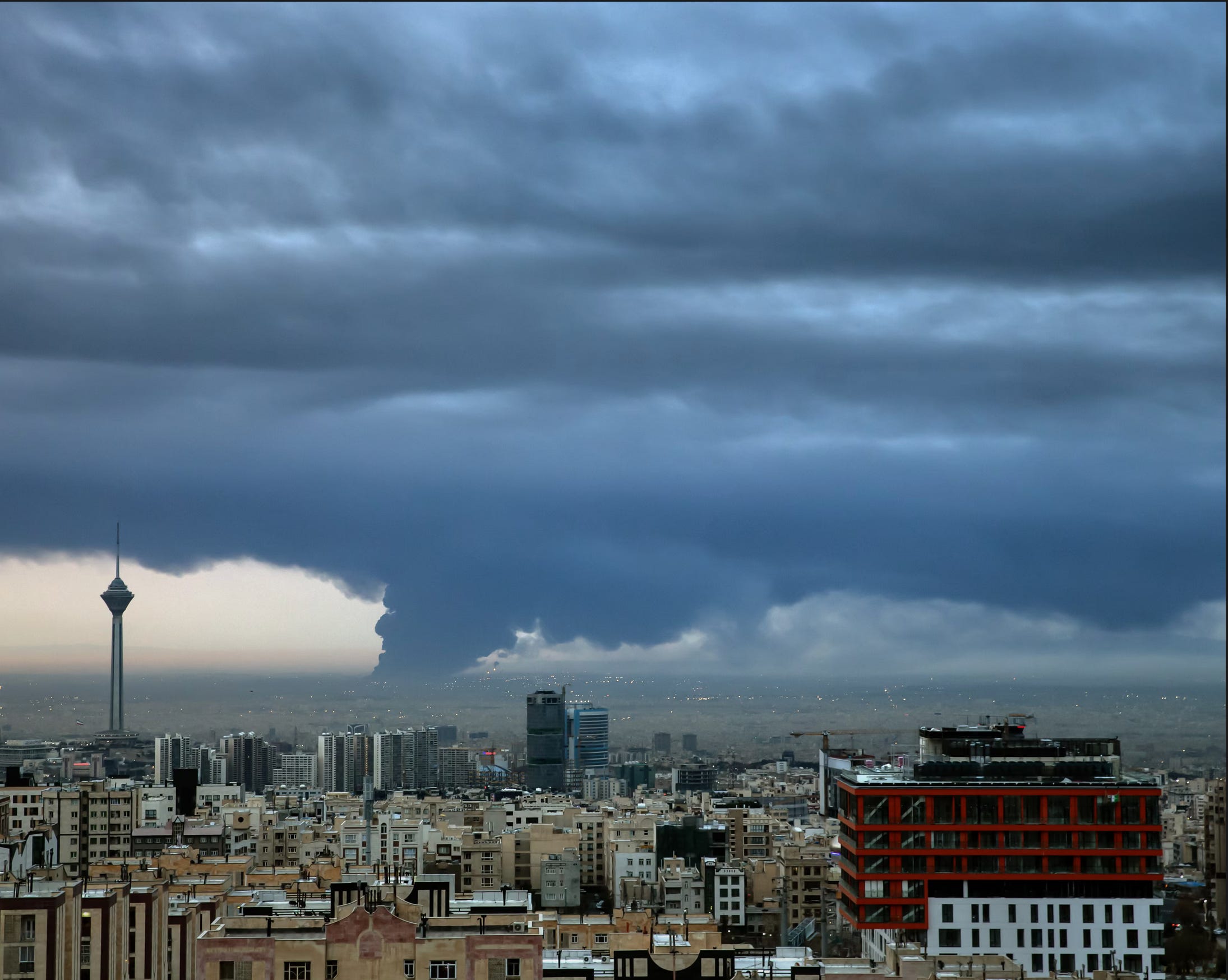
Toxic black rain fell on the residents of Tehran for days after Israel bombed Iran’s oil depots. The war in Iran, the destruction of oil and gas fields in the region combined with the total shutdown of the Strait of Hormuz, means that oil markets may not recover for months or years. BP’s chief economist said: “It’s every oil analyst’s study piece or worst nightmare—one that we never thought would happen.” The US military is one of the world’s largest consumers of fossil fuels, purchasing 269,230 barrels of oil a day, oil that is about to become drastically more expensive due to the actions of the same. Americans may experience it in terms of increased gas prices, but in poorer countries like the Philippines, transportation workers are already striking over the impossible cost of fuel. What’s even more frightening is that the gulf states produce a significant amount of the natural gas that is used to make fertilizer, meaning the global food supply chain is in jeopardy. Combine that with the USAID cuts made by Elon Musk last year and we’re staring down the barrel of a deadly spiral for large swaths of the globe.
What’s happening in Cuba is a grim window into what the future might look like for much of the global south. Cuba has been under a total US-imposed oil blockade since December; they have now run out of fuel, facing blackouts so severe that surgeries are reported being performed in the dark, and children on ventilators are dying, a crisis compounded by the US refusing to allow medicine and medical supplies into the country. This country of 11 million mostly very poor people, whose largest export is their well-trained doctors, is being collectively punished for a revolution that happened in the ‘60s. The US is able to hold such a stranglehold over this powerless nation because they are dependent on fossil fuels, as much of the world still is. I really recommend listening to this week’s episodes of the podcast TrueAnon to hear directly from Cuban people about what is being done to them right now: It is utterly abhorrent.
Simultaneously this month, the United States just experienced a heatwave so intense that it smashed records in 180 cities. Temperatures reached dangerous levels, particularly for unhoused people and the farmworkers throughout the country. These extreme, unusual fluctuations in temperature are, of course, driven by climate change. It’s essential that we keep the link between these catastrophic weather events we experience at home and the very real lives that will be lost due to this oil crisis at the front of our minds; they are part of the same crisis.
The politics of oil, the drive to keep the world dependent on oil as the dominant commodity form that governs all of modern life, is central to everything else that’s happening in our politics today. The fossil fuel industry spent $219 million to sway the 2024 election for Trump and the GOP, primarily because of Biden’s modest attempts to transition to renewables. Car dealership owners famously also give overwhelmingly to Republicans. Over 40% of the electricity that powers AI data centers comes from natural gas, creating more incentive to keep burning it longer. It’s no wonder the tech industry has gotten much closer to Trump in his second presidency. To put it simply: Fossil fuels are funding the modern fascist movement.
We shouldn’t forget that oil has always been corrosive to democracy. Linda Tarbell’s 1904 book The History of Standard Oil exposed how John D. Rockefeller’s aggressive monopoly on Standard Oil was harming the economy and everyday people. Henry Ford used his immense wealth and the ubiquity of his vehicle show rooms around the country to push antisemetic conspiracy theories. Cars have been corrosive to our society from their inception, with freeways disproportionately displacing communities of color. Oil wells are often next to communities of color in so-called “sacrifice zones” where they inhale toxic fumes. The power of oil as a commodity form has been central to capitalism as it exists today, and has always come at a steep price to human life.
It’s painfully obvious why the US is doing all of this, thrashing around so violently and seemingly irrationally. We have to ensure that oil remains the world’s primary fuel source if we want to maintain the US empire. Republicans have spent my entire life insisting that we cannot transition off fossil fuels because it would mean the end of America as we know it. The last year has made it clear that they have been right about that. There is no world in which America remains the domineering imperial superpower when other countries are not dependent on the flow of oil to sustain themselves. The illegal kidnapping of Maduro was very plainly about controlling oil in this hemisphere, not even directly for the profit of US based oil companies, but more so for maintaining hegemony. It may very well be that the end of this evil, illegal war in Iran is a humiliating end to the US’ control over the global oil supply. If Iran gets to set the terms of the peace deal, which currently seems like a real possibility, it could mean the end of the US dictating the flow of energy around the world.
Historian Alfred McCoy published a recent piece comparing what’s happening between the US and Iran with the Suez Crisis in 1965 between the British and the Egyptians. Britain, France, and Israel easily defeated Egypt’s military at the time, but their leader Gamal Abdel Nasser sunk a bunch of ships in the Suez canal and cut Britain off from its oil supply. McCoy writes: “By the time British forces retreated in defeat from Suez, Britain had been sanctioned at the U.N., its currency was at the brink of collapse, its aura of imperial power had evaporated, and its global empire was heading for extinction.” It is extremely easy to see a world where an uncannily similar situation plays out as Iran continues to hold the Strait of Hormuz and hold up one-fifth of the global oil supply.
But I don’t mean to completely doom spiral here. As I’ve written about before, we’re living through an unfathomable transition to solar energy lead by China. Bill McKibben’s book Here Comes the Sun details how Europeans rapidly adopted solar for their homes due to the shocks triggered by Russia’s invasion of Ukraine. It’s easy to see how an even more intense oil crisis will lead to many more people around the globe making the switch to solar energy. It is a tragedy that what it takes is this type of war and chaos, a brutal fight over the global energy supply that will kill thousands of people, and probably hundreds of thousands indirectly. But the adaptation to the crisis will be remarkable too; we’re already seeing Cubans scrambling to install solar panels as quickly as possible to ease their dependency on oil. I also picked up Matthew T. Huber’s 2022 book Climate Change as Class War again, in which he argues that a coordinated, international class struggle against certain key industries, such as cement and fertilizer, could dramatically change how carbon emissions impact the globe. This perspective seems more essential than ever in our current crisis.
It’s tough to know what to do as an individual American in a time when our government is directly responsible for so much suffering around the world. I personally devote a lot of energy to fighting to get city candidates elected who are willing to take the climate crisis seriously and get us off of fossil fuel dependency. Making a personal effort to drive less and walk or bike more is also a tangible thing you can do; you don’t need to invest in an entire electric vehicle if you can commit to taking an e-bike around your neighborhood or public transit to work. If you’re in a union, organizing to divest your pensions from fossil fuel companies is a great way to invest in the future and show solidarity with everyone currently being so brutally punished by this oil crisis. International solidarity, like the aid flotilla that recently went to Cuba with solar panels and medical supplies, is more vital than ever.