
This article by Carter Moon originally appeared in his Substack, and is republished here with his permission.
The left in the United States is rapidly ascending into an unprecedented era of seriously contesting for power. DSA-endorsed candidates are winning primaries all around the country and support for Medicare for All , unions, and ending military aid to Israel, are at historic highs. In a moment where it feels that history is begging the American left to step onto center stage, I’ve been spending this summer interrogating why the US left has failed to build hegemonic consensus before now and questioning the wisdom of disavowing “Woke 1.” I urgently want to see the left become much more popular and much more powerful, but I also don’t want to see us simply reproduce the same systems of exploitation and oppression that have defined the US empire with slightly better marketing.
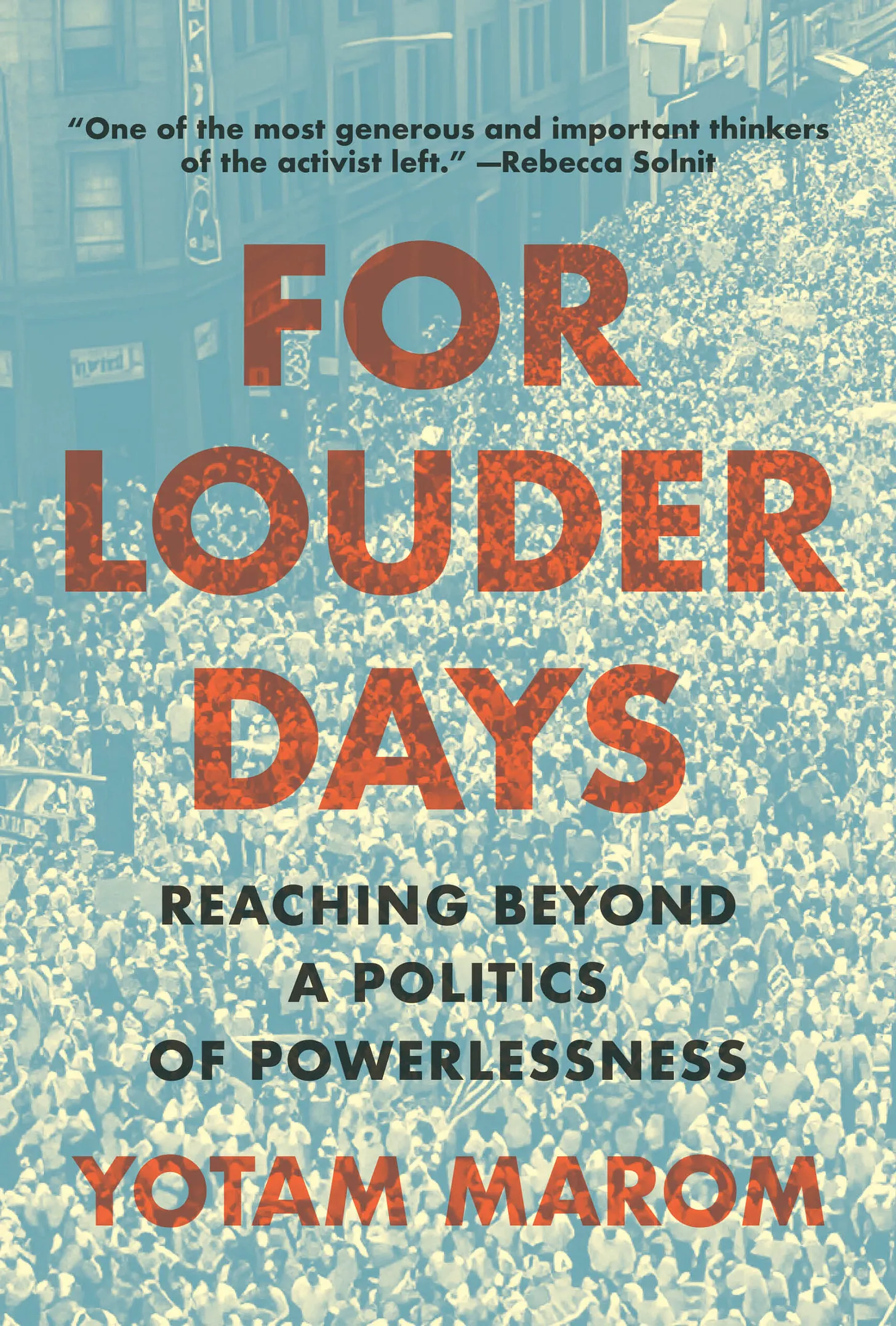
Yotam Marom’s For Louder Days has been published for exactly this moment. Marom has been doing behind-the-scenes yeoman work, training and supporting social justice movements so that they can be their most powerful and effective. He was on the ground during the anti-Iraq war protests of 2003 and played a key role in mobilizing 80,000 people to take over Times Square during Occupy Wall Street. He describes standing on top of a trashcan looking out at the sea of people gathered in the symbolic epicenter of capitalism: “Years from now I will remember this exact moment, this exact feeling in my body, as the first time I really considered that we might be powerful.” If you’ve dedicated your life to movement politics, you know precisely what he’s talking about, and how illusory that feeling is.
The subtitle of Louder Days is “Reaching beyond a politics of powerlessness.” The book is an interrogation of the tendencies in left politics to flail about while intentionally keeping ourselves insular and away from the levers of power. The potent example Marom opens with is how in the immediate aftermath of his successful protest in Times Square, he was confronted by another Occupy Wall Street organizer and told that people were furious that he had organized the protest without getting proper consensus from the general assembly of Occupy. He had moved too quickly and nimbly without waiting for the horizontal, leaderless process at Occupy to sanction the protest. As a result, he was pressured to dismantle the 200-plus-person organizing committee that had pulled off the protest, stopping the momentum in its tracks. Looking back today, it’s impossible to not feel an icy, crushing regret at what could have been had all these people kept working together. This is what Marom means by the politics of powerlessness: stopping ourselves from reaching our full potential and meeting the moment when it’s at our very fingers.
One of Marom’s great insights from spending the time since Occupy facilitating movement spaces is how often we inhibit ourselves and precondition our own defeats in our desperation to not reproduce the power structures we’re trying to overthrow. We create exhaustive rules of engagement in our spaces and engage in elaborate games to try to act as though no one holds more leadership or power than anyone else within our groups. He acknowledges that our movements are often driven by fear and despair, and that these emotions “are reasonable reactions to this world and the struggle to change it.” It’s important to always remember that it is an enormous burden to see the world for what it is, and that there’s a huge price to be paid when we assert our demands, only to see them crushed by hegemonic forces.
One of the gentlest insights Marom offers is that “the politics of powerlessness is not our enemy; it is a reaction to the enemy.” He calls it “a defense mechanism” that “has served us — to navigate real fears, real threats, real tendencies inside each of us.” We can’t blame ourselves for the time and energy that have been spent shrinking away from power; all we can do is accept that there were valid reasons for the left to rely on it and recognize that now is the time to find the will to change. He has very concrete suggestions about how we can start building better internal strategies to be our most powerful and effective selves within our organizations, so that we can win when we step into the wider world. (These are laid out in chapter three of the book; it’s worth getting your hands on a copy just for this chapter alone.)
Marom makes a very clear diagnosis of what the left is going to have to do if we’re serious about gaining power:
“Unless or until movements are in the position to depose and replace the power structure they are challenging, they need demands, a strategy for getting after them, the power to make their adversaries pay, the strategic wisdom to know when to exact those costs and when to compromise, a legitimate structure for negotiating with their opponents, and more.”
This is a tall order, but changing the world always has been. Contesting for power comes with risks and responsibilities; it means having to actually do things where you can’t be certain of the outcome and owning the consequences. The big things we aim to achieve will inevitably fall short of our ambitions, and it’s easy to see that on the horizon and find excuses for in-fighting and inaction so that we don’t have to live with the disappointment of not winning everything we want. And let’s also be honest, the shared memory of all the most effective leaders of the new left in the late ‘60s all being assassinated makes all of us nervous about becoming prominent leaders. But as ICE arrested nearly 50,000 people in July and we watched 1,252 people die in minutes from flooding in Nepal, the time for excuses is over.
Marom also presents some bold challenges for all of us to rethink power within our groups and how we distinguish rank. There are always leaders within groups, and there are always ranked hierarchies we create based on who has outsized influence and sway. It is much better to openly acknowledge and affirm these rankings than to work ourselves into a frenzy trying to pretend they don’t exist. So much of the US left was heavily influenced by anarchist philosophy for the last generation, a romantic tradition I’ve learned a lot from over the years, but ultimately one that I believe stymies the ability to really be effective. Spending hours deliberating and making sure everyone is fully treated as an equal partner in making every single decision is entirely impractical; we have to trust giving people power to execute effectively on behalf of our groups.
One of the best aspects of the book is how Marom is vulnerable in bringing up his own mistakes and shortcomings in movement work to give concrete examples of what it looks like to reckon with the politics of powerlessness. He’s honest about times he shrunk away from being his most powerful and effective self because he didn’t want to over-assert himself as a white guy. He brings up a time he forced a female colleague of color into more of a prominent position of authority and responsibility than she was ready for within his organization because he knew it looked better optically. He openly wrestles with feeling himself at odds with parts of the Palestinian liberation movement after October 7th as a Jewish person with family in Israel. The honesty about the messiest and hardest parts of the emotional work involved in this work is a great modeling of the courage it takes to commit to this work for the long haul.
_____________
There is so much I cherish and admire about Marom’s book; it is the hard-won wisdom that only comes from decades of bone-deep commitment to making our movements stronger. But I do want to put forward some constructive criticisms of the book, something I hope he’d appreciate. I really wish he devoted more space to interrogating why and how our enemies wield so much power, and exploring where our real collective power rests to intervene against the apocalyptic fascist forces that are dead set on burning civilization to the ground. The fascist right loves power, status, and hierarchy, and in some ways that makes them more efficient than we are at mobilizing towards their goals. Most of their ideas and goals are broadly unpopular with the majority of regular people, and yet they’ve managed to gain control over all the major bodies of the federal government. When we talk about the contours of power in this country, it’s essential to acknowledge that the Senate exists to crush the popular will of the majority and the Supreme Court is and always will be an undemocratic body that has mostly existed to uphold white supremacy. Part of contesting for power means being clear-eyed about the structural forces we’re up against so that we can come up with strategies to overcome them.
I also wish Marom would have explored how certain right-wing movements are able to maintain such an outsized foothold in American politics despite being marginal issues for most people. I know the left spends a lot of time talking about these obstacles as things we’re against, but we don’t spend enough time dissecting the mechanics of how the right effectively wields these tools to maintain a hegemonic consensus for their project. I spend a lot of time studying right-wing figures like Lydnon LaRouche and Phyllis Schlafly; they were shockingly successful organizers, even if their politics were abhorrent. If we’re serious about building power; it’s important to study why our enemies have so much of it compared to us.
The other side of the coin that I think Marom doesn’t devote enough energy to is exploring the places where the masses of us hold the most power: primarily in our workplaces and in our apartments. Most of us spend the majority of our lives feeling powerless; we spend eight or more hours at work where we have no democratic say in our conditions, and then come home to apartments we don’t own and have no power to control or improve. It’s no wonder that when we show up in social justice spaces we have no idea how to wield power; the vast majority of our lived experience is profoundly disempowering. But simultaneously, our ability to withhold our labor and our rent checks is still one of the biggest places we hold collective leverage. Marom doesn’t really explore this day-to-day reality as a contributing factor to the politics of powerlessness — which is odd.
One of the biggest reasons movements for social justice haven’t been able to build durable power so far is because we haven’t been able to fully incorporate labor unions into those movements. The one place where we do always hold a lot of power as the working class is in key industries that are essential to the reproduction of daily life: farm workers, healthcare workers, and transportation workers. The ability to have these instrumental members of the working class be able to strategically withhold their labor in order to demand the more just and democratic world we deserve is probably the only way we’re going to really achieve the transformational change we desperately need to survive. One of the most inspiring moments of the Black Lives Matter uprisings of 2020 was when port workers across California collectively went on strike in solidarity with the movement. Similarly, the peak of the Minneapolis resistance against ICE in January were the back-to-back one-day general strikes soft-endorsed by the labor movement. If we’re honest about truly wielding power more effectively, labor power is inarguably the most important component to building that, and Marom largely side-steps discussing it.
I want to be really generous to Marom, though, because this is a lovely and generous book. Marom is much more invested in dissecting how we get in our own way when we try to build durable organizations capable of challenging the status quo, and that is an entirely worthy thing to devote a 250-page book to. Everything I’m talking about here would require at least another substantial chapter to explore effectively, and it’s outside the central scope of Marom’s immediate expertise as a facilitator of guiding movement organizations to be more effective. The book is much more about the internal politics of how we relate to each other within our movement spaces than about the broader balance of power in the United States as a whole. (If you’re interested in exploring those topics further, I really recommend Mike Davis’ Prisoners of the American Dream and Jane Macalevy’s No Shortcuts.) I just think we can’t ever lose sight of where our power really lies with the broader masses of everyday working people, especially in a moment where everyone feels so afraid and alienated.
Yotam’s book is an act of vulnerability and courage. It is about the terrifying reality of trying to claim power collectively and responsibly, despite the harsh consequences inherent in doing so. There is heartbreaking emotional labor that has to be done in order to achieve this seemingly impossible goal; we have to make hard sacrifices and compromises in order to reach the horizons we’re striving for.
__________________________
I’ve been so fixated on this book for the last month because I’ve had to face some bruising defeats in my own organizing attempts. I’ve written about my experiences supporting Faizah Malik for City Council and the heartbreak of having to live through another term of my crypto-fascist councilmember Traci Park. I was also one of the very first people to throw myself into supporting my friend Rae Huang for mayor of LA. My hope for Rae’s campaign was rooted in an analysis that the grassroots progressives who have been steadily gaining power at City Hall have been stymied by the mayor blocking their best ideas, and that we needed a mayor to unify these individual candidates as a cohesive slate. We completely failed to build that slate, or the coalition we needed to get Rae to victory. It’s been an embarrassing process to have to face how naive we were for thinking there was a path for Rae; I’ve had a lot of sheepish conversations with organizers I respect over the last few months. But with some time to reflect, I am really proud of me and my friends for trying to contest for power. We did build coalitions, we did open up new pathways by putting ourselves out there. We did assert that our vision for a city that isn’t dominated by cops and wanton cruelty to unhoused people is worth taking seriously. We connected with hundreds of people and brought many new people into the struggle for the city we deserve. The point now is to sharpen and deepen the strategy, to dig deeper into the soil of my immediate community and grow something truly capable of reshaping the world. That’s still maybe a naive thing to continue believing in, but I can see the horizon more clearly thanks to Marom’s book.
There’s a song by the singer Emma Ruth-Rundle that’s been echoing around my head for weeks as I’ve been taking this summer to reflect on all of this. The song is literally called “Powerlessness,” and the best verse goes like this:
Let me lie here with this hammer in my hand
One for breaking one for building something better
Let me lie here with this hammer in my hand
One for breaking one for building something better
Let me die here with a hammer in my hand
One for finding one for showing something better
Let me walk here with a lantern in my hand
One for finding one for showing something better
Let me die here with a hammer in my hand
One for smashing one for making something better
Power/Powerless
Let us all commit ourselves to finding the strength to lift the hammer we need to smash the infernal machines that want to destroy us all. Let us commit to turning that same hammer to bend the scrap of those machines into new shapes that suit our survival. The hammer is too heavy for any of us to lift on our own; we can only wield it through the force of many. Let us set aside our excuses and find where our hands fit on the mighty tool that is both creator and destroyer. Let us share the burden of lifting the hammer until it becomes light, until bringing it up and down, over and over, becomes as natural as breathing. May we then truly be free.