
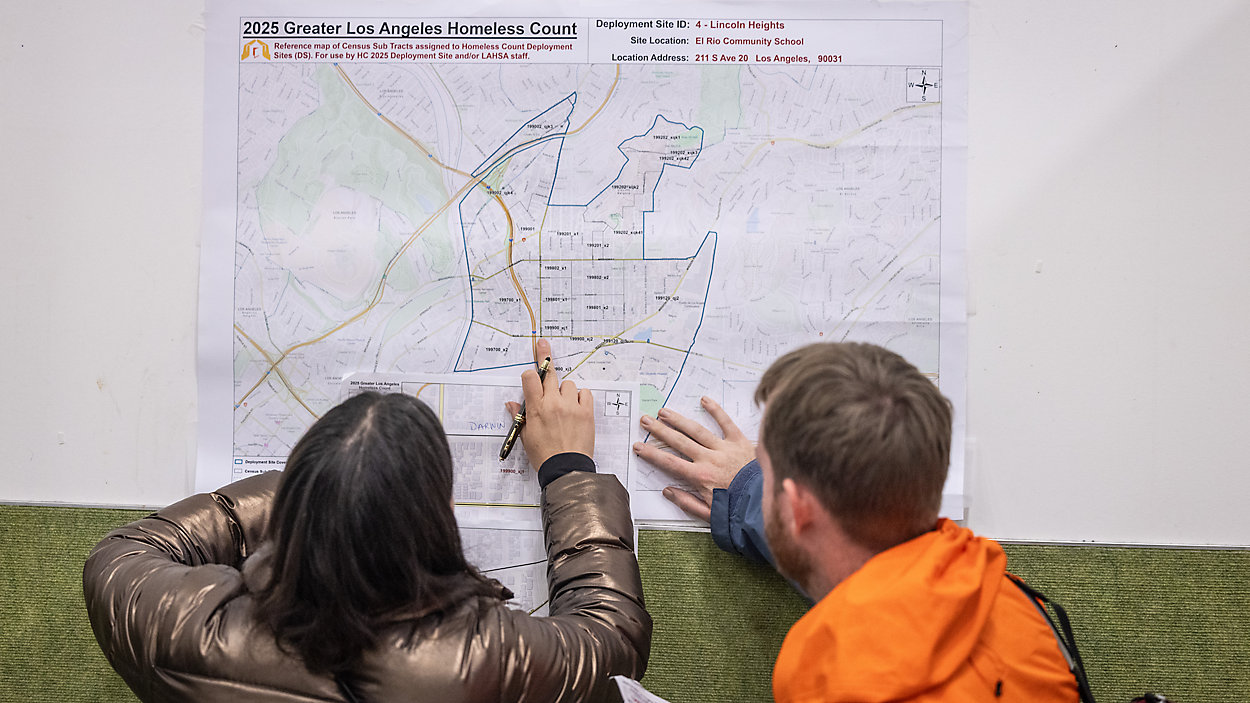
The Los Angeles Homeless Services Authority announced Friday that homelessness increased 3.4% in the City of Los Angeles, to 45,194 people experiencing homelessness. The number of people living unsheltered outdoors or in vehicles increased 7.9%, reversing two consecutive years of declines. Across the Los Angeles Continuum of Care, which covers most of the county outside Pasadena, Glendale and Long Beach, homelessness increased 1.2%.
For Mayor Karen Bass, whose reelection campaign has centered on reducing homelessness, the numbers are an obvious political setback. But they also raise a larger question that extends beyond City Hall. What should Los Angeles measure when it claims success on homelessness? Cleaner parks and fewer encampments in individual neighborhoods, or fewer people experiencing homelessness across the region?
On the Westside, Councilmember Traci Park quickly pointed to a different set of numbers. According to LAHSA’s council district data, homelessness in Council District 11 declined for the third consecutive year. Park credited expanded encampment enforcement, RV removals, and increased policing of public spaces. Those visible changes are real, with 338 unsheltered people counted this year, down from 503 a year ago. Tents declined by more than 30%, RVs fell nearly 19%, and the total number of observed dwellings dropped from 814 to 705. Compared with the encampments that once lined parts of the district during and shortly after the COVID-era shelter in place order, the Westside looks different than it did just a few years ago.
The citywide data, however, tell a more complicated story. While homelessness and unsheltered homelessness both increased, the most visible forms of homelessness continued to decline. Across LA, the city counted fewer tents, fewer RVs and fewer observed dwellings than it did the year before. At the same time, it counted more people sleeping outdoors and a 23% increase in makeshift shelters. The numbers suggest Los Angeles is becoming more successful at reducing the visibility of homelessness than at reducing homelessness itself.
That distinction matters because Council District 11 has become one of the city’s clearest examples of an criminalization and enforcement-first approach to homelessness. Over the past three years, Park has aggressively expanded anti-camping zones, supported encampment sweeps, restricted vehicle dwelling and prioritized clearing parks, sidewalks and public spaces. Those policies have reduced the visibility of homelessness within CD11, but enforcement is not a housing strategy. At its core, it determines where people can and cannot exist in public space. Someone displaced from Mar Vista does not cease to be unhoused simply because they are no longer west of the 405. If homelessness declines in one district while increasing across Los Angeles, the question is not simply whether one neighborhood has improved, but whether the city is reducing homelessness or redistributing it.
RAND’s recently completed four-year study of homelessness in Venice, Hollywood and Skid Row helps explain why these trends can exist at the same time. Rather than taking a snapshot once each year, RAND researchers repeatedly interviewed people experiencing homelessness over four years. Their conclusion was not simply that progress had stalled, but that LA has entered a different phase of the crisis. Many of the people who were easiest to connect with housing have already moved indoors. Those who remain outside are more likely to have significant physical health challenges, untreated behavioral health needs and other barriers that make permanent housing much harder to achieve. The report also found that homelessness has become increasingly dispersed, with fewer large encampments and more people living alone, in vehicles or in smaller, less visible locations.
The city’s own data on Inside Safe point toward a similar conclusion. Bass’ signature program has succeeded in moving people into hotels, motels and other forms of interim housing. But roughly 40% of participants had returned to homelessness by this spring. The difference between moving someone off the street temporarily and helping them permanently exit homelessness is night and day. Interim housing, like encampment enforcement, changes what the public sees and can remove tents from sidewalks and parks. But without a permanent housing exit, too many people eventually cycle back into homelessness.
Taken together, the latest homeless count, RAND’s research and the city’s own Inside Safe data all point toward the same conclusion. Los Angeles has become increasingly effective at reducing the visibility of homelessness, but far less successful at creating actual housing for a permanent exit from homelessness. The people who remain outside are increasingly those with the greatest barriers to housing, while the city’s reliance on enforcement and interim housing continues to prioritize immediate visibility over long-term stability.