
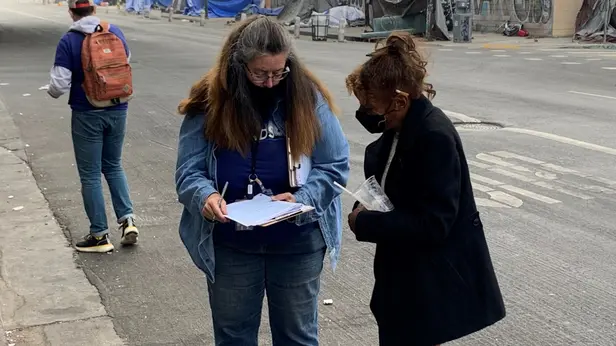
A four-year study of unsheltered homelessness in Hollywood, Skid Row, and Venice has concluded, and its final findings cut directly against the narrative of progress that Los Angeles officials have been building. The number of people living outside in the three neighborhoods is nearly identical to where it stood a year ago. The reductions that city leaders celebrated in 2024 have not extended into 2025. And the population that remains is more vulnerable, harder to reach, and increasingly invisible to the programs designed to help it.
The Los Angeles Longitudinal Enumeration and Demographic Survey, or LA LEADS, tracked unsheltered homelessness across Hollywood, Skid Row, and Venice from fall 2021 through January 2026. The research was conducted by RAND and published this spring as the 2025 Annual Report. For years, the city’s primary tool for reducing street homelessness has been removing tents. RAND’s final report concludes that the tents are nearly gone, the people who lived in them largely are not housed, and the programs built around encampment resolution have no comparable strategy for what remains.
The most striking finding is about tents. Since 2021, tent dwelling across the three study areas has fallen by 55 percent. That is the number the city points to as evidence that Inside Safe and encampment resolution are working. RAND’s data confirm that those interventions drove real reductions, particularly in Venice in 2023 and Hollywood in 2024. But the report is equally clear about what happened next: for roughly every four tents removed, three rough sleepers or vehicle dwellers appeared in their place. The total number of people living outside barely moved. The street just looks different.
By January 2026, 44 percent of the unsheltered population across the three neighborhoods was sleeping rough, meaning directly on pavement or in doorways with no tent, vehicle, or structure of any kind. That figure was 30 percent in 2021. Rough sleeping is now the single most common form of unsheltered homelessness in the LA LEADS study area. And RAND’s own survey data show that rough sleepers have worse health outcomes, more substance use diagnoses, less documentation, fewer phones, and less contact with caseworkers than people living in tents or vehicles. The population the city can most easily see and count has shrunk, but the population with the deepest needs has grown.
The report also introduces new data that strengthens a conclusion RAND has been building toward for two years, that tent confiscation is directly contributing to rough sleeping. Among rough sleepers surveyed in 2025, 48 percent reported losing a dwelling in the past year. Of those, 46 percent said it was towed or confiscated by government officials or service providers. RAND describes the correlation between falling tent counts and rising rough sleeper counts as likely causal. People are not moving indoors when their tents are taken. Many are simply losing the minimal shelter they had.
That pattern holds across Hollywood and Venice. In Skid Row, the picture is more complicated. People who lost dwellings there were nearly five times more likely to receive a housing offer than those who did not, a statistically significant finding that suggests enforcement in the city’s densest encampment zone is at least sometimes paired with outreach. But RAND notes that every respondent in the study was, by definition, still unsheltered. Whatever offers were made, they did not result in durable exits from homelessness. The report is careful about this finding, that housing offers are happening, but people are not able to stay indoors.
The neighborhood-level profiles are worth reading closely, because they complicate any single citywide story. In Venice, approximately 700 people were living unsheltered on an average night in 2025, with vehicle dwelling the dominant mode at 57 percent. Venice’s population skews younger and more transient, with lower rates of chronic mental illness and substance use diagnoses than Hollywood or Skid Row, but also the highest rates of criminal justice contact and enforcement-driven displacement of any site in the study. Seventy percent of Venice respondents reported being forced to move by law enforcement in the past year. Fifty-one percent cited sanitation. Housing interest was notably lower in Venice than elsewhere, and researchers attribute this partly to population characteristics, including higher rates of prior foster care involvement and preferences for family reunification or neighborhood-specific housing, that point toward interventions the city is not currently offering at scale.
Skid Row presents a different and more alarming picture. Its unsheltered population grew by 17 percent over the course of the study, the only neighborhood of the three where the long-term trend is upward. An average night in 2025 found approximately 2,100 people unsheltered there, with 48 percent in tents, 40 percent sleeping rough, and 11 percent in vehicles. Health and substance use indicators in Skid Row are severe by any measure: 58 percent of survey respondents reported a mental health condition, 45 percent reported a substance use disorder, 33 percent reported a lifetime overdose, and 19 percent met criteria for trimorbidity, meaning a chronic physical condition, mental health condition, and substance use disorder simultaneously. RAND describes Skid Row as the only area in the study where encampment-focused interventions could still mathematically drive meaningful reductions, but adds that no such intervention will work without concurrent expansion of low-barrier behavioral health treatment and long-term supportive housing. The program designs the city has used elsewhere are not sufficient for this population.
The broader structural argument the report makes deserves attention in the context of current policy debates in Los Angeles. Council Motion 26-0652, introduced in May by Councilmembers John Lee and Monica Rodriguez, proposes a November ballot measure that would double school encampment buffer zones to 1,000 feet and create a citywide daytime camping ban. The RAND report does not address that motion directly, but its findings speak to its premise. The proposal assumes that expanded enforcement authority would reduce visible homelessness. RAND’s four years of data show that enforcement consistently reduces visible homelessness, specifically by eliminating tents, while leaving the total number of people outside nearly unchanged and increasing the share sleeping rough. The people who remain after a sweep are harder to count, harder to reach, and clinically worse off than before. If the city moves forward with a broader prohibition on daytime camping, RAND’s findings suggest the most predictable result is not fewer unhoused people, but more people sleeping directly on pavement with nothing over their heads, a population even less visible and even more difficult to help.
RAND’s recommendations point in the opposite direction from expanded prohibition. The report calls on city and county agencies to base any further encampment resolution policies on the actual number of available alternative dwelling places, including safe parking, safe camping sites, and interim housing beds. It calls for expansion of low-barrier permanent supportive housing with integrated behavioral health for high-acuity populations, rapid rehousing and employment support in neighborhoods like Venice with younger and more transient populations, and the creation of centralized service hubs with real-time bed matching as a replacement for street-based outreach, which the data show is becoming less efficient as the population scatters. The report also calls for technology access programs, mobile documentation clinics, and basic income supports to reduce the administrative barriers that prevent people from accepting housing when it is offered.
The report’s most direct challenge to the city’s current posture comes in its conclusion. The gains made since 2021 are real. Inside Safe removed tents and moved people indoors. But roughly 40 percent of Inside Safe participants were back on the street by late 2025, a figure that aligns with a recent Los Angeles Times analysis the RAND authors cite. The people who remain outside are not the people the city’s flagship program was designed to serve. They are rough sleepers and vehicle dwellers, groups that encampment resolution cannot reach, and their numbers are growing.
LA LEADS was designed to fill a data gap that the annual Point-in-Time Count cannot. Its final report shows how wide that gap has become, and how much the character of street homelessness has changed in four years. The tents that dominated the visual landscape of homelessness in Hollywood and Venice are largely gone, but the people they sheltered are still there.