
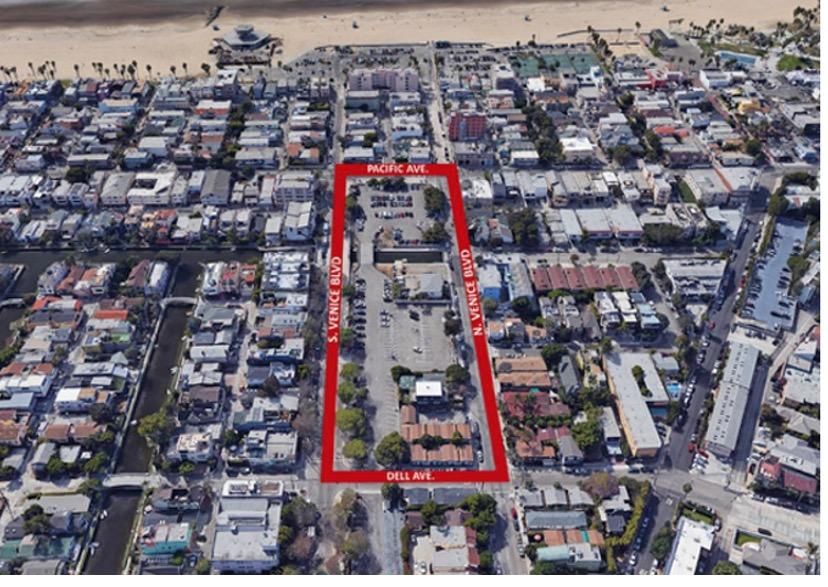
Earlier this month, LA City Council voted to rein in the Board of Transportation Commissioners (BOTC) after a judge ruled that the appointed body overstepped its authority in trying to block Venice Dell, the long-planned 120-unit affordable housing development in Venice. The October 16 vote was 10-1, with Councilmember Traci Park casting the only no vote. But one piece of the BOTC’s effort to stop the project is still pending. A report advancing Park’s plan to build housing on nearby Parking Lot 701 while turning the already-approved Venice Dell site into a parking and transportation facility is still pending in the Housing and Transportation Committees. This despite the fact that a recent court ruling and Council vote have fundamentally undermined the basis for the 701 proposal.
City Council should put an end to this proposal once and for all. The commission’s Lot 701 recommendations didn’t emerge from an independent effort to build more affordable housing. They grew directly out of Park’s campaign to block Venice Dell and redirect the property toward parking and transportation uses. Now that the courts have rejected the commission’s attempt to interfere with the project, and Council itself has voted to limit the commission’s authority, there’s little justification for keeping this alternative plan alive. Council should formally reject the recommendations to the extent they would replace Venice Dell, rather than leave another tool in Park’s campaign to derail the development available for future use.
Venice Dell has been in the works for a decade. In 2016, the city selected Venice Community Housing and Hollywood Community Housing Corporation to build affordable housing on city-owned Parking Lot 731 near Venice Beach. The project would provide 120 permanently affordable homes, including supportive housing for people experiencing homelessness. It went on to win approvals from City Council and the California Coastal Commission, including a unanimous Coastal Commission vote in December 2024, and secured substantial commitments of public funding.
Park has opposed the project and pursued several ways to stop it. One was through the Board of Transportation Commissioners, an appointed body that advises the city on transportation and parking issues. Even though the city had already approved Lot 731 for affordable housing, the commission claimed authority over the property because it was operated by the LA Department of Transportation.
On December 10, 2024, the commission unanimously rejected the use of Lot 731 for Venice Dell, citing concerns about parking, city revenue, maintenance, liability, and coastal access. Instead, it recommended exploring affordable housing on nearby Lot 701, another city-owned parking lot. This came after years of approvals for Venice Dell and threatened to derail a project that was already well along in the development process.
Park quickly put the commission’s decision to work. On January 7, 2025, she introduced a motion directing city officials to study whether affordable housing could be built on Lot 701 and develop plans for a mobility hub on Lot 731. Her motion explicitly cited the commission’s rejection of Venice Dell and its recommendation to explore Lot 701. The proposal raised serious questions about whether the alternative site was viable.
The connection was clear. Park wasn’t just asking the city to find another place for affordable housing. She was pushing a plan that would replace the already-approved Venice Dell development with a completely different use of the property, while starting the housing approval process over again at another site. The commission’s decision gave her a new way to pursue that goal.
The city went ahead with the study. In February 2026, the City Administrative Officer’s assessment concluded that Lot 701 could potentially accommodate around 107 affordable housing units or more. But the report also identified some major obstacles. Unlike Lot 731, where Venice Dell had already received key approvals, Lot 701 is zoned for open space, meaning residential development isn’t currently allowed. Building housing there would require a General Plan amendment, a zoning change, changes to coastal planning requirements, coastal development permits, and other approvals.
The report also found that the rental subsidies needed to finance supportive housing weren’t available, and recommended focusing on affordable housing more generally instead. So not only would the Lot 701 proposal mean starting over on a site that still needed major approvals, but it wouldn’t necessarily provide the same kind of housing as Venice Dell.
Even more tellingly, the report recommended moving Lot 701’s existing 150 public parking spaces to Lot 731, the Venice Dell site. That recommendation made the relationship between the two plans especially clear. The city would build housing on Lot 701 and use the property already approved for Venice Dell to replace the parking spaces lost in the process.
The Board of Transportation Commissioners first considered the CAO’s recommendations at its March 26 and April 9 meetings, ultimately approving them and sending the report to City Council on April 28. The recommendations included developing affordable housing on Lot 701, beginning the process of selecting a developer, transferring the property to the Housing Department under certain conditions, and looking into moving the parking spaces to Lot 731. The commission’s report is still pending in Council’s Housing and Transportation committees.
But by then, the commission’s attempt to block Venice Dell was already being challenged in court.
On May 26, Los Angeles Superior Court Judge Curtis Kin ruled against the commission’s attempt to stop Venice Dell. The court rejected the idea that the commission’s authority over city-owned parking facilities allowed it to override decisions already made by City Council and the mayor to use the property for affordable housing. In effect, the commission couldn’t use its parking responsibilities as a veto over a housing project the city had already approved.
The ruling didn’t specifically invalidate the Lot 701 report, which concerned a different property and was approved before the court’s decision. But it directly undermined the commission’s attempt to control what happens to Lot 731, the very site the Lot 701 report proposed using for replacement parking.
City Council took things even further in October. On September 22, Councilmember Eunisses Hernandez introduced a motion to change the Los Angeles Administrative Code and clarify the limits of the Transportation Commission’s authority over city-owned land approved for affordable housing. The motion pointed directly to the problem with Venice Dell: the commission’s advisory powers had been weaponized to delay or overturn affordable housing projects that City Council and the mayor had already approved.
The motion described blocking affordable housing over parking concerns as legally indefensible and warned that these delays could put important public funding at risk. It proposed removing housing-approved parking facilities from the commission’s usual responsibilities, giving the Housing Department control over applicable properties, and taking the commission out of certain development approval processes.
On October 7, the Transportation Committee unanimously recommended moving the proposal forward. Park, who sits on the committee, voted yes.
But when it reached the full City Council on October 16, Park changed her vote. She was the only councilmember to oppose the measure, which passed 10–1. Council directed the City Attorney to prepare an ordinance changing the commission’s powers. That ordinance still needs to go through the legislative process before the changes take legal effect.
Park’s no vote is especially notable given how heavily she relied on the commission to advance her Lot 701 alternative. The commission had given her another way to challenge Venice Dell, even after the project had cleared the city’s approval process. Council’s action was intended to prevent transportation officials from continuing to use their authority over parking lots to interfere with affordable housing decisions.
All of this leaves the Lot 701 proposal in a very different position than when the commission approved it in April. The CAO’s finding that the property could accommodate affordable housing hasn’t changed. But the commission’s recommendations can’t be separated from the effort to block Venice Dell. They grew out of that effort, and the proposal to move parking onto Lot 731 directly conflicts with the city’s existing plans for the site.
Neither the court ruling nor the October Council vote automatically canceled the Lot 701 recommendations. But together, they’ve effectively stripped away the basis for using the proposal to replace Venice Dell. The court rejected the commission’s attempt to interfere with the project, and Council voted to close the loophole that allowed that interference in the first place.
There’s a big difference between building affordable housing on Lot 701 in addition to Venice Dell and using Lot 701 as an excuse to abandon Venice Dell. The first would mean more affordable housing for Los Angeles. The second would mean giving up a long-approved supportive housing project in favor of starting over on another site, with new approvals, new financing, and years of additional work ahead.
Council should make that distinction clear. Rather than leaving the commission’s recommendations sitting in committee indefinitely, it should formally reject those that would redirect Venice Dell or turn Lot 731 into a parking facility.