
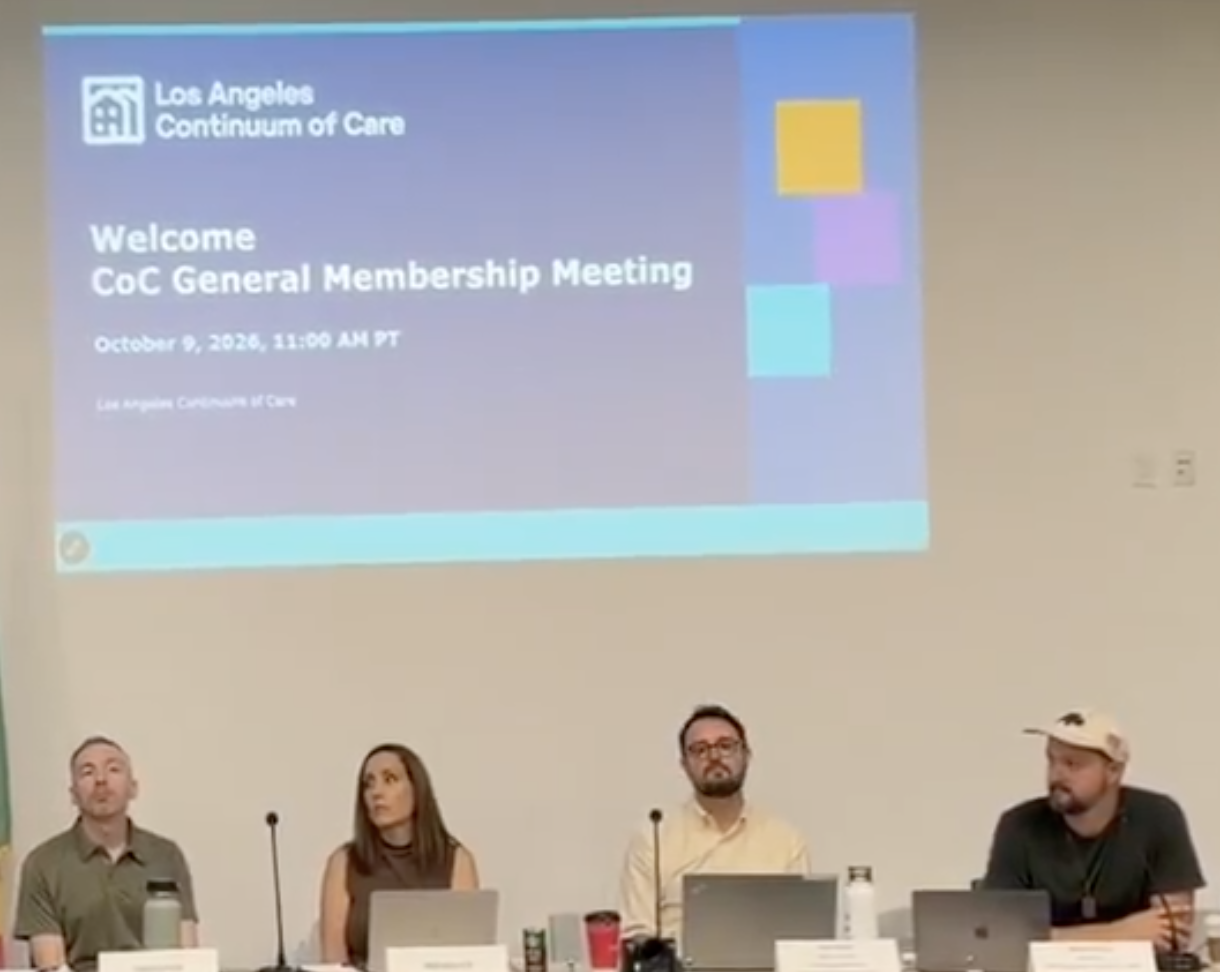
Photo courtesy of Elizabeth Chou of The LA Reporter
Los Angeles officials, including Mayor Karen Bass and City Council President Marqueece Harris-Dawson, helped mobilize a crowd that overwhelmed Friday’s meeting to select new administrators for the region’s homelessness systems. They then blamed the LA Continuum of Care board for denying residents a voice, even though that board had no choice but to adjourn once the Zoom attendance cap was reached.
The City and County are competing to take over key homelessness functions that LAHSA is giving up, in a regional system that brings roughly $240 million in federal housing and services funding to Los Angeles. The City applied to run the regional homelessness database and the system that connects people to housing and services. The County applied for those roles and two others: the annual homeless count and the region’s federal funding application. An independent evaluation scored the County higher on both roles the City sought, and the board of the Los Angeles Continuum of Care (CoC), the regional body overseeing the federal funding process, recommended the County. Friday’s membership vote gave City officials a chance to defeat those recommendations and reopen the fight over control.
The postponement leaves that transition unresolved just days before the October 13 deadline for the CoC to submit its evaluation report to U.S. District Judge David O. Carter. The money at stake supports housing and services for more than 11,000 people across 85 cities, according to LAHSA’s account of the federal injunction. The federal CoC program pays for permanent supportive housing for people with disabilities, rental assistance, housing operations and other forms of housing and support. Eligible services include case management, mental health care, substance use treatment, childcare and transportation. For the people who depend on those programs, a loss of funding could mean losing a home or the support that helps them stay housed.
Mar Vista Voice attended the October 9 CoC meeting remotely as a Zoom participant. The CoC chair had barely begun introducing the meeting when it was adjourned after online attendance reached the platform’s 1,000-person limit. Because the CoC’s membership is open to people interested in collaborative efforts to address homelessness, those unable to enter were potentially entitled to vote, not simply watch. Attorney Shayla Myers explained that “members of the CoC are not able to participate. We have to continue this.” She said organizers would add capacity, noting that the 1,000-person limit was already substantially larger than the capacity usually provided for public meetings. The Los Angeles Times reported that more than 1,500 potential voters had registered.
Audience members challenged Myers, with one calling out, “So just upgrade [the Zoom capacity] right now. I can show you how!” Shortly afterward, City Council President Marqueece Harris-Dawson repeated the claim at City Hall: “My understanding of Zoom is you can increase the capacity of a Zoom with a push of a few buttons.” But the CoC’s license did not allow that immediate upgrade. Organizers needed a new link, which required a newly noticed meeting. By lending his office’s authority to an unsupported claim, the Council President cast doubt on the CoC’s fairness when it was protecting members’ right to vote. Harris-Dawson also acknowledged that multiple City offices had organized the turnout. “Many offices did mobilization,” he said, adding that “we were able to show up in force and cause at least them to have to figure out when they’re going to meet again and make this decision.”
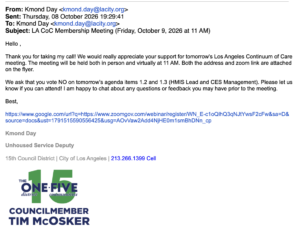
The campaign showed a striking degree of unity at City Hall, with the mayor and several council offices deploying their extensive outreach networks to fight the County’s selection. Emails shared with Mar Vista Voice document outreach by Councilmembers Tim McOsker and Ysabel Jurado’s offices, in addition to the text message from Mayor Bass. McOsker’s District 15 office explicitly asked recipients to vote no on items 1.2 and 1.3, the recommendations for the homelessness database and coordinated-entry system. According to the recipient, the October 8 message was mass emailed using BCC and thanked them for taking a phone call that never occurred. Jurado’s District 14 office emailed partners that afternoon, asking them to attend and recruit others. The message questioned the City’s application scores and advocated shared administration.

After the meeting ended, Bass, Harris-Dawson, Jurado, McOsker and Councilmember Imelda Padilla issued a joint statement blaming the CoC for inadequate preparation and saying Angelenos had been “silenced today.” The CoC needed enough capacity for eligible members to participate. Once people were locked out, however, postponing was the way to protect their right to vote. City officials portrayed that decision as shutting residents out, without acknowledging their own role in driving turnout to defeat the recommendations.
The turnout was far larger than the CoC’s previous meetings had attracted. In an August 22 essay, LAHSA Commissioner Justin Szlasa described a CoC with no comprehensive membership list or separate budget, relying on LAHSA’s staff, mailing lists and technology. A recent general membership meeting had drawn about 200 people, he wrote, although the charter’s definition could encompass a vastly larger electorate. City officials used that broad eligibility and their extensive email and text networks to mobilize a much larger crowd against the County’s selection. That makes Szlasa’s call for resources to support independent operations especially relevant: the CoC needs to accommodate its open membership while conducting a fair selection, including when applicants use their own communications networks to campaign against the outcome.
Suggestions that the CoC simply use a City or County Zoom account also overlook a basic concern: both governments were applicants for the jobs being decided. Having either applicant run registration, access or voting could raise questions about the fairness of the selection. The CoC’s charter requires avoiding conflicts and their appearance. It does not expressly ban using an applicant’s meeting platform, but keeping the process independent helps protect the decision from challenges. The County’s new statement says it took steps to avoid conflicts, including recusing itself from applicable votes.
Beyond its attacks on how the meeting was handled, the City argues that County administration would leave it without enough control over housing placements. Bass and the councilmembers complained that people from surrounding cities receive housing funded by LA’s taxpayers, saying the City needs to place people from its own streets into homes it builds and funds. But the County’s new statement directly challenges that argument. The City, it says, already decides placements into City-funded beds and would continue to do so if the County were selected. Policies for matching people to housing through coordinated entry are set by the CES Policy Council, where both governments have seats. Running the system would not give the County unrestricted authority over who receives housing or erase the CoC’s oversight responsibilities.
Supervisor Lindsey Horvath also said in her October 10 statement that the County had committed to preserving, at a minimum, the City’s existing access to the database and coordinated-entry system. Those commitments leave room to negotiate specific protections for the City’s role. City officials should explain which placement decisions they cannot make now, what County administration would change, and why those concerns justify blocking this transition.
All of this is unfolding as the CoC fights in federal court to keep decisions about the region’s homelessness systems and federal funding in local hands, rather than turn them over to HUD. HUD has already sought to let providers apply directly to Washington, bypassing the region’s process for evaluating projects and setting funding priorities. Its own guidance acknowledges that the court order currently requires Los Angeles providers to apply through LAHSA. By casting the CoC’s effort to protect voting access as evidence that the process is unfair, City officials risk feeding HUD’s case against the local control Los Angeles went to court to defend.
As Mar Vista Voice previously reported, Judge David Carter protected the regional funding process from HUD’s effort to bypass LAHSA while requiring the CoC to evaluate administrators for 2027. His August 13 order explicitly said any transition must be “gradual and measured” to protect people receiving services. It also criticized the longstanding cycle of blame-shifting among the City, LAHSA and HUD. The court gave the region time to choose successors without disrupting the housing and services people already receive.
That protection came with a timetable. Under the August order, the CoC must report its applicant evaluations by October 13, HUD must respond by October 20, and the parties return to court October 27, when the injunction blocking HUD from suspending LAHSA’s role in the regional federal funding application expires. The October 13 deadline is for the evaluation report, not the membership vote, so the postponement alone does not mean the CoC has violated the order. But it leaves the choice of successors unresolved as the court prepares to review the transition.
The Ninth Circuit’s September 24 ruling also kept the 2026 funding application on track while allowing the region to choose new administrators for 2027. HUD had approved LAHSA to submit the region’s annual funding application, then abruptly suspended the agency over allegations of fraud and mismanagement when it was too late to register a replacement. The judges recognized HUD’s responsibility to investigate those allegations, but found it had not justified the need for an immediate suspension that threatened to disrupt housing and services. Friday’s postponement does not undo that ruling or stop the current application. Continued fighting over the next administrators could, however, delay the transition and give HUD more material to challenge the region’s plans.
Keeping these decisions local matters for the people who depend on the funding. Trump’s July 2025 executive order calls for moving away from Housing First, expanding involuntary commitment and making assistance conditional on treatment for people with substance use disorders or serious mental illness. Those directives remain subject to existing law, but they signal what the administration wants: a shift away from providing housing without treatment requirements and toward coercion and institutionalization. Treatment is already an eligible use of CoC funds. The question is whether people can receive housing and care that meets their needs or risk losing assistance because they cannot meet prescribed treatment conditions. Local control gives the region a voice in defending access to stable housing and voluntary services.
There is no evidence in the outreach we reviewed that City officials intended to overwhelm Zoom or force an adjournment. But after mobilizing the turnout, they used the postponement to attack the body responsible for making the decision. The City’s lower scores do not put the evaluation beyond criticism. Officials who believe it was flawed should identify the errors and explain how to correct them without prolonging the transition. Not getting the arrangement they wanted is not, by itself, evidence that the process was unfair.
The City can negotiate protections for its access to the systems, its role in housing placements and its ability to hold the new administrators accountable. If officials insist that the recommendations must be rejected, they owe members a concrete alternative and a timetable that protects housing and services. They should be working to strengthen the local process against HUD’s challenge. Turning a fight over administrative control into an attack on that process puts far more at risk than which government gets the jobs.