
A federal judge has blocked the Trump administration’s attempt to remove the Los Angeles Homeless Services Authority from the region’s homelessness system, ordering the U.S. Department of Housing and Urban Development to release approximately $241 million earmarked for Los Angeles and allow LAHSA to submit the region’s 2026 funding application.
The ruling is an immediate victory for the thousands of people whose housing and services were threatened by HUD. It is not necessarily a long-term victory for LAHSA.
U.S. District Judge David Carter’s order keeps LAHSA in place for the 2026 funding cycle but requires the Los Angeles Continuum of Care to begin accepting applications from organizations interested in assuming LAHSA’s four principal regional roles in 2027. That creates a court-supervised path for the City of Los Angeles, the County or another entity to take over some or all of LAHSA’s responsibilities without blowing up the funding system in the process.
Mayor Karen Bass and City Council President Marqueece Harris-Dawson made clear in a separate letter to Carter that the City is already considering such a future.
“The City is preparing a transition plan that anticipates a future in which LAHSA may no longer be the sole or primary administrator of the region’s homelessness system and the City assumes greater responsibility for governing the system it has helped build over decades,” they wrote.
That language may ultimately prove as consequential as the injunction itself. Los Angeles County has already moved hundreds of millions of dollars and hundreds of service-provider contracts into its new Department of Homeless Services and Housing. City officials have also been considering whether to remove City-funded programs from LAHSA and administer them directly or through another entity.
Carter’s order may accelerate that process. But it draws an essential distinction between a planned local transition and HUD’s attempt to use an administrative suspension to seize control of the region’s federal funding.
HUD suspended LAHSA on June 11, after approving it as the region’s Collaborative Applicant in April and after the deadline for another organization to register for that role had already passed. A second HUD letter barred LAHSA from performing its other delegated functions and proposed allowing individual providers to apply directly to Washington.
That threatened housing, shelter and services for more than 11,000 people across 85 cities. The approximately $241 million supports 140 projects serving veterans, families, children, transition-age youth, seniors and survivors of intimate partner violence.
“Inevitably, this suspension will result in deaths among the homeless and the displacement of over 11,000 unhoused individuals,” Carter wrote in his 28-page order.
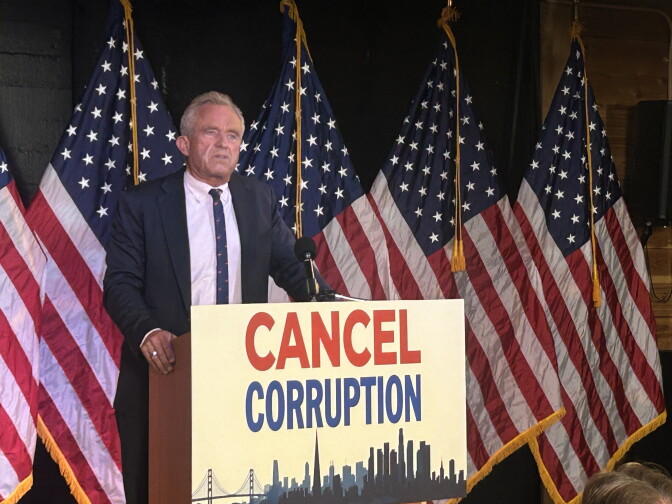
The ruling came two days after HUD Secretary Scott Turner and Health and Human Services Secretary Robert F. Kennedy Jr. staged a press conference at the Dream Center in Echo Park under the banner “Cancel Corruption.” Flanked by American flags and television screens, Turner declared that LAHSA would “not receive another cent of American taxpayer money” until it could account for every dollar.
The performance was less an explanation of HUD’s legal authority than a preview of what the administration wants to do with federal homelessness funding. Turner and Kennedy promoted faith-based residential recovery programs as replacements for Housing First, denounced harm reduction and repeatedly framed homelessness as primarily a problem of addiction, mental illness and moral failure.
The administration has made the policy behind that performance explicit. President Trump’s 2025 executive order on homelessness directs federal agencies to favor jurisdictions that expand involuntary civil commitment, clear encampments, punish public drug use and move people into treatment or long-term institutional settings. HUD’s newly released “Best Practices Toolkit” promotes the intentional integration of faith-based institutions into recovery programs. The stated concern is accountability, but larger project is to commandeer congressionally authorized homelessness funding for an ideological shift away from permanent housing and toward religious recovery programs, forced treatment and institutionalization.
Carter’s order says HUD’s proposed direct-application process appeared to be a “pretextual attempt” to bypass the regional system established by Congress. He wrote that HUD was “leveraging a crisis of its own making to wrest power to itself that Congress expressly granted to local communities.”
Carter did not excuse LAHSA’s record. He has repeatedly criticized its financial controls, data systems, delayed payments and inability to document how public money was spent. His order says LAHSA and HUD have been engaged in a “joint partnership in failure” for decades.
But that history undermined HUD’s claim that an emergency suspension was suddenly necessary. HUD relied on old audits, public reports and problems it had known about for years. It continued approving LAHSA for federal grants despite those findings, including approving new awards only weeks before the suspension.
“None of this is new,” Carter wrote.
HUD had previously investigated the conflict involving former LAHSA CEO Va Lecia Adams Kellum and closed the matter after finding that the agency had taken sufficient corrective action. It nevertheless reused the same incident to justify an immediate suspension years later.
If HUD’s goal had been an orderly change in administration, it could have notified the Continuum of Care before the registration period, allowed it to select another applicant and supported a transition. Instead, it waited until Los Angeles had no feasible replacement and then declared that local providers should bypass the regional process and apply directly to HUD.
When a Los Angeles Times reporter asked Turner whether HUD would give the Continuum of Care time to select another Collaborative Applicant, Turner did not answer. He attacked “litigation activism,” denounced Housing First and pulled a harm-reduction kit from a brown bag for the cameras.
Carter has now ordered the measured transition HUD refused to offer. LAHSA will remain the Collaborative Applicant for 2026, allowing it to evaluate, rank and submit more than 100 local projects through a single regional application. It will also temporarily remain responsible for the region’s homelessness database, coordinated-entry system and annual homeless count.
HUD must distribute the approximately $241 million Congress allocated to the region according to the local application. It must also immediately execute agreements for previously approved 2025 grants that had not yet been finalized. LAHSA told LAist those delayed grants total approximately $66.5 million.
At the same time, the Continuum of Care must immediately solicit applicants to serve as the Collaborative Applicant, homelessness database administrator, coordinated-entry coordinator and homeless-count administrator in 2027. It must report on the applicants by October 13, and HUD must respond by October 20. The parties return to court October 27, when the preliminary injunction expires. A trial is scheduled for February 23, 2027.
The order therefore does not preserve LAHSA indefinitely. It protects the funding and the people who depend on it while allowing Los Angeles to decide what should replace the current structure.
A local decision to move City programs away from LAHSA may be justified. LAHSA’s structure has allowed the City and County to blame each other while responsibility disappears between them. The City assuming clearer control over its own contracts and programs could make it easier for the public to know who is responsible when something fails.
But HUD was not offering clearer local accountability. It was using LAHSA’s failures as a publicity hook for a national attack on Housing First and an opportunity to redirect homelessness dollars toward its preferred religious and institutional programs.
The administration attempted the same shift through its 2026 funding notice, which created a $1.3 billion set-aside for transitional housing and programs emphasizing mandatory services. On August 7, a federal judge in Rhode Island vacated that notice, finding that HUD had bypassed the public notice-and-comment process required by federal law.
That ruling eliminated the immediate August 26 application deadline, but it did not restore LAHSA’s authority or guarantee Los Angeles access to the next competition. Carter’s injunction does both while a longer-term structure is developed.