
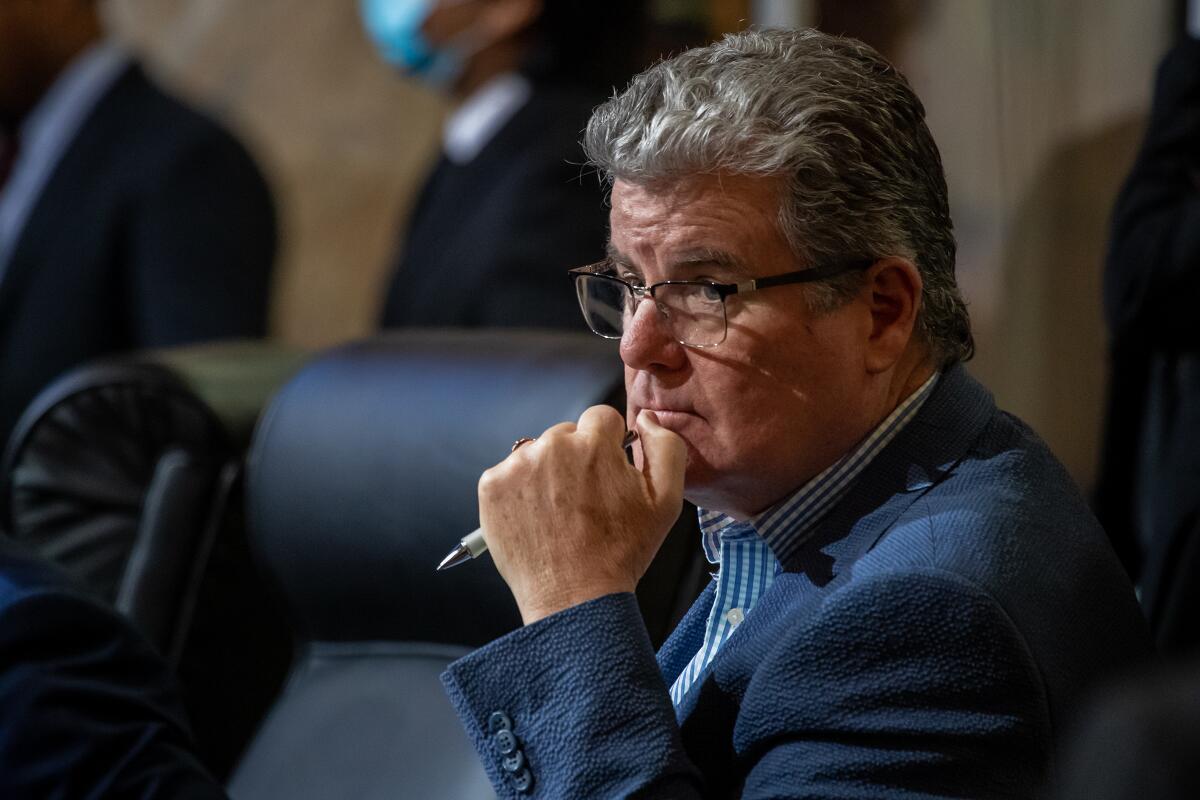
This past Wednesday, February 11, Councilmember McCosker successfully moved to renew an ordinance meant to prohibit private detention facilities throughout the city. During the meeting, McOsker suggested renewing a previous file and updating its research and applicability.
On paper the motion focused specifically on unaccompanied minors, however, McOsker clearly stated during the City Council meeting that he aims to prohibit these facilities altogether. He claimed the initial file “expired” in 2021 “because the concern expired.” McOsker asserted that these private detention facilities are unconstitutional in that they violate human rights by fostering poor living conditions resulting in harm, disease and death of U.S. residents, while profiting from doing so.
The initial 2019 motion- introduced by former Councilmember Herb J. Wesson Jr. and seconded by Councilmembers Gil Cedillo and Paul Krekorian- noted concerns about private entities gaining profit by holding undocumented immigrants. The 2019 motion stated, “The Trump administration’s hardline immigration policies have done more than create a humanitarian crisis along our southern border; it has opened the door for hundreds of privately-owned detention centers across the country to profit by holding undocumented immigrants detained by U.S. Immigration and Customs Enforcement. Nearly three-quarters of all detained immigrants, adults and children alike, are held in these private prisons until their court hearings, which can take months.”
On December 3, 2018, during the 2019-2020 legislative session, former Assemblyman Rob Bonta introduced a law (Assembly Bill 32) to prohibit private, for-profit detention facilities throughout the state of California. Despite being passed by legislature and signed into law by Governor Gavin Newsom in 2019, it was later deemed unconstitutional by the 9th Circuit U.S. Court of Appeals under the Supremacy Clause as it interfered with the federal government’s authority.
McOsker aims to use the City’s land use and zoning authority to have the same effect on a more local level. This action is meant to prevent the conversion of unoccupied spaces, like closed prisons, into detention facilities by prohibiting them from being built in all zoning designations throughout Los Angeles. “We have something different at the local level,” McOsker said. “The most significant police power we have is not police, the most significant police power we have is land use.”
The councilmember also made it clear that he is unaware of any private detention center proposals in the city as of now, though there have been reports that they will be implemented in eight states. He specifically cited a Washington Post article, published on January 30 and titled “ICE buys warehouses for mass detention network, rattling locals,” which wrote, “the Trump administration has moved to acquire industrial buildings in at least eight states.” It also stated that in the month of January they purchased two spaces, one for $102 million in Maryland and the other for $70 million in Arizona.
Though no private detention facilities have yet been initiated in the state of California, McOsker expressed concern over potential spaces in his district, District 15. This includes a number of warehouses, a harbor area with available land and a federal penitentiary that is set to close down. “I have every expectation that this administration plans this aggressive, unsustainable growth by using private entities to profit off of the harms caused to our residents,” said McOsker. For these reasons he stressed the importance of being prepared by reactivating and updating the initial file. To conclude his statement, McOsker says he looks forward to working “cooperatively” with his fellow Council members so that they are prepared to respond “when and if it is proposed.”
Councilmember McOsker asserted that local residents do not want to be a part of the federal government’s “unconstitutional actions” and “human rights violations,” and that he assumes “the same will be true for all of our communities.”