
This article by Carter Moon originally appeared in his Substack, and is republished here with his permission.
Like any good American leftist, elections make me miserable. I hate the dirty feeling of voting for people who I know full well are more interested in preserving the power and wealth of the rich than they are in meeting the needs of the most vulnerable in our society. I hate giving legitimacy to this empire that rains down death and destruction all over the globe. Our institutions are structurally anti-democratic; the Senate, the Supreme Court, and the Electoral College all exist to override the will of the people. True democracy is a sham in this country. As the band Chat Pile says it: “This world is filled with hallowed halls of degradation,” and nowhere is that more true than Washington D.C. These are all shibboleths I muttered to myself at an election watch party where I was tabling for my grassroots community organization.
But in the last few years I’ve been sucked into investing a lot more time and attention to electoral politics. I still believe that the world we need is only going to be won through bottom-up people’s movements and that elected officials can serve as vehicles for the organized will of these movements at best. Yet there’s no denying that the only mechanism to currently bring an end to the worst atrocities of our moment — the mechanized internment of immigrants in concentration camps in our borders and the genocide of Palestinains abroad — is by winning power in Congress. Mass popular resistance to these crimes against humanity has been essential up to this point, but the only way to bring about an end is ultimately by electing people willing to stop them. I’ll talk more about how the results of these elections were only possible thanks to masses of people rejecting fascism in the streets, but we have to contest for power on multiple fronts if we want to end the intolerable suffering our government is inflicting on innocent people, and one of those fronts is electoral.
We should be really clear-eyed about how badly the next two years are going to go, no matter what. The AI bubble appears to finally be getting ready to burst. Anthropic’s IPO shows it is deeply unprofitable and the circular financing scheme driving the AI boom seems to finally be crashing into reality. Nvidia, the company making the chips that is holding up the entire industry, lost billions in value after its CEO was exposed as having an affair with a Chinese spy, potentially causing a national security incident. The exact contours of how this plays out remains to be seen, but an AI bubble bursting will almost certainly wreck people’s 401ks and cause a depression we haven’t experienced in almost a century. Democrats will struggle enormously to hold onto legitimacy if they’re in power while such economic devastation destabilizes a country where most people are already hanging by a thread. They’ll have to show deep courage to punish the bad actors in tech who engineered this crisis and bail out regular people instead of Wall Street. I’m not holding my breath.
I also want to encourage anyone currently crowing about the total destruction of MAGA to slow their fucking roll. It felt good to watch Trump actually take it on the chin and admit he lost, but that’s not the same thing as defeating these freaks. The end times fascist coalition of Big Tech oligarchs, apocalyptic Christians, and ultra-nationalists are going to keep organizing for power. Stephen Miller has more power and influence over Trump than ever before. Benjamin Netanyahu might be ousted from power, but the fascist movement in Israel is going to keep pushing Trump to escalate the war in Iran. The billionaire class still controls all the money and can influence elections, like they did in California when they defeated Prop 40, a modest one-time tax on their wealth. Now up to 14 million Californians are at risk of losing access to their healthcare. The struggle to overcome these forces is only beginning, not ending.
I expect many of the candidates who won big upset victories on Nov. 3 to be grave disappointments. The Democratic party is still beholden to venture capital, AIPAC, and the military industrial complex, same as it ever was. But masses of people organizing to pull off incredible wins and near-wins means something. Scott Colom becoming the first Black senator of Missisppi since post-Civil War Reconstruction is a stunning historical moment. Democratic socialist Angie Nixon losing her race in Florida by only two points — despite the Democratic party refusing to fund her campaign — is a remarkable testament to her organizing abilities. There are plenty of things about James Talarico that make me wary of him, but his forceful rejection of Christian nationalism while defeating one of the worst MAGA fascists in the country is significant.
The other component of elections that is meaningful to me is how they reflect what people care about in a moment of time; among the rank and file of Democratic voters, there is a lot of encouraging consensus forming. Consistent majorities of these Democrats support Medicare for all, abolishing ICE, and ending military aid to Israel. 46% of 18-34-year-olds support democratic socialism. The durable unity around these issues has shifted rapidly during the second Trump administration, and this can only be an opening for the left. As the anarchist writer Margaret Killjoy put it: “The Republican party made a bold gamble: they thought that Americans hated trans people and migrants more than they hated fascism. Yesterday, Americans refused them, in the greatest electoral upset of my lifetime.” These are not people who are ready to embrace a mass working class revolution to seize the means of production, but they are hopefully developing a class consciousness that has been absent for generations.
What’s been particularly encouraging in the immediate aftermath of the elections is how forcefully people have rejected the notion of Chuck Schumer and Hakeem Jefferies getting to serve as House and Senate majority leaders. Mass popular rejection of these two feckless establishment Dems backed by AIPAC and Wall Street is an encouraging sign that the anger of Democratic voters is not going to cool off the second the new Congress is sworn in. The iconoclastic writer Sarah Kendzior put it well in her typical blunt fashion: “It would be wrong to have the House, Senate, and Presidency headed by three politicians from any one city. But to have all three from New York — a transnational mafia hub and the home of Wall Street — ensures that the corruption that voters condemned will not only continue but thrive.”
I want to pause here and reset the narrative of what actually caused the blue tsunami. We need to turn back to 2024 and the mass protest movements that forced the Palestinian genocide into the national conversation. The sustained student encampment protests facing down the full force of the American police state were particularly brave. They also forced many establishment Democrats to reveal their true face; I believe that Mayor Karen Bass showing up to UCLA to personally oversee the LAPD’s brutal crackdown of student protestors was the beginning of the end of her political career in Los Angeles. It is becoming increasingly more challenging for Democrats to continue defending military aid to Israel, and that is solely thanks to the relentless advocacy of the Palestinian liberation movement. The moral clarity millions of people found within themselves in the three years since this genocide began is already tangibly shifting the balance of power in this country, despite the best efforts of the Democratic party to suppress it.
We should also never forget that it was mass movements of ordinary people who mobilized against ICE in their cities. While many elected Democrats hemmed and hawed and attempted to feign powerlessness in stopping federal troops, regular people fought these armed thugs in the streets. Los Angeles refused to accept occupation; we rioted against federal agents and organized patrols to defend our neighbors. Minneapolis similarly refused to be occupied and organized resistance at a scale that was frankly astounding. After the Trump administration relied on racist conspiracies about Somalis to justify their invasion, Minnesotans put together messy, spontaneous networks of patrols and care, making sure their immigrant neighbors had groceries and clean laundry while they couldn’t safely leave their homes. This mass bravery of regular people, the love and solidarity neighbors have expressed for one another, is the real historical engine that eventually expressed itself in the form of November’s elections.
This is what Naomi Klein and Astra Taylor call “the politics of hereness” in their exceptional new book End Times Fascism. They argue that the dividing line in politics is now between “end times fascists” who believe that the world will end in one way or another, but that they are the chosen few who will be able to escape, and the regular people who “are committed to staying right here, in the complexity of earthbound reality, with one another.” They offer a roadmap of what it will actually take to overcome fascism, which is a deep commitment to refusing to let our neighborhoods, schools, and landscapes be overrun by these ghouls. Sometimes that looks like dramatic confrontations with ICE, but sometimes it looks like showing up to a city council meeting to resist Flock or an AI data center in your backyard. It looks like organizing to get your city to divest from Israel, like Providence, Rhode Island just did.
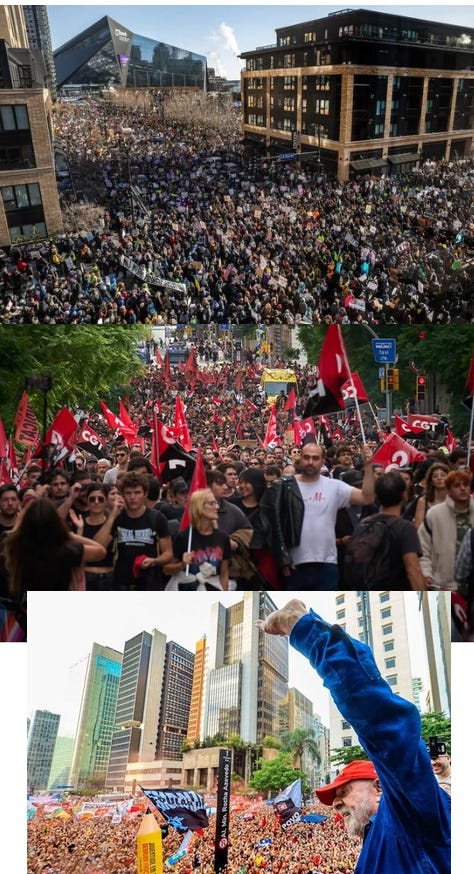
I also really want to encourage Americans to zoom out to an international perspective for inspiration. The mass student-lead protests in India and France have been joyful, militant, and intense. Lula De Silva clawed his way back to victory in Brazil despite coming in second in the presidential primary, overcoming a well-organized fascist movement that’s a mirror of MAGA here in the US. Lula’s victory arguably had less to do with his unique skills as a politician than it did with the efficacy of the Brazilian left’s astute social media organizing and mass mobilizations in the streets. And the most inspiring movement of all happening right now is in Spain, where a militant tenant movement staged the country’s first general strike in 14 years. Millions of people shut the country down on Thursday, and by Friday had won major reforms against evictions and real estate speculation. Expanding our imaginations to embrace these more confrontational forms of resistance is going to be essential in the ongoing war against American fascism.
Every election cycle forces me to reaffirm what world I actually want to live in and how far we are from achieving it. I want a world where workers own and democratically control the means of production. I want a world where so much of our housing supply is directly owned by the people that no one is homeless or drowning in rent debt. I want a world that rapidly transitions off of fossil fuels and on to publicly owned renewables. I want to live in a country that doesn’t have migrant concentration camps or the largest incarcerated population in the world. We are still a very long way from any of those goals in November of 2026. But now is nowhere near the time to admit defeat; just because we can see that the road ahead will be bleak and treacherous does not give us permission to stop pressing forward. Not when so many people around the world have shown they’re willing to try to struggle for something better with us.