
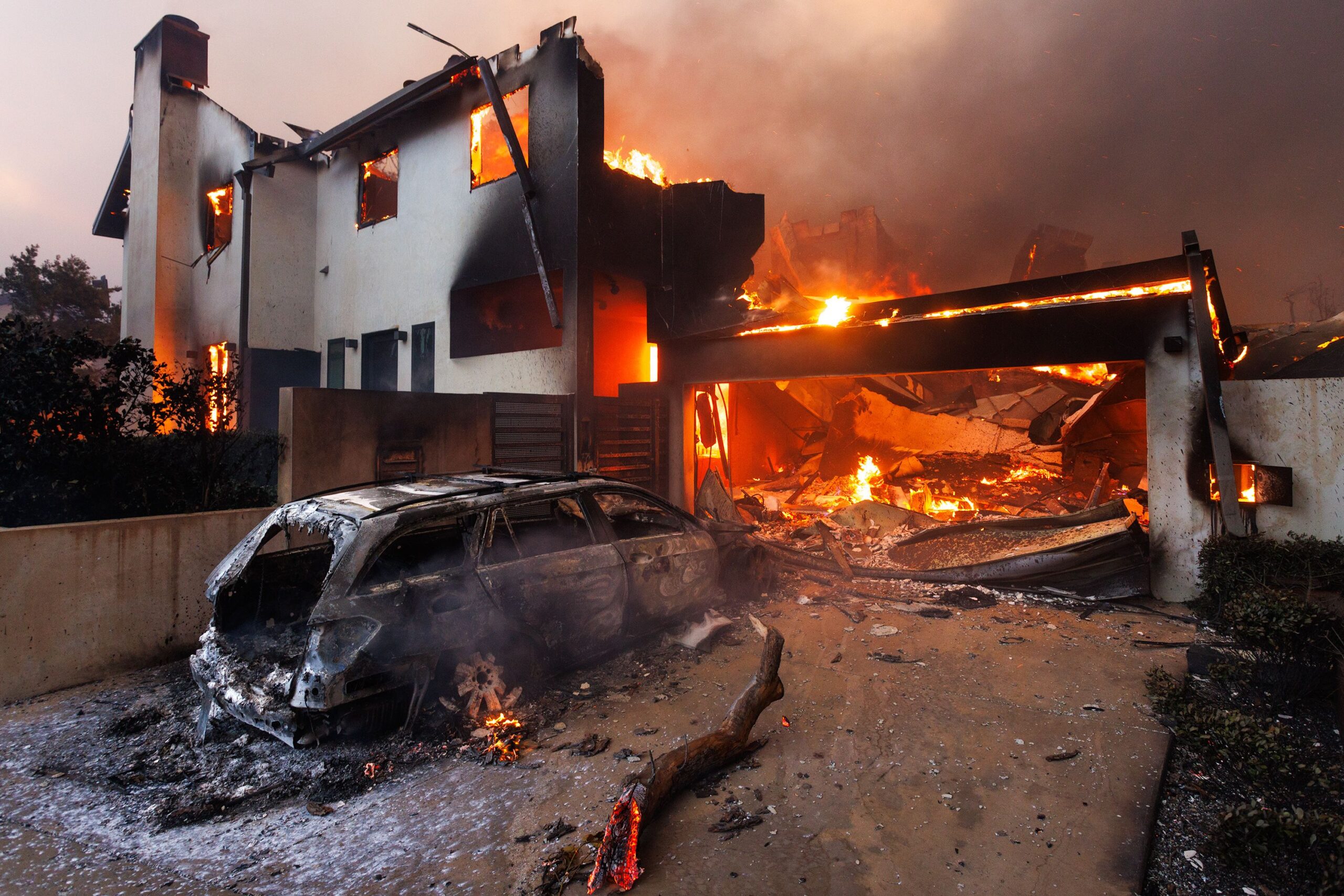
The following piece was written by a survivor of the Palisades fire whose family lost their home of nearly 30 years. The author has chosen to remain anonymous. We are publishing their perspective ahead of Tuesday’s vote on Measure TE, which would exempt certain fire-affected property sales from Measure ULA, the voter-approved tax that funds affordable housing and homelessness prevention in Los Angeles.
My family, who lost their home of almost thirty years in the Palisades fire, is closely watching Measure TE, which Los Angeles residents will vote on this Tuesday. On paper, it sounds like a compassionate gesture to provide relief to Palisades residents who are facing challenging and devastating decisions about whether or not to rebuild their homes. If passed, Measure TE would temporarily exempt Palisades residents who choose to sell their property from Measure ULA.
Measure ULA, which voters passed in 2022, is colloquially known as the mansion tax. It implements a 4% sales tax on properties valued at $5 million or more; and a 5.5% sales tax on properties valued at $10 million or more. The funding from this sales tax supports city initiatives to build more affordable housing and provide services for people experiencing homelessness. It faced continual opposition from realtors and developers, who have used their political influence to try and undermine it ever since its passage.
The Palisades and surrounding Westside neighborhoods have been among the largest contributors to Measure ULA. According to data from the Los Angeles Housing Department, properties in Council District 11, which includes the Palisades and Brentwood, generated more than $310 million in ULA revenue between 2023 and May 2026, nearly a quarter of the citywide total. Single-family home sales in the Palisades alone generated more than $64 million.
If passed, Measure TE could reduce revenue to anywhere between $35 million and $66 million. In the last fiscal year, it raised around $548 million for essential services.
A well meaning voter may see TE on their ballots and think, surely, this is providing much needed relief for disaster victims. Maybe they watched the mayoral debate, in which Karen Bass apologized for infamously being in Ghana at the onset of the fire, despite being informed of increased fire danger ahead of time, and realized this was the first time she publicly addressed everyone who was affected. Maybe they remember how the city was unprepared to handle the crisis. Neighbors who evacuated later in the evening, long after the order had been issued, stayed behind until almost 8pm, waiting for fire crews to come to our neighborhood. To our knowledge, they never arrived. There is no situation that rationalizes or validates leaving a community to burn.
The argument in favor of Measure TE provided on the ballot is full of language that feigns empathy. The writer talks about ULA making a “devastating situation worse” and suggests it is a meaningful barrier to those seeking to move elsewhere. A look at its supporters shows that this sentiment is disingenuous.
Measure TE’s most high profile supporters are Mayor Bass and Councilwoman Traci Park, who represents Pacific Palisades and was one of its initial architects. Park claims to be the champion of the Palisades, but her policy decisions and high profile supporters suggest that she is only a champion for its wealthiest residents. In 2022, when Park first ran for office, she received campaign contributions from the Apartment Association of Greater Los Angeles, a PAC for the Building Owners and Manager Association of Greater LA. Developers, realtors, and building managers, who all deal with high value property, all have a vested interest in seeing ULA weakened. However, the working class members of the Palisades, who live in protected areas such as Tahitian Terrace, a rent controlled mobile home community, would be put at risk. Bass and Park can vocally support the Palisades all they want, but in my opinion, their political records suggest that their priorities are property, not people.
Though he is not explicitly listed as a supporter, developer Rick Caruso used his PAC to support Park’s initial proposal for what would become Measure TE. During his failed mayoral campaign, Caruso claimed he would use his business experience to circumvent bureaucratic delays and get affordable properties built faster, despite having never made any serious efforts to do so at any point in his career. When driving around West LA, I see billboards celebrating the reopening of Palisades Village, Caruso’s luxury shopping center, and think of how my family and many of my neighbors are struggling to begin the rebuilding process due to the city’s slow issuing of permits. He claims it is a beacon of hope. I suppose that even if I can’t go home, I can find hope and inspiration at Brandy Melville.
Voters should also consider who Measure TE would actually help. Though longtime Palisades residents are lucky that property values have increased over time, the people who will truly reap the benefits are those with investment homes. Measure TE is designed for the ultra wealthy. It has no owner occupancy limits, which means that people with second or third homes in the Palisades would be rewarded much more than the average homeowner.
Measure TE’s supporters are politicians who live in the pockets of developers and multi-millionaires. It does not acknowledge the reasons why people are being forced to sell their homes. Though the city cannot meaningfully address the conduct of insurance companies, it can and should take more of an effort to expedite the building process for residential properties. If our leaders truly cared about victims, they would do what they could to reduce the barriers against residents, instead of incentivizing them to sell.
Should Measure TE pass, it has frightening implications for the future of politics. It is already disturbingly commonplace for the wealthy to interfere with politics. However, Measure TE’s potential passage would go beyond money influencing elections. It would mean that powerful people saw legislation that was passed with a majority vote, decided they didn’t like it, and retaliated by exploiting an unprecedented natural disaster. Though Measure TE promises the exemption from ULA would be temporary, the rebuilding process is long and exhausting. If there was already precedent to limit the scope of ULA to five years, why not make it ten? Or fifteen?
When referring to Measure ULA, the language of the argument in favor of Measure TE states that “It was never intended to penalize survivors who lost everything in a declared disaster.” It seems that Measure TE is intended to penalize Angelenos who dare to need affordable housing. It seems that Measure TE is intended to penalize victims, who quite literally must rebuild from the ashes, and are faced only with leaders who want to exploit their suffering for political gain. It seems that Measure TE is intended to penalize voters who are challenging the status quo, and is a shameful attempt from Los Angeles’ political establishment to hold on to the power they are losing.
I am now speaking to my fellow Palisadians, many of whom support the likes of Traci Park and Karen Bass – and before her, Spencer Pratt. Even those who supported Measure ULA may see their name and assume this measure has a semblance of credibility. I want you to think of who this rebuilding process is prioritizing. The Palisades Village is up and running while many of the independent small businesses you grew up with or raised your kids with are left to hope the land they rent isn’t snatched out from under them by developers. If you occasionally drive through town, as I sometimes feel called to do, you’ll still see that patches of dirt and ash outweigh the houses being framed. When you cast your vote, I ask you to consider this: is a seller’s desire to avoid a $200,000 tax, pocket change on a 5 million dollar sale, more important than your desire to return home?