
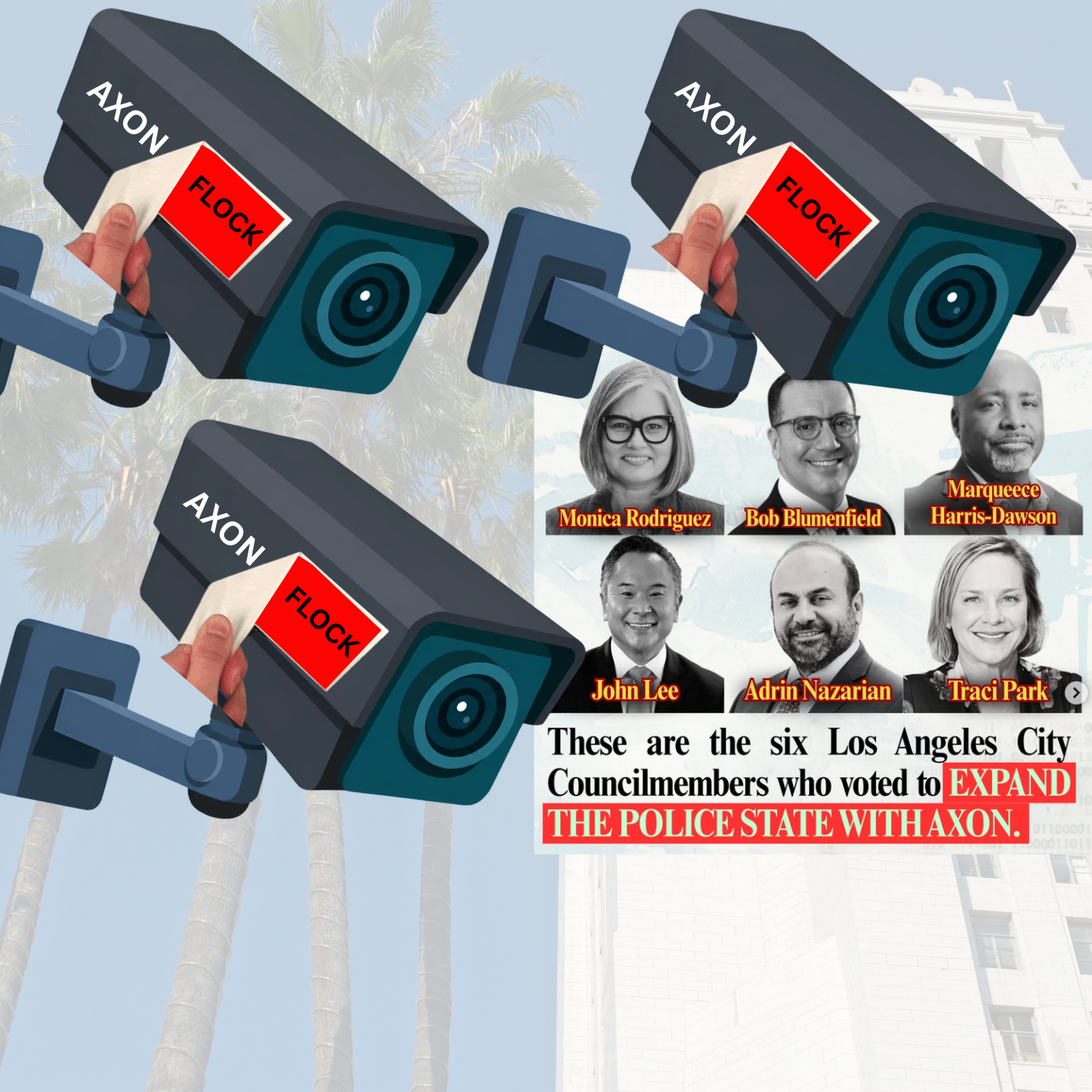
Nine members of the LA City Council voted Tuesday to block LAPD from rolling out yet another network of surveillance cameras across the city. Only six voted to let the program proceed. But despite this clear Council majority and mounting opposition to mass surveillance in LA and communities across the country, the cameras are moving forward anyway. That’s because the city’s unelected Police Commission already approved the deal, and under the City Charter, overturning a commission decision requires a two-thirds majority of the 15-member Council, or ten votes. The nine councilmembers who voted to stop the program fell just one vote short. So the Police Commission’s decision stands, thanks to the six councilmembers who refused to overturn it, including CD11 Councilmember Traci Park.
The vote raises serious questions that go well beyond this particular contract. Why is LAPD replacing one controversial surveillance company with another? Why is the city moving forward with more cameras when its own watchdog identified significant problems with the ones it already uses? And how did an unelected commission manage to approve a program that a majority of the City Council wants to stop?
Swapping Flock for Axon is a bait and switch happening nationwide
This decision to swap Flock for Axon is part of a bait and switch happening all over the country. Flock Safety has become notorious nationwide for its massive license plate reader network and revelations that ICE agents are accessing its data. Police have also abused the system in countless ways, from stalking former partners and their children to entering nonsense justifications for searches, tracking down a woman in connection with an alleged abortion, and monitoring political protests. In some cases, officers have continued accessing the surveillance network years after leaving their police jobs. With so many reports of abuse, Los Angeles has joined communities across the country in pushing back, and LAPD finally ended its relationship with Flock this summer. But rather than reconsider the surveillance system itself, LAPD is moving forward with Axon, a policing giant with its own close ties to ICE, while leaving open the possibility of resuming its relationship with Flock if new data-sharing safeguards can be negotiated.
This is becoming a national trend. Denver has already replaced Flock with Axon, and Douglas County, Durango, Colorado, and Sun Prairie, Wisconsin, have pursued similar transitions. Boston discontinued its Flock trial and is testing Axon’s license plate readers. Axon is openly capitalizing on the backlash against Flock, with its CEO telling investors that a significant number of police agencies were looking to switch to its technology. The problem is that changing vendors doesn’t eliminate the underlying dangers of mass surveillance. Flock is taking the heat, while companies like Axon are stepping in to preserve and likely expand the same surveillance infrastructure communities have been fighting against.
And the relationship between these companies is not simply that of competitors. Axon held a financial interest in Flock Safety, reporting $14.5 million in proceeds from its strategic investment in Flock in 2021. Even if Axon retains no ownership stake today, it shows how interconnected the police surveillance industry has become. Companies competing for government contracts tend to invest in one another, even as public pressure pushes departments to flip the switch to another vendor.
Axon is hardly a newcomer to LAPD. The relationship stretches back decades, beginning with the department’s early taser trials in South Los Angeles in 1980, using technology developed by Jack Cover, who later helped launch the company that became Axon. Over the years, the relationship expanded to include tasers, body cameras, in-car recording systems, and other police technology. In January 2014, LAPD began testing body cameras in Skid Row, including on officers assigned to the Safer Cities Initiative, the department’s aggressive policing program targeting unhoused residents. The department subsequently selected Axon’s cameras for broader deployment. Some of the communities subjected to LAPD’s most intensive policing were also among the first subjected to its new surveillance technologies.
In fact, Axon is pursuing a much bigger deal with LAPD. In September, the Police Commission approved a separate ten-year, $235 million contract covering body cameras, Tasers, cloud storage, license plate readers for more than 1,600 police vehicles, and AI software that can generate draft police reports from body-camera recordings. Axon’s business model increasingly involves integrating these technologies into interconnected policing systems, raising concerns not only about the amount of information police can collect, but also about how easily it can be combined, searched, and analyzed. LAPD also already uses Axon’s Fusus platform, which integrates information from surveillance cameras, body cameras, and other sources into centralized monitoring systems. That larger agreement still needs City Council approval. But the smaller streetlight-camera pilot didn’t. Once the Police Commission signed off, it could move forward unless the Council stepped in to stop it.
LAPD has already demonstrated that it cannot be trusted with these surveillance systems. In July, the department’s own Inspector General identified serious problems with its license plate reader agreements, data retention, access controls, and auditing, and recommended suspending new deployments and contracts until those problems were addressed. LAPD hadn’t conducted a comprehensive audit of its license plate reader use in years. Yet just two months later, the Police Commission approved the Axon pilot anyway, apparently satisfied with the department’s assurances that its new policies would prevent the problems that plagued the old system.
At Tuesday’s hearing, LAPD officials offered a familiar set of promises. They said the new system would have stronger protections, including shorter data retention periods, additional training, and restrictions on sharing information outside the department. Searchable records would be kept for 90 days instead of two years, and access would be limited to approximately 4,000 officers. Four thousand officers. That’s what LAPD considers restricted access to a database recording people’s movements through the city. And while the department insisted that federal and out-of-state sharing would be prohibited, it also described arrangements for sharing information with numerous California law enforcement agencies. Opponents wanted to know why anyone should take the department’s word for it before an independent audit had established whether existing safeguards were actually working.
Harris-Dawson helped bring the challenge, then sided with LAPD
Councilmember Hugo Soto-Martínez tried to pump the brakes on the program. He and Council President Marqueece Harris-Dawson introduced a motion to review the Police Commission’s decision under Section 245 of the City Charter, which allows the Council to intervene in certain commission actions. Then on October 20, the Public Safety Committee voted 3–2 to recommend blocking the pilot, with Soto-Martínez, Nithya Raman, and Curren Price supporting the veto, and Park and John Lee opposing it. Soto-Martínez wanted an independent audit of LAPD’s license plate reader practices and stronger protections before the department installed more cameras. But Harris-Dawson ultimately voted against the veto, helping defeat the very effort he helped bring before Council.
This is not the first time Harris-Dawson’s stated concerns about police brutality or accountability have failed to translate into support for reform. In June, he initially voted to advance a charter amendment that would have given elected officials more control over LAPD policy and strengthened the Inspector General’s independence. But after the police union threatened to sue, Harris-Dawson quickly backtracked, voting to pull the measure from the November ballot before Angelenos could decide for themselves. And during last December’s fight over LAPD hiring more officers than the city budget authorized, Harris-Dawson acknowledged how reliably the Council funds the department, declaring, “This council, given a majority, will fund the police department . . . so we should just expect that.” His record underscores a recurring tension in City Hall, where officials publicly recognize problems with police power and oversight, but when faced with decisions that would actually constrain the department, they choose to preserve its authority instead.
At Tuesday’s meeting, Blumenfield argued that his constituents wanted the technology and that the three-month trial would allow the city to evaluate it before making a longer-term commitment. Lee suggested that an audit could be conducted after the pilot. Park, meanwhile, defended the cameras by emphasizing that they don’t use facial recognition, record audio, or identify drivers and passengers, and pointed to LAPD’s staffing shortages as a reason to embrace new technology. But none of those arguments answered the central question: Why should LAPD get to expand its surveillance powers before proving that it can be trusted with the powers it already has?
Ultimately, the Council voted 9–6 to overturn the Police Commission’s approval. But under Section 245, a veto requires ten votes, not a simple majority. The six councilmembers who voted against blocking the program were Park, Lee, Blumenfield, Monica Rodriguez, Adrin Nazarian, and Harris-Dawson. Their votes allowed the commission’s decision to stand.
Axon’s ties to ICE
For immigrant communities, the stakes are crystal clear. Federal immigration agents are already terrorizing families across Los Angeles, and surveillance databases can make it easier to identify, locate, and track people. During public comment, Diana Escamilla of the Central American Resource Center, or CARECEN, connected the proposed expansion to the fear and disruption caused by immigration raids. Arielle Bernstein of the Los Angeles Alliance for a New Economy (LAANE) warned that promises and written policies do not eliminate the risk of data breaches, misuse, or future changes in who can access the information. Julian, a CD11 resident and music educator whose grandfather survived the incarceration of Japanese Americans during World War II, warned councilmembers about the dangers of allowing the government to build tools that can be used to target entire communities. Another CD11 resident, Alice, condemned the erosion of privacy and democratic accountability.
And then there’s the question of who LAPD is doing business with. According to research by the American Friends Service Committee, Immigration and Customs Enforcement and Customs and Border Protection awarded Axon more than $96 million in contracts between 2003 and September 2024, including for Tasers, body cameras, and related technology. That doesn’t mean Axon is handing LAPD’s license plate data over to ICE. But it does mean that the company selling LA its new surveillance equipment has made tens of millions of dollars supplying the same federal agencies carrying out the immigration crackdown. That relationship should be disqualifying, particularly when the city’s residents are being asked to trust that their information will remain protected.
The Police Commission’s history of failed oversight
This brings us to the Police Commission itself, the supposedly independent civilian oversight body that approved this deal in the first place. How is it that five unelected, part-time commissioners managed to push through a surveillance program that a majority of the City Council wanted to stop? To answer that question, we need to look at the commission’s history.
The Police Commission is supposed to be the civilian check on LAPD’s enormous power. Its five members are appointed by the mayor and confirmed by City Council. They set policy, oversee the department, and review serious uses of force. But they serve part-time, without pay, and depend heavily on information supplied by the department they’re supposed to oversee. The police chief still controls individual officer discipline. And while the commission is often described as independent, its members are selected through a political appointment process rather than elected by the public.
After LAPD officers brutally beat Rodney King in 1991, the independent Christopher Commission investigated the department and found a culture in which excessive force and misconduct were allowed to flourish. It produced a damning assessment of civilian oversight and determined that the Police Commission’s authority over LAPD was largely illusory. Reforms followed, with the commission given stronger powers, and an Inspector General was established to provide independent scrutiny. Angelenos were promised that things would be different.
Then came the Rampart scandal. In the late 1990s, revelations of widespread corruption and misconduct within LAPD’s Rampart Division exposed that the department’s accountability systems were still failing badly. The Rampart Independent Review Panel found that civilian oversight was being undermined by political interference and LAPD was not cooperating with investigators. This was yet another scandal, another investigation, and another round of promises to fix the system. The department eventually came under a federal consent decree requiring broader reforms.
More than thirty years after Rodney King, we’re still having the same conversation. A June 2026 LA Times investigation noted that the Police Commission was struggling to get answers from LAPD and failing to challenge the department over major controversies including racist traffic stops and its response to immigration protests. Commissioners have come and gone, meetings have been canceled because the board couldn’t muster a quorum, and the unpaid, part-time body continues trying to oversee a massive police department with a multibillion-dollar budget.
But the commission’s history isn’t just one of failing to restrain LAPD. At times, its leadership has actively helped the department expand its reach. In 2013, then-Police Commission President Steve Soboroff made body cameras a priority and raised more than $1 million from private donors, including prominent entertainment figures and local businesses, to help launch the program. The cameras were promoted as a way to improve transparency and accountability, but Soboroff also emphasized their potential to reduce litigation costs and protect officers from complaints. In a 2015 interview, he argued that cameras would change behavior on both sides of police encounters. He added that, from his perspective, behavior needed to change more on the civilian side – a damning statement from the official supposedly responsible for holding police accountable.
Who holds the Police Commission accountable?
Soto-Martínez questioned whether five part-time appointees can realistically provide meaningful oversight of LAPD. It’s a fair question, especially when the commission’s response to its own Inspector General’s warnings about license plate readers is to approve more license plate readers. Those defending the commission argue that keeping police oversight separate from elected officials insulates it from political interference. And there is a legitimate history behind that concern. In 1995, the City Council used its authority to overturn a Police Commission reprimand of then-Chief Willie Williams, who was accused of lying to commissioners about accepting free accommodations at a Las Vegas casino. City Councilmembers anxious to end the politically divisive controversy and avoid a potential lawsuit voted 12–1 to reverse the discipline without even reviewing the commission’s investigative file. Two commissioners resigned in protest, arguing that City Council was undermining their authority to hold LAPD leadership accountable. It’s a revealing example of how the same Charter powers now being invoked to limit police surveillance have historically been used to protect police leadership from oversight.
The Axon vote is another example of how this system fails to deliver accountability. LAPD’s own watchdog raised serious concerns about its surveillance practices. Community organizations demanded an independent review before the department expanded those practices. A majority of the City Council agreed. Yet the Police Commission’s approval stood anyway, not because most elected representatives supported it, but because the Charter required a supermajority to intervene.
Councilmember Eunisses Hernandez made the stakes clear. She challenged the hypocrisy of city officials who speak out against federal authoritarianism while approving the local surveillance infrastructure that fuels repression. “Fascism is built through a thousand seemingly ordinary government decisions that, taken together, give the state more and more power over people’s lives,” she warned. “Authoritarian governments don’t have to build these systems from scratch if we are willing to build them first.” Hernandez pointed out that her colleagues had repeatedly condemned ICE raids and expressed solidarity with immigrant families, yet were now willing to expand surveillance systems that could put those same families’ lives at risk. “If we spend all day talking about resistance while quietly building the infrastructure that makes authoritarianism possible, then what exactly are we resisting?”
Axon’s Ties to Israel’s Surveillance Industry
Axon’s surveillance empire also has ties to Israel’s military and intelligence establishment. In February 2026, Axon completed a $625 million acquisition of Carbyne, an Israeli emergency-response technology company founded as Reporty Homeland Security. Carbyne’s technology allows emergency dispatchers to collect live video, precise location information, and other data from callers, and integrates that information with police surveillance systems.
Carbyne’s early investors included former Israeli Prime Minister and Defense Minister Ehud Barak and Pinhas Buchris, a former commander of Unit 8200, the Israeli military’s signals intelligence unit. The company also received financing from convicted sex offender Jeffrey Epstein, who invested $1 million in 2015 through an investment partnership established by Barak. According to a February 2026 Forbes investigation, newly released Justice Department correspondence revealed details of the arrangement, which gave Epstein a financial interest in a company developing technology for law enforcement agencies. Carbyne has said Epstein’s estate no longer held shares when Axon acquired the company.
The company’s connections to Israel’s defense industry extended beyond its investors. In 2021, Carbyne partnered with the state-owned defense contractor Israel Aerospace Industries to develop emergency communications technology that could establish cellular networks and locate mobile devices. Former Israeli military and intelligence personnel have also been involved in the company’s leadership and development. At the time of Axon’s acquisition, Carbyne maintained a research and development operation in Israel.
These connections are especially relevant because Axon was already integrating Carbyne’s technology into its broader police surveillance infrastructure before the acquisition. In 2024, Carbyne announced an integration with Axon’s Fusus platform, which brings together feeds from public and private cameras, sensors, and other sources into a centralized system accessible to law enforcement. Carbyne’s emergency-call data can now also flow into Axon Evidence, the company’s digital evidence management platform.
Carbyne is not Axon’s only connections to Israel’s surveillance industry. In 2021, Axon invested $90 million in Cellebrite, an Israeli digital forensics company whose technology is used to extract and analyze information from phones and other electronic devices. That same year, Axon and Cellebrite announced a partnership integrating Cellebrite’s Pathfinder investigative analysis software with Axon Evidence. This allows investigators to transfer digital evidence and metadata between the systems. This expands the range of information that can be amassed within Axon’s policing infrastructure.
Axon has also pursued business with Israeli law enforcement agencies. Israeli police tested Axon body cameras in a 2016 pilot program, and in 2020 the company hired Zvika Birman as its Israel country manager to expand sales to Israeli agencies. Birman previously oversaw cybersecurity sales and support involving Israel’s Ministry of Defense and IDF.
There is no concrete evidence that Israeli intelligence agencies have access to LAPD surveillance data. But Axon’s acquisitions, investments, partnerships, and efforts to expand sales to Israeli authorities raise troubling questions about its deepening ties to the military and surveillance apparatus of a state committing genocide in Gaza.
Traci Park’s record of expanding police surveillance
CD11 Councilmember Traci Park has consistently sided with expanding police authority, and Tuesday was no exception. In December 2024, she announced plans for 100 new license plate reader cameras across CD11 and directed $450,000 in district funds toward the program. According to a recently filed lawsuit, the Los Angeles Bureau of Street Lighting indicated that Park had sought “preferential attention” to “rush” approval and installation of the cameras. She has also pushed to expand LAPD’s Real-Time Crime Centers which bring together camera feeds, license plate data, and other surveillance tools into centralized monitoring hubs. And when the Mar Vista Community Council considered a motion opposing Flock cameras and calling for their removal earlier this year, Park’s office sent a letter urging the council to reject it. The motion passed anyway, following overwhelming public opposition.
Park’s support for Flock extended beyond funding and lobbying neighborhood representatives. According to the Stop LAPD Spying Coalition, more than 60 members of the public testified at a July 2026 Police Commission hearing, nearly all calling for the city to cut ties with Flock. Park was one of the few speakers defending the company and the only city official to offer public comment.
Now Park is facing a lawsuit over her office’s refusal to disclose information about the surveillance technology she champions. On Monday, October 26, the Stop LAPD Spying Coalition filed suit against the City of Los Angeles, alleging that Park’s office failed to comply with a California Public Records Act request seeking communications with and about Flock Safety. The request, submitted June 16, sought communications involving specific city agencies, representatives of Flock, and the Los Angeles Police Foundation, a private organization that the coalition says has donated Flock cameras to LAPD. According to the coalition’s verified petition, Park’s office had produced no records in response. The coalition is asking the court to order the city to produce the requested documents promptly and to award attorney fees and costs. The coalition is seeking to uncover Park’s role in financing and promoting Flock cameras, including her allocation of more than $450,000 in district discretionary funds toward installing at least 100 cameras and her efforts to discourage the Mar Vista Community Council from opposing the technology. While Park continues to defend the expansion of police surveillance, community advocates are now having to go to court to obtain records about her office’s involvement in bringing that surveillance to their neighborhoods.
Defending the cameras at Tuesday’s hearing, Park called them an “extremely effective tool” and dismissed concerns about surveillance abuses as “persistent misinformation,” insisting LAPD already had rules in place to prevent abuse. But two CD11 residents who testified that day challenged Park’s dismissive attitude toward mass surveillance. Julian, whose grandfather survived the incarceration of Japanese Americans during World War II, warned, “I cannot help but see history repeat itself.” Alice urged councilmembers to reject the expansion, declaring, “You have an opportunity in this moment to unplug this monster.” A majority of Park’s Council colleagues voted to block the program, but she voted to let it proceed.
The three-month Axon pilot can now move forward, and the much larger $235 million contract remains under consideration. The public is being asked, once again, to trust LAPD now and ask questions later. And the people who will bear the greatest risks when that trust is broken are the same communities that have been warning the city about those risks all along.