
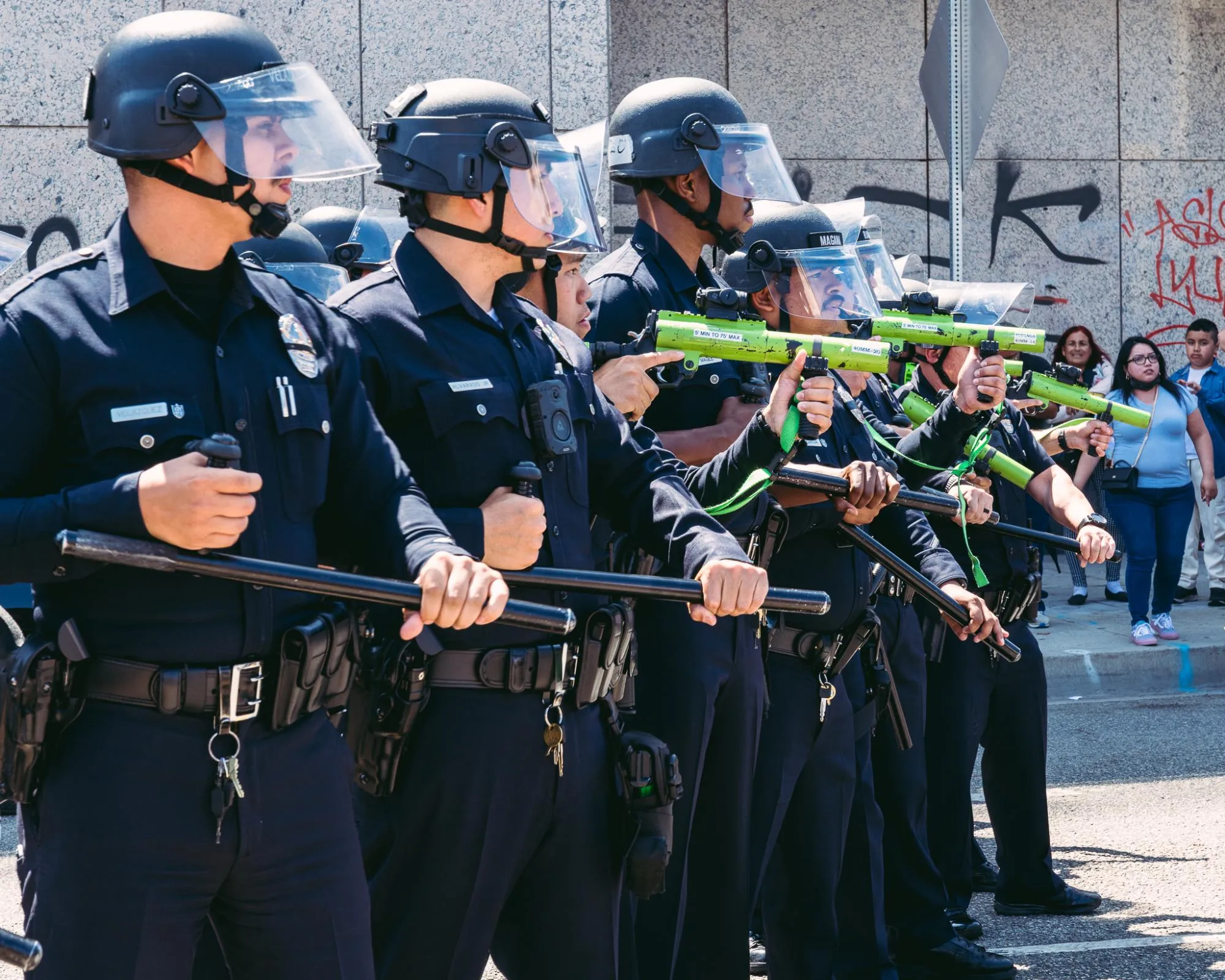
LA City Council voted Tuesday to remove one of the most significant police accountability measures from this year’s charter reform package, pulling it from the November ballot after the Los Angeles Police Protective League threatened legal action.
The vote preserves a system in which the City Council is expected to devote roughly 40 percent of Los Angeles’ General Fund, and nearly half of its discretionary spending, to the LAPD while exercising remarkably limited authority over many of the policies that govern the department. When police misconduct results in lawsuits, it is that same General Fund that pays hundreds of millions of dollars in settlements and judgments, leaving less money for affordable housing, homelessness prevention, libraries, parks, recreation centers, street repairs, and other neighborhood services.
The charter amendment sought to narrow that gap. It would have shifted significant policymaking authority over LAPD from the Board of Police Commissioners to the City Council, giving elected officials more authority over the city’s most powerful department while preserving the Police Commission’s oversight role and the Chief of Police’s authority over discipline, criminal investigations, and tactical operations. The measure also would have strengthened the Office of the Inspector General by preventing the Police Commission from blocking audits and investigations. Supporters argued the proposal would simply allow voters to decide whether the Council should have clearer authority to establish department-wide police policy. “I hope this is something we can put on the November ballot,” Councilmember Hugo Soto-Martínez said before the vote, “so that the residents of the city can have a say whether they want to grant and clarify that this Council indeed has the power to set police policy.”
Two weeks ago, the proposal appeared headed to the November ballot. On June 17, the Council voted 10-5 to advance the measure and directed the City Attorney to prepare ballot language. The following day, the Los Angeles Police Protective League threatened legal action, and councilmembers suddenly reversed course, voting 8-6 to send the measure back to committee, removing it from the November ballot.
LAPPL’s formal demand letter argues that state labor law required the city to negotiate with the union before placing the measure before voters. The union warned that if the proposal proceeded, it would file an unfair labor practice charge and seek a temporary restraining order preventing it from appearing on the ballot. Supporters disputed that interpretation, pointing to the City Attorney’s analysis and arguing the proposal did not trigger a mandatory meet-and-confer process.
LAPPL argued the proposal would fundamentally change who governs the department by moving the Council “from veto power to a policy making power” and giving elected officials authority to adopt department-wide policies binding on LAPD. Because those policies could affect officers’ working conditions, overtime, discipline, and safety, the union argued the city was legally required to bargain before asking voters to approve the change.
The threat was enough. Before LAPPL filed suit, before any judge had an opportunity to evaluate the union’s claims, or any labor board ruled on whether the proposal violated state law, a majority of councilmembers voted to pull the measure from the ballot. Litigation is a regular part of governing, with cities routinely having to defend housing laws, labor agreements, environmental regulations, election rules, civil rights protections, tax measures, and countless other public policies in court. Major public policy decisions frequently carry litigation risk. Rather than allowing that process to unfold, however, the Council withdrew the proposal before Angelenos had the opportunity to vote on it. In this case, the prospect of litigation alone proved sufficient to halt one of the most significant police governance reforms in the city’s charter package.
The vote revealed three distinct political coalitions. Traci Park, John Lee, Tim McOsker, Adrin Nazarian, and Monica Rodriguez opposed expanding democratic oversight of LAPD from the outset and voted to send the proposal back to committee. Bob Blumenfield, Marqueece Harris-Dawson, and Heather Hutt voted on June 17 to place the measure before voters, then reversed course after LAPPL threatened litigation. Eunisses Hernandez, Hugo Soto-Martínez, Ysabel Jurado, Imelda Padilla, Nithya Raman, and Katy Yaroslavsky voted both times to keep the proposal on the ballot, arguing that Angelenos, not City Hall, should decide whether elected officials deserve a greater voice in setting police policy.
City Controller Kenneth Mejia said the vote reflected a broader pattern he has observed during nearly four years at City Hall.
“I’ve been here for nearly four years in City Hall, and there really is no accountability for the police,” Mejia said after Tuesday’s vote. “Even the slightest, tiniest reforms, it’s always fought.”
Before the vote, Councilmember Eunisses Hernandez argued that the proposal would not interfere with day-to-day police operations but would simply give elected officials “a little bit of a voice at the table” on department-wide policy. “No one wants to create more opportunities for liabilities,” she said. “We don’t want to keep paying out lawsuits because of LAPD. Please give the voters the opportunity to give us a voice at the table when it comes to certain LAPD policies.”
Councilmember Hugo Soto-Martínez argued the decision represented a broader retreat from the charter reform process.
“Every significant charter reform was killed by this body,” Soto-Martínez said. “Expanding City Council, killed. Ranked choice voting, killed. LAPD reform, killed. Strengthening independent oversight and giving strength to our controller, killed.”
Tuesday’s vote was the latest in a steady narrowing of what began as Los Angeles’ most ambitious charter reform effort in decades. In recent weeks, proposals to expand the City Council, adopt ranked-choice voting, strengthen the independence of the Controller’s Office, broaden democratic participation, and increase civilian oversight have all been delayed, weakened, or removed before reaching the November ballot.