
The point isn’t to just criticize the current conditions from the sidelines, the point is to change them.
This article by Carter Moon originally appeared in his Substack, and is republished here with his permission.
For a certain set of millennial radicals, the question of, “Do you remember Occupy Wall Street?” is our version of asking our zoomer comrades, “Do you remember 9/11?” I was a senior in high school when the occupation of Zuccotti Park in New York City’s financial district gripped the headlines for 59 days. More than any other event in my lifetime, the continual protest and the nationwide movement that sprung up across the country in response to it started me on the path to developing the politics I have today. I could come home from school, log in to Facebook, and see videos of what was happening in the park firsthand. I had never heard of the concept of a general strike before, and I was electrified when an Occupy-inspired general strike in Oakland shut down the port for a day. I was devastated when the cops finally rolled in and crushed the Zuccotti encampment, and equally heartbroken when it felt as though the momentum the movement had started died off almost as quickly as it had begun. I found myself depressed and apolitical for years, convinced that if something like Occupy could crash and be forgotten, then there wasn’t much point in getting invested in trying to change things.
But looking back 15 years later, it’s clear that actually Occupy has had a robust legacy. The phrase “We are the 99%” has arguably infiltrated our politics more than ever before. Bernie Sanders would most likely have not been able to grab national attention if the conversation around obscene inequality hadn’t been started by Occupy. Prominent Occupiers formed the Debt Collective, one of the smartest and most nimble nationwide organizations undermining the logic of debt that keeps so many people perpetually trapped in cycles of inequality. In the long run, the spirit of Occupy has had tremendous influence, even if it lasted for less than 60 days and the average kid getting into left-wing politics today has no idea it happened.
Yet it’s undeniable that Occupy’s inability to translate its popular moment into a sustained, coherent movement was a major setback in realigning this country towards a world without economic coercion, ecological disaster, or militarism. There was a real need in the wake of Occupy to take an honest assessment of why the movement couldn’t sustain itself in the long term, and there was no better person to write a sober book analyzing precisely this than Johnathan Matthew Smucker. He helped to draft a lot of the press communications for the Zuccotti Park occupation and was heavily involved in Occupy for its duration. Before that, his radical bona fides can hardly be questioned; he had lived in a Catholic Worker house, traveled to Cuba, been arrested many times, and been involved in the infamous WTO/99 “Battle in Seattle.” In the time since Occupy, he’s gone on to pursue a PhD in Sociology with an emphasis on popular social movements.
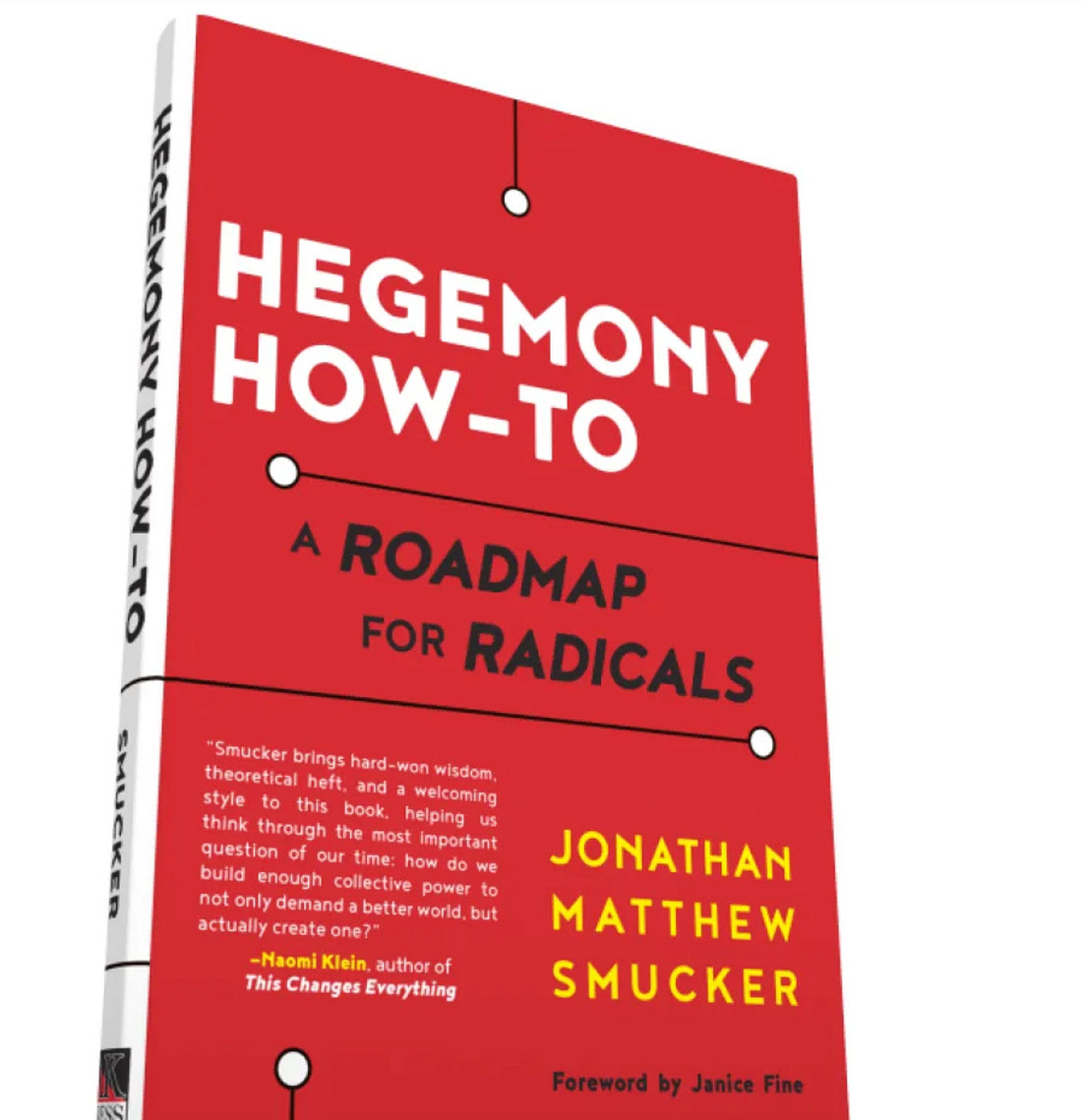
The resulting book, Hegemony How-To, isn’t simply a narrow critique of OWS. It’s a much deeper intervention in American left politics and an attempt to reckon with the left’s marginality and inability to shift core attitudes among the general population towards our way of explaining the world’s problems and the radical changes necessary to remedy them. Written in 2017, the book is a clarion call for the left to get serious about contesting for power and not simply critiquing it from the sidelines. Nine years out from the time of publication, it’s actually incredibly gratifying how much the hard-won wisdom Smucker shares seems to finally be coming to fruition, even if the political stakes are now higher than ever.
To begin from the most basic component of what Smucker is exploring, let’s define hegemony and why it’s important to contest. Put simply, hegemony can be understood as the dominant ideology or power structure shaping a society. Leftists often point to Margaret Thatcher’s assertion that “there is no alternative to capitalism” as the dawn of the hegemonic consensus that neoliberal capitalism was the only game in town as the Soviet Union collapsed and the Cold War ended. This hegemony has felt totalizing for over 30 years, thanks in particular to the historical period we’ve lived through representing what Smucker calls “the tail end of a decades-long decline in bottom-up civic, labor, and progressive political infrastructure.” The terrain of politics, at its most base level, can be understood as the struggle to define the hegemonic conditions which translate into material power to shape our world.
“And somewhere along the way we seem to have lost faith in the possibility of really winning against these logics and systems in the world beyond our little clubhouse; the possibility of gaining ground again in the terrain of society.”
For most of my lifetime, the American left has been deeply afraid of power and passively critical of hegemony without attempting to take control of it. As Smucker explains: “Somewhere along the way we seem to have lost faith in the possibility of really winning against these logics and systems in the world beyond our little clubhouse; the possibility of gaining ground again in the terrain of society.” DIY punk venues, Food Not Bombs and Catholic Worker Houses, small anti-imperialist organizations, these have been hubs of radical politics for my lifetime, and oftentimes they’ve taken pride in their insularity and marginality. Smucker asks a hard question that I think the left has needed to ask itself for a long time: “How many times, I wondered, had I favored a particular action or tactic because I really thought it was likely to change a decision-maker’s position or win over key allies, as opposed to gravitating toward an action because it expressed my activist identity and self-conception?”
Smucker uses this question to interrogate the efficacy of prefigurative politics, a defining feature of Occupy Wall Street. Prefigurative politics comes from anarchist philosophy and asserts that the best way to transform the world is to build models of the alternative world you’d like to live in instead. Occupy ran community libraries and kitchens modeling a society not based on transactions and exploitation. It also emphasized a “direct democracy” model of consensus decision-making where everyone participating in the project was officially allowed to participate in any meeting and there were no formal leaders making executive decisions on behalf of the group. Smucker explains how this played out in practicality: “Because they were so cumbersome and easily derailed, many of the most active Occupy Wall Street organizers, myself included, eventually stopped attending with much frequency. We were too busy attending to tasks to be able to sit through hours upon hours of exasperating do-nothing meetings.”
Smucker calls this kind of culture “the life of the group,” and while he emphasizes that it’s important for groups to have shared rituals and practices, it’s also essential to remember that these practices are not a substitute for engaging in the work of transforming hegemonic consensus. A feeling of creating utopianism isn’t the same thing as making it materialize in the wider world. The American left has really bristled at the concept of structured organization and leadership processes, I believe to all of our detriment. A romantic and vague anarchism pervaded heavily over our left culture for the last few decades, a sense that all forms of political structure and organization are inherently replicating the power dynamics that we want to destroy and therefore have to be rigorously avoided at all costs. A Minnesota organizer named Zede rejected this notion very effectively in a recent Substack essay, writing:
“So when someone says that structure is inherently a tool of oppression, the question is: Which structure? The structure Fannie Lou Hamer built was not the same structure as the plantation system she was fighting. The Panthers’ organizational structure was not the same as the COINTELPRO operation that targeted them. Structure is a form. What matters is who it serves, who holds it, and who it protects.” – Zede
It’s fascinating to engage with Hegemony How-To almost a decade after it was published. We’ve seen the Black Lives Matter uprisings of 2020 have an even greater explosion of support, opening an opportunity for masses of Americans to radically reorient their political worldview. And again, we’ve watched as the promise of that movement has been steadily crushed, this time through a much more sustained, overt campaign of state repression and propaganda. The Stop Cop City movement engaged in multiple layers of resistance to a massive police training facility built in the forest outside of Atlanta and was similarly crushed by the political establishment. The student encampments led at universities around the nation in 2024 to demand divestment from Israel and an end to the genocide of the Palestinian people were violently defeated, oftentimes at the direct behest of President Biden. Under Trump’s second term, we’ve witnessed unbelievable bravery in the wake of ICE raids and migrant concentration camps, and we’ve all seen the brutality of the state in response to these protests.
The important thing to keep in perspective, even in the face of these movements being crushed, is how dramatically they’ve cumulatively helped to shift the hegemonic consensus. These types of mass mobilizations are also undeniably happening with more frequency and intensity than they were in the 2010s. Many left-wing positions that were fringe a decade ago, from universal healthcare to ending wars of aggression to taxing the ultra-wealthy, have undeniably become mainstream. Independent media like More Perfect Union and figures like Hasan Piker are reaching an audience at a scale that I don’t think anyone involved in Occupy would have ever thought possible. We can remain critical of electeds voted in via the DSA, but the fact that people with such politics are increasingly politically viable would have been unthinkable a decade ago. We are, in fact, shifting hegemony in this country, even if the crises we face get more dire by the hour. Allowing ourselves to wallow in private pools of despair is not only self-defeating, it also misses the objective reality that conditions are shifting under our feet.
If you’re someone who sees yourself as recently radicalized and you’re looking to understand the world of organizing, this book is a phenomenal resource. Smucker’s wisdom is both personal and deeply informed by engagement with sociology research and theorists like Antonio Gramsci. Even if you’re someone who’s been engaged in various forms of activism for a long time, the book is an incredibly helpful intervention to help you take stock of what has been effective and what hasn’t in your own efforts. The truth is, we need to be finding ways to fold regular people into change-making work wherever we can, in our workplaces, in our apartment buildings, and in our neighborhoods. We need to take sympathetic neighbors with imperfect ideology and shape community with them, even if it means tolerating some grating disagreements. And we need to take ownership of building out practical leadership capacity among each other, not because some people are inherently better than others, but because we need structures to see our vision through to reality.