
This article by Carter Moon originally appeared in his Substack, and is republished here with his permission.
On Tuesday, June 2nd California held a primary election for governor, with several major downballot primary elections also on the table. I was most personally invested in the city council race for LA’s 11th district, where I live. I have made it abundantly clear that I believe my councilmember, Traci Park, is a MAGA-aligned fascist. Her primary motivation for serving on the council is to criminalize homelessness and disappear poor people out of the district. In 2023, she facilitated the largest illegal mass eviction in 40 years at the direct behest of her landlord mega-donor, Douglas Emmett. She’s gotten max donations from dozens of MAGA donors; particularly notable is the $2,600 she’s gotten from Bill Simon, a trustee of the Heritage Foundation of Project 2025 infamy. Park’s voice was used in an ad by the White House where she can be heard thanking Trump. Traci is also heavily backed by the LAPD’s police union; they spent $700,000 supporting Park and another $200,000 opposing her opponent Faizah Malik. All told, Traci had a $3,970,189 war chest backing her for a single city council seat, the most ever spent in a city council race.

Her opponent, Faizah Malik, is a public interest attorney who focuses primarily on housing justice. I was a day one supporter of Faizah’s campaign against Traci; I helped facilitate the coalition that invited Faizah to run and challenge Traci in early 2025. This coalition was made up of a number of progressive organizations with a base of Westside members. We wanted to find a candidate that a broad coalition of progressives could agree on from the jump because we knew Traci would have enormous money backing her. By creating an alliance from the beginning, we were able to connect Faizah to the best resources for fundraising and campaign support that we could find. Despite the fact that Faizah just lost this race, I still firmly believe we made the right call to bring these groups into alignment to seriously challenge Traci as a formidable opponent. Faizah was able to amass a staggering coalition of endorsements and fundraise extremely competitively. Faizah’s platform was based on principles of solidarity and affordability, finding ways to give everyone a chance to flourish in this extremely divided and expensive enclave. Her campaign managed to knock a record-breaking 125,000 doors in six months, a massive achievement for a first-time candidate. Ultimately, however, Faizah still lost the race roughly 60/40 in favor of Traci.

The following is my personal analysis of why the race went the way that it did. I’m not writing this as the official stance of any of the organizations that endorsed Faizah or as an official representative of her campaign. I was simply a volunteer and up-close observer in this race and want to share my perspective. I’ll break down the unique makeup of the district and then go through the major obstacles that I think blocked Faizah from a path to victory. I’ll close with the things I think her campaign did exceptionally well and why I’m still ultimately optimistic about LA’s electoral landscape despite the brutal defeat in my own backyard.
The Landscape of Council District 11
CD11 is the wealthiest and whitest district out of LA’s 15 council districts. It includes the Palisades and Brentwood, two of the wealthiest neighborhoods in the country, and is home to billionaires like infamous land developer Rick Caruso, as well as celebrities and prominent political figures like Kamala Harris. To give you a sense of the area, the house where Nicole Simpson-Brown was murdered is a couple blocks from my grocery store. The district also encompasses two key parts of LA’s economic engine, LAX and Venice Beach, making it an epicenter of tourism dollars that flow through the city. Notably, Traci Park has vociferously opposed the $30/hour minimum wage increase for tourism workers, impacting thousands of LAX employees in her district.
CD11 used to be considerably more diverse, but decades of gentrification have radically reshaped the district. The Oakwood area in Venice was historically Black and Chicano; Venice played a significant role during the Chicano Moratorium of the late ‘60s and early ‘70s. Oaxacan and Tongva people have deep roots in the district. There’s historically been a Japanese community; while it’s dwindled, you can still feel its vibrancy on Sawtelle Boulevard. The steady displacement of these communities is a significant historical factor in Traci’s rise to power, as I’ll discuss later.
The district is a high-propensity, liberal voting district, with 76% turnout in the 2024 presidential election, and 76% of those votes going to Kamala Harris. There is a notable, vocal contingency of wealthy, MAGA-aligned donors, particularly in the Pacific Palisades, but the actual voting data reveals the district is solidly, albeit moderately, liberal. Analysis of the 2024 election results by Unrig LA per LA city council district revealed that CD11 supported LGBTQ rights, affordable housing, and a minimum wage increase when they were on the ballot, putting the voters at odds with many of Traci Park’s stances. However, Prop 33, which would have strengthened local government’s ability to impose rent controls, was resoundingly rejected.
Despite the intense concentration of wealth in the area, CD11 is still ultimately majority renter; we make up 57% of the district. While the median income in the district is $134,221, the inequality between renters and homeowners is stark. Rent in the district is extremely unaffordable; 44.3% of renters spend more than 30% of their income on rent, and 23.6% spend more than 50% of their income on rent. I’ll explore the thorny issue of tenants as a voting block later in this piece.
Homelessness is a persistent and volatile problem in the district, particularly around Venice Beach. While Traci Park has touted her success in using violent encampment sweeps and the destruction of RVs to reduce visible homelessness, a comprehensive study by RAND found that this has mostly just resulted in people sleeping on the streets without any shelter, or simply being pushed to neighboring city council districts without being placed in housing. Traci first rode into office on promises of getting tough on solving homelessness, and the disappearance of visible homelessness clearly helped her secure her victory in this re-election, but it remains to be seen what the long-term effects of displacing people without providing meaningful forms of shelter will have on the district during her second term. Traci has also devoted millions of dollars in taxpayer money to fighting the Venice Dell housing development, which would provide 120 units of low-income and supportive housing, particularly targeted at people experiencing chronic homelessness in the area. That project recently won a significant legal victory against Traci; how it plays out in her second term will say a lot about the direction of homelessness policy in the district.
Now let’s transition to some unique factors of this election that I believe shaped the outcome.
The Palisades Fire of 2025
Everyone on the Westside knows someone who lost their home in the horrific tornado of fire that engulfed LA on January 7th, 2025. The fire killed 12 people and destroyed 6,837 structures, making it the most destructive climate disaster in LA history. With so many people suddenly displaced, landlords went on a spree of price gouging their rental properties, taking advantage of victims of climate catastrophe. In the months leading up to the fires, 1,600 families had had their home insurance policies canceled due to the increased threat of climate disaster. It’s difficult to know when and if rebuilding can even be done safely; the soil is likely heavily toxic and FEMA, under the Trump administration, has refused to conduct serious testing. Across LA county, an estimated 35,000 jobs held by low-income immigrants have been lost due to the fires. Suffice it to say, the rebuilding process is going to be a painful, uneven experience that will likely take a generation or more to complete.
Understandably, anger and distrust in the LA government has been at a boiling point for displaced Palisades residents. Mayor Bass made the absolutely baffling decision to get on a plane to visit Ghana during the fires, despite being warned how dangerous the wind forecasts were. She became the permanent enemy of Palisades residents in the immediate aftermath of the fires, especially after the LA Times uncovered evidence of Bass watering down the after-action report to reduce the city’s liability. LAFD Fire Chief Kristin Crowley was fired over her supposed mishandling of the emergency; she’s been particularly criticized for not fully extinguishing a fire that started on January 1st, which most likely re-ignited on January 7th and developed into the Palisades fire.
Interestingly, Traci Park was able to spin herself as the “savior” of the Palisades, despite the fact that she admitted in an interview that her office was not communicating with LAFD to coordinate pre-deployment in the days leading up to the fire. Former Assistant Chief of LAFD Patrick Butler testified to Congress that proper pre-deployment would have likely prevented the extent of the destruction in the Palisades. Still, Traci made a grand show of being outraged on behalf of her constituents at the failures in planning and prevention that lead to so much destruction, ultimately culminating in her being a featured speaker at the “They Let Us Burn” rally on the anniversary of the fires. At the rally, she exclaimed that: “It wasn’t an act of nature. It wasn’t some ‘storm of the century.’ And it wasn’t climate change, and don’t let anybody try to tell you otherwise.” Traci Park, it should be noted, received $89,000 in campaign donations from Chevron in 2022.
They Let Us Burn featured another speaker you might have heard of: Spencer Pratt. Conspiracy theories abounded after the fires; they were being set by homeless people being paid by the Democrats to create chaos, Democrats intentionally let the reservoirs in the Palisades run dry to protect an endangered fish, you get the idea. Anything to displace blame from the burning of fossil fuels and the effects of man-made climate change. Add to the stew a constant stream of fear-mongering and hate on NextDoor and X, and you’ve got a potent recipe for reactionary backlash.

The Mayoral Clusterfuck
In March 2026, a UC Berkeley poll revealed that 56% of voters had an unfavorable view of Mayor Bass. The reasons for this are diffuse, but the fallout from the Palisades fire is undeniably the biggest factor. Reality TV bottom feeder and sister abuser Spencer Pratt became the vessel for all of the wealthy Palisadians’ outrage that the climate crisis had come for them. Pratt’s house burned down in the fires, and his launch video began with him claiming he was living out of an Airstream trailer. (It was eventually revealed he was staying at the Bel-Air Hotel for $1,500 a night.) He pumped out racist AI slop attacking his opponents and depicted LA as a drug-ridden crime den (we are currently experiencing the lowest homicide rate in generations). He went on Fox and Joe Rogan. He got the Trump endorsement. He threatened to ship all homeless people to Seattle. He blamed anyone and everyone in the LA and California political establishment for his personal pain, and it clearly resonated with a lot of people. Despite being a clown and cravenly self-serving, he’s currently sitting at 216,122 votes and came in third place. Roughly 50% of the Palisades and 34.7% of CD11 as a whole voted for Pratt.
It appears that Pratt being in the race as a lightning rod for anguished Palisades voters gave Traci a major advantage in the race. As of June 9th, there were 82,252 votes counted in the city council race for 2026, compared to 66,171 in the previous June primary race in 2022. We can’t see how the votes shook out by precinct for the city council race, but this snapshot of the mayor’s race in the district shows how divided CD11 is between the top three mayoral candidates. It will be interesting to see in the coming weeks just how much support for Pratt directly correlated to strong support for Traci.

I’ve seen a lot of people performatively angry online that Pratt was even treated as a viable candidate, but I see his candidacy as an expression of grief and rage by climate disaster survivors. Anger isn’t a rational or fair emotion, but it’s incredibly potent when exploited by opportunists. I can understand if you personally don’t feel sympathy for Palisades residents, but it’s worth it to remember that a number of people from the area were middle class and had bought their homes decades before the area ballooned in value. They’re now left with no insurance and no viable path back to the place they’d called home. Some of these people may be more privileged than most, but they were legitimately failed by a government that hasn’t properly prepared for climate disasters for decades. If there’s a lesson for the broader American left to learn from this election, it’s that surviving a traumatic climate catastrophe dramatically changes people’s political priorities. Making sure people don’t succumb to charlatan conspiracy theories to explain their suffering takes consistent engagement and relationships, which definitely didn’t happen in this race.
Dark and Dirty Money
As emphasized at the beginning, an unprecedented amount of money poured into this race in support of Traci. I probably could’ve stacked all her mailers that clogged my mailbox floor-to-ceiling if I hadn’t immediately thrown them in the recycling. Some of those mailers were funded by an extremely sketchy “nonprofit” known as Better Neighbors. Mike Bonin wrote an incredibly thorough exposé of Better Neighbors, explaining that the organization is “part of a political machine built and controlled by a Republican law firm north of San Francisco.” This group does not have to disclose who its donors are because “they are careful never to use the precise legal language that would define them as campaign expenditures and trigger disclosure requirements.” They presented Traci Park as a positive force for the district without ever explicitly encouraging people to vote for her. Traci’s team constantly accused Faizah of being funded by “outside money” (i.e. personal donations from Faizah’s law school network), but Traci never had to account for this spending by a Bay Area right-wing dark money operation.
Traci is also undeniably a fundraising behemoth herself. Her personal raise of $1.4 million is eye-watering. It’s extremely telling, however, to look into who she attracted to max out donations. There is an absolute army of MAGA and corporate real estate donors heavily invested in Traci. Particularly notable donors include John Hering, an Elon Musk investor and MAGA America PAC mega-donor, and Carolyn and Daniel Jordan, corporate landlord attorneys and consistant Republican donors. A true “moderate Democrat” would not attract these types of donations. Douglas Emmett put $500,000 into Traci’s campaign in 2022 and received Traci’s support to carry out the illegal Ellis Act eviction of Barrington Plaza, making it clear that Traci is very open to the pay-to-play politics Citizens United has permitted.
Faizah aggressively fundraised herself, and the city’s matching funds program that grants 6:1 funding for donations from LA city residents definitely made her competitive in this race. LA’s most aggressive union, Unite Here Local 11, which represents hotel and service industry workers Traci has consistently voted against, also invested roughly $1 million supporting Faiazh and attacking Traci. But it’s also clear that until LA forces special interest and dark money out of our elections, people like Traci are going to continue to have a massive advantage.
The Tenant Problem
The only way Faizah was ever going to win this race was by gaining a supermajority of the renter vote in the district. Her campaign field staff aggressively targeted renters, knocking the doors of the most renter-heavy neighborhoods three times or more. Faizah’s record on renters’ rights is rock solid; through her work at Public Counsel she’s consistently helped to shape pro-tenant policy at City Hall. When I personally talked to renters on this campaign, it usually only took a minute to get them excited about supporting Faizah. The problem is that renters consistently vote in lower turnout than homeowners, and it appears that trend held in this primary. I think this is a much deeper problem in the district than simple apathy towards elections by working-class people.


This presentation by Judy Saunders of the Southern California Association of Non-Profit Housing demonstrated that apartments covered by the Rent Stabilization Ordinance are being heavily dismantled in CD11. These apartments are buildings built before 1978 and landlords can only increase rents determined by a specific formula every year. They are one of the only tools to keep rents relatively stable for tenants. Two of the top three neighborhoods losing the most RSO units are in CD11, Westchester and Sawtelle. This effectively means that lower-income tenants who have often lived in the district for a decade or more are given a payout and generally have to find housing outside of the district since market rates are so exorbitant here. It should also be noted that the loss of these rent-stabilized units disproportionately impacts the communities of color who made up this district in the past. These RSO units are disproportionately being replaced by market rate units, which are not subject to the same rent stabilization and can charge much, much higher rents year over year. As a result, you have a lot of young professionals living in the area who are often transplants with no deep ties to the district, transplants who often have to move out of CD11 themselves if they want to start a family or otherwise find more space.

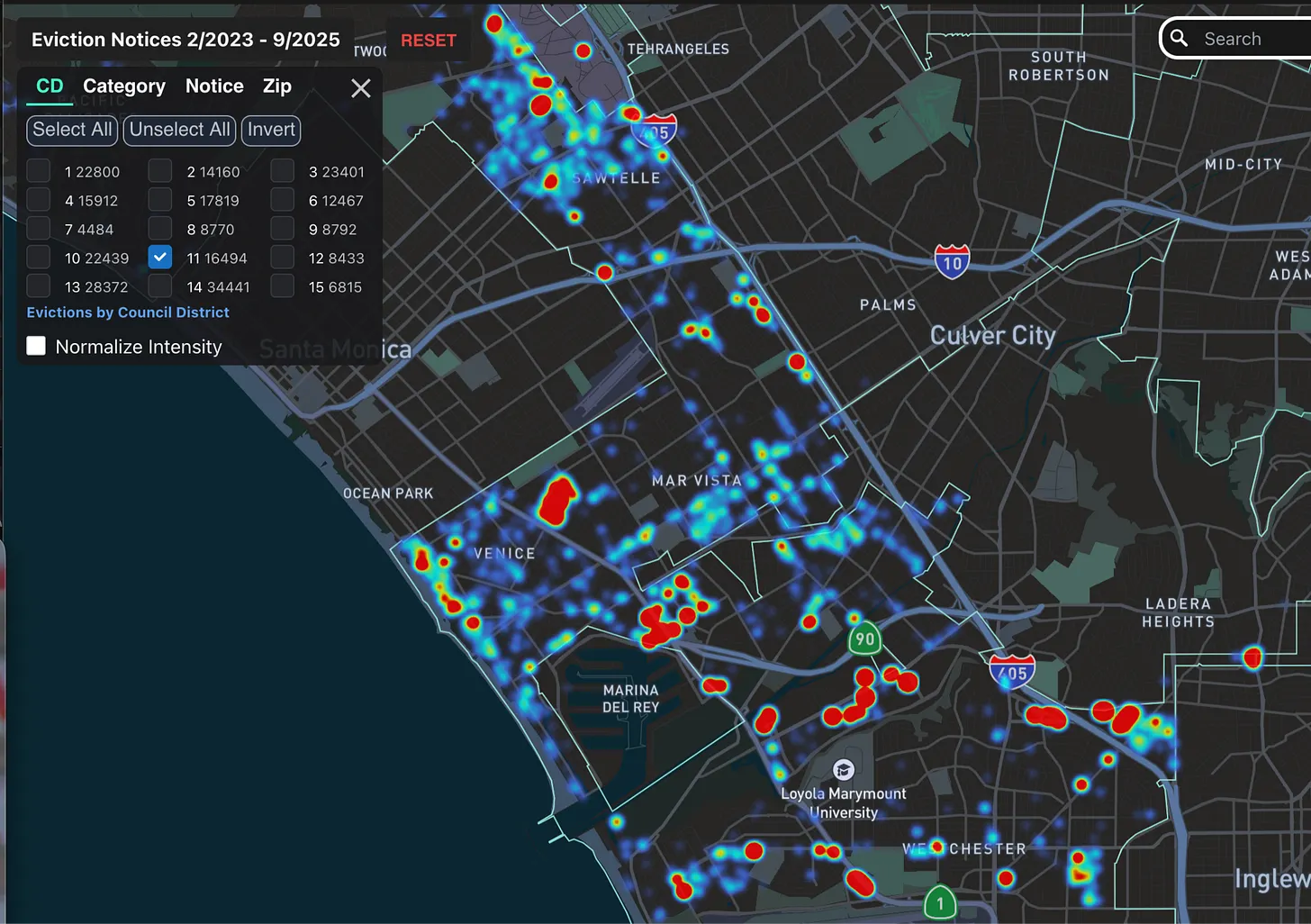
To look at it another way, the district saw a shocking 16,494 evictions between 2023 and 2025 as COVID-19 eviction protections expired. This level of displacement demonstrates that many lower-income communities were pushed out of the district during Traci’s first term, further solidifying her homeowner base and displacing working-class people who might otherwise have turned out to support Faizah.

The instability of the rental market in these renter-heavy neighborhoods creates conditions where people don’t see their class status as tenants as core to their political identity. As a result, you find tenants who are disconnected from paying attention to what their city council member is doing, and in turn Traci Park feels little pressure to care about the needs of tenants as a constituency in this district. My personal commitment during Traci’s second term will primarily be focused around building up tenant power in this district. The tenant movement is remarkably strong in other parts of LA, but it’s sorely behind on this side of town, despite the admirable efforts of the Westside LA Tenants Union and housing nonprofits like Venice Community Housing. Developing the class consciousness of tenants on this side of town will be essential for anyone trying to deny Traci Park a third term.
What Faizah Did Right
I’ve laid out what a David vs. Goliath battle Faizah was fighting. Faizah was running to become the first Muslim ever elected in LA. She’s a proud first-generation immigrant in a time when xenophobia is at a fever pitch. She carried herself with incredible poise and clarity; it was obvious watching her campaign that she genuinely loved connecting with voters and understanding their perspectives. She was an unequivocal champion for working families and a truly just and equitable city. The bravery of putting herself out there in a time of ascendant fascism is admirable in and of itself. Even the official propaganda rag for Traci Park, the Westside Current, had to admit that Faizah was “arguably the best DSA-backed candidate yet to run in any LA City Council race.”
Her campaign team truly worked their asses off in a way that was inspiring to watch. Her communications director Kendall Mayhew is someone who’s been deeply invested in the effort to get left-wing candidates into City Hall for a decade, and her expertise and insights dramatically elevated Faizah’s messaging. Alex Michel handled Faizah’s videos and did an excellent job making her a star on LA Instagram while explaining policy in ways that were consistently dynamic and engaging. Her fundraiser Jamie Feiler did a phenomenal job helping Faizah host innovative fundraisers and keep the donations coming in to compete with Traci’s money.
That money was then able to be spent paying canvassers who live on the Westside a livable wage to knock doors. This team of canvassers were highly motivated and committed to Faizah’s platform; they were the engine that led to Faizah’s campaign smashing records on doors knocked. Beyond the paid canvassers, Faizah’s platform brought in over 800 volunteers to participate in the campaign. These canvassing efforts did pay off; Faizah got 34,052 votes, more votes than the first place candidates received in CD1, CD3, CD9, or CD15. Had this been a normal primary not super-charged by the fires and Pratt, Faizah would have been highly competitive.
The coalition backing Faizah was also made up of heavy hitters. The initial coalition we brought together in 2025 included DSA LA, Ground Game LA, LA Forward, and Streets for All, all organizations that have had a massive impact on progressive politics in LA over the last decade. It wasn’t just these organizations that got behind Faizah; she leveraged her years of networking around City Hall and the broader LA political ecosystem to gain support from everyone from YIMBY urbanists, moderate Democratic clubs, the Sierra Club, and even Bernie Sanders. I am sure there will be some who say that Faizah collaborating with DSA LA was a net negative for her campaign in this moderate district, but DSA members knocked over 17,000 doors for Faizah and made up her most enthusiastic base of support. It’s also just undeniable that democratic socialism is no longer scary in a post-Mamdani world where polling suggests many Democrats now identify as democratic socialists and an LMU poll from this year suggested that 47% of Angelenos want a democratic socialist mayor. Advancing the project of building class consciousness, of politicizing working class people into fighting for a just world, is always worth doing, especially in a part of the city with such sharp contrasts between the haves and have nots.
If you want to read even more analysis of this campaign, long-time Venice activist Mike Bravo wrote a very thorough piece with more historical context.
The Good News
Even more encouraging is how well DSA-backed candidates did in the rest of the elections around the city. Particularly exciting to me is the commanding lead Marissa Roy had in the city attorney race. Roy ran on a bold platform of radically re-imagining the office as the largest public advocacy office in the country, using it to aggressively prosecute wage theft and criminal landlords. Similarly, Eunisses Hernandez, arguably the most effective and furthest-left member of the city council, beat a crowded field of challengers and won her primary outright with 58% of the vote. Better Neighbors spent aggressively to try to oust Eunisses and their money was wasted. There was similar aggressive spending to back City Hall insider Jose Ugarte to block DSA candidate Estuadro Mazariegos, and he still managed to come in second place and advance to the general election.
Even non-DSA endorsed candidates who are part of the broader progressive movement in the city overperformed. Kenneth Mejia, the independent city controller who’s become famous for transforming the office and using it to aggressively criticize the LAPD budget, easily obliterated his opponent with 63% of the vote. This, despite the fact that Zach Sokoloff’s mom spent $7.5 million trying to buy the controller’s seat for her son. (I’m not kidding.) I have a lot of criticisms of how Nithya Raman ran her campaign for mayor, but she did ultimately beat out Spencer Pratt and advanced to the run-off. I’m skeptical that her time as mayor would really see that much daylight from Bass’ tenure, but it is a very encouraging sign that voters in LA as a whole rejected a MAGA reality TV star outright. All told, it’s pretty clear that progressive candidates are extremely viable in the city of LA as a whole, which I think is a good indicator of trends happening in races all around the country in Democratic party politics.
Traci Park is a wretched piece of shit and Los Angeles as a whole is worse off with her serving a second term. However, one of her key allies in City Hall, City Attorney Hydee Feldstein-Soto, has been resoundingly knocked out of office after being plagued by constant scandals. Without Hydee, and hopefully with Raman in the mayor’s seat instead of Bass, I think Traci is going to find herself increasingly isolated. The trend toward progressive politics is clearly not going anywhere in this city, and Traci’s abrasive style won’t mesh well with the agendas of much of the rest of the council. There’s also a newly activated base of people in CD11 who adamantly hate Traci and what she represents; I hope they’ll continue to be a thorn in her side over the next four years.
Final Thoughts
I want to close out by saying that electoral politics shouldn’t be the furthest horizon for anyone. I’ve obviously devoted a lot of my personal time and energy to it over the last few years, but to truly build the society we need requires shifting the hegemonic balance of power in much more profound ways than simply winning individual elected offices. If you’re someone who volunteered for Faizah feeling heartbroken by this outcome, remember that our commitment to a better world was always deeper than just this election. We need to build a social base of people committed to fighting for a more just and sustainable world on a daily basis, not just during election cycles. I devote a lot of time and energy to municipal politics because it’s where the most immediate impacts on vulnerable people’s lives are felt, but it’s not the only avenue for changing things. As I mentioned, I’m personally going to be committing myself to tenant organizing over the next few years. I’d encourage everyone to check out the group Rent Brigade, who I’m very excited to get more involved with. I also have to emphasize the importance of supporting mutual aid as many overlapping crises continue to threaten our most vulnerable neighbors. Mar Vista Voice runs a vendor buyout program supporting street vendors targeted by ICE: They could always use your donations and volunteer time.