
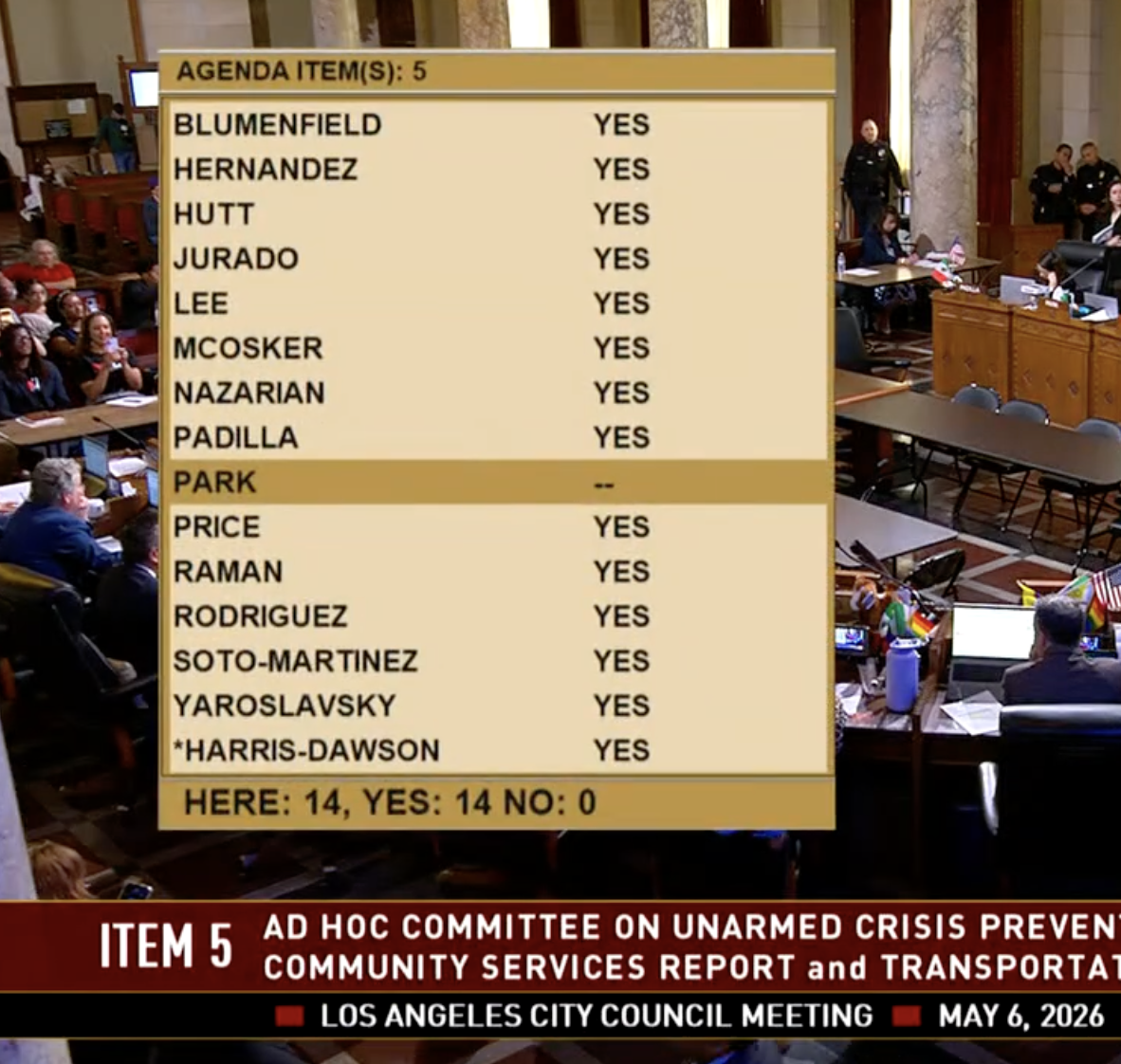
On Wednesday, LA City Council voted 14-0 to advance a sweeping set of recommendations aimed at limiting LAPD pretextual traffic stops, marking the culmination of nearly five years of organizing, testimony, research, and political pressure around one of the city’s most controversial policing practices.
The vote was historic in one sense. For the first time, City Council formally aligned itself with the argument that low level traffic enforcement has functioned as a mechanism of racial profiling and overpolicing in Black and Brown communities across Los Angeles. But the vote also exposed the limits of what City Hall is currently willing to do.
Even supporters of the reforms repeatedly acknowledged that the package amounts more to a recommendation than a binding restructuring of policing policy. Under the Los Angeles City Charter, the Council does not directly control LAPD operational policy. Authority over policing practices largely rests with the Police Commission and the Chief of Police, meaning the department could dilute, reinterpret, or ignore portions of the recommendations altogether.
That structural contradiction hovered over the entire debate. After years of testimony describing traumatic police encounters, racial disparities, and aggressive overenforcement, the city’s response ultimately remained constrained to urging LAPD to reform itself.
The effort to curb pretextual stops in LA dates back to the summer of 2020 after the murder of George Floyd and the nationwide uprising against police violence. That year, then-Councilmembers Mike Bonin, Marqueece Harris-Dawson, Curren Price, Herb Wesson, and David Ryu introduced Council File 20-0875 calling for alternatives to armed traffic enforcement and acknowledging that police agencies, including LAPD, had long used minor traffic violations as a pretext to harass and profile people of color.
Bonin played a significant role in launching the effort. At the time, he was among the most prominent police reform voices on the Council and had increasingly aligned himself with organizers demanding alternatives to punitive policing. His office worked closely with transportation justice and racial justice advocates who argued that traffic safety should be approached through infrastructure, public health, and community investment rather than armed enforcement.
The coalition PUSH LA became one of the driving forces behind the campaign. Formed in response to what members described as decades of racist policing in Los Angeles, the coalition brought together organizations including Black Lives Matter Los Angeles, Community Coalition, CHIRLA, Brotherhood Crusade, Catalyst California, labor unions, faith groups, and transportation justice advocates.
Their vision extended far beyond the narrow reforms ultimately adopted Wednesday. PUSH LA’s 2025 policy brief argued not only for ending pretextual stops, but for fundamentally rethinking traffic safety through investments in self-enforcing street infrastructure, economic assistance programs instead of punitive ticketing, and care-based crisis response systems rather than expanded police enforcement. The coalition argued that pretextual stops are not simply isolated bad encounters but part of a broader system of racialized criminalization. The brief describes the practice as a “repackaged and sanitized version” of older forms of racial control including Black Codes and Jim Crow enforcement.
The data presented by advocates and researchers throughout the process was stark. According to PUSH LA’s brief, Black Angelenos accounted for 26.9 percent of LAPD stops between 2019 and 2021 despite making up only 7.8 percent of the city population. During traffic stops, Black residents accounted for 30.1 percent of LAPD uses of force.
At hearings leading up to Wednesday’s vote, residents described being stopped over broken taillights, expired tags, or objects hanging from rearview mirrors before being searched, interrogated, or handcuffed. Parents, including Councilmember Heather Hutt, described teaching their children how to survive police encounters before they were even old enough to drive. Others spoke about the constant anxiety of seeing flashing lights behind them while driving through heavily policed neighborhoods.
Advocates also challenged the underlying logic behind aggressive traffic enforcement itself. PUSH LA’s brief noted that despite LAPD’s enormous investment in traffic stops, traffic fatalities have continued rising. In 2023, Los Angeles reached a twenty year high in fatal crashes, with more residents dying in traffic collisions than homicides that year. The coalition argued that the city’s current approach prioritizes punishment over actual safety improvements. “Where wealthy white communities get safe streets,” the brief states, “low-income communities of color get cops and cameras.”
That critique points to a broader contradiction that remained largely unresolved throughout the debate. Even many councilmembers who supported limiting pretextual stops have continued supporting the broader expansion of LAPD’s budget and staffing despite years of evidence showing that overpolicing flows directly from those investments. While councilmembers increasingly acknowledge the harms of aggressive enforcement, few have shown willingness to fundamentally challenge the scale of LAPD’s budget or the city’s continued dependence on policing as its default response to social problems.
That contradiction became especially visible during last year’s fight over LAPD’s off budget hiring spree. After LAPD exceeded the number of officers authorized in the city budget, the Council was effectively asked to retroactively approve additional funding for hiring that had already moved forward with backing from Mayor Karen Bass. During the debate, Council President Marqueece Harris-Dawson acknowledged the political reality directly, stating, “This council, given a majority, will fund the police department.” Organizers and budget advocates argued the episode exposed a deeper democratic problem inside City Hall, where even when LAPD exceeds adopted budget limits, elected officials remain deeply reluctant to meaningfully constrain police spending or hiring.
In that sense, Wednesday’s vote reflected both a political shift and a political ceiling. The Council unanimously acknowledged that pretextual stops are harmful and racially discriminatory. But the city still stopped short of imposing binding restrictions on LAPD or reducing the enormous policing infrastructure that produces the overenforcement advocates have spent years documenting.
The final recommendations approved Wednesday encourage LAPD and the Police Commission to narrow the circumstances under which officers can conduct pretextual stops, discourage consent searches during low level traffic encounters, and explore alternatives to armed traffic enforcement. Even those modest reforms took nearly five years to advance.
By the end of the process, opposition inside City Hall had almost entirely disappeared. The final vote was unanimous among councilmembers present, reflecting how dramatically the politics around policing and traffic enforcement have shifted in LA since 2020. What was once treated as a fringe or radical demand pushed by organizers in the aftermath of the George Floyd uprising has increasingly become mainstream consensus inside City Hall, at least rhetorically.
That broader shift made Traci Park’s position especially conspicuous. Park was the only councilmember to actively oppose advancing the recommendations during committee deliberations, casting the lone no vote in Transportation Committee weeks earlier. Her opposition prevented the item from moving forward with an official committee recommendation, forcing it to advance procedurally “without recommendation” despite overwhelming support from advocates, researchers, and fellow councilmembers.
Then, when the item finally reached the full Council for its decisive vote Wednesday, Park was absent. The sequence reinforced a growing perception among critics that Park is increasingly out of step with the political direction of Los Angeles on policing, immigration, housing, and criminalization issues. Observers pointed to similarities with last year’s sanctuary city ordinance, when Park was absent for the Council’s final vote establishing Los Angeles as a sanctuary city before later publicly criticizing the measure as “an act of symbolic resistance” and suggesting it could jeopardize federal funding.