
This review was originally published on Carter Moon’s Substack. Subscribe here!
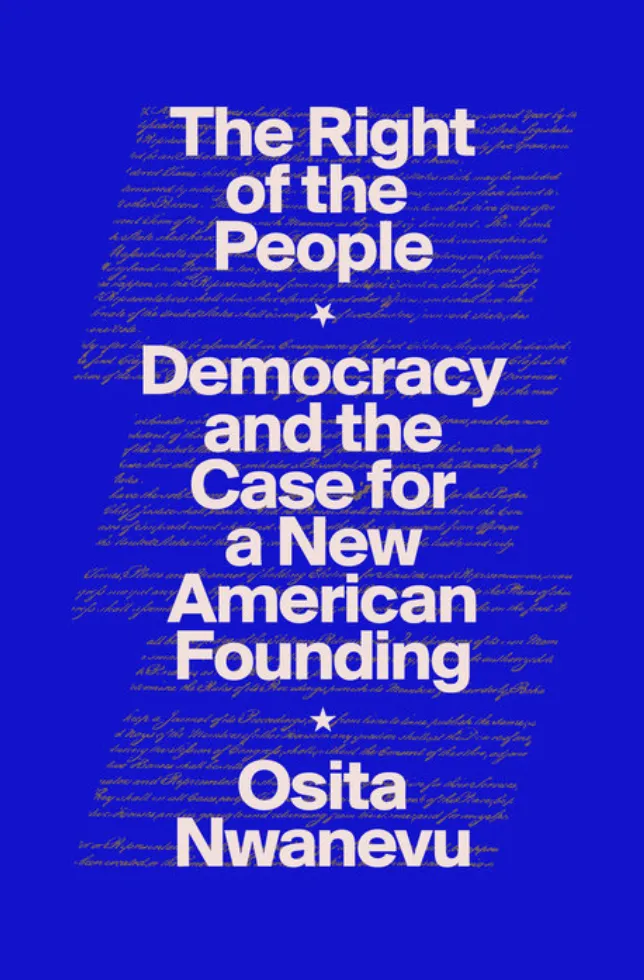
Osita Nwanevu is much smarter than I am. I want to begin by saying that because this is going to be a more critical review than I normally write of books. Generally speaking, I write about books I really liked with ideas that I think are worth sharing with my readers for the week. And to be clear, there are a lot of really excellent ideas in The Right of the People; Nwanevu’s 2025 book explains many of the structural flaws in our federalist system that make it extremely difficult for “the will of the people” to mean much in terms of enacting transformative policies that actually materially make American lives better. It’s a sobering book for anyone outraged and confused about how it could be possible that someone like Trump could win for a second time in a row. But the book also has a few fundamental, glaring omissions that I find very frustrating.
Nwanevu argues that our Constitution as currently designed is counter to what could be called democracy. The electoral college, the filibuster, the Supreme Court; we’ve all been well aware of how minoritarian parties like the Republicans can wield power even without technically having the majority of the people on their side. He goes through the history of democracy as a concept, laying out how the citizens of Athens actually lived in a much more participatory democracy than ours. The founders of this country obviously didn’t believe in giving the franchise to women, immigrants, or formerly enslaved Black people, and the Constitution reflects that. In other words, it’s a document that needs a major overhaul, if not a complete rewrite.
I picked up the book because I was particularly interested in the last chapter, which is about economic democracy, something I care about deeply as a socialist. He correctly points out that most Americans work under conditions that could only be described as authoritarian, with strict controls over what we wear, what hours we work, and in extreme cases like Amazon, how often we go to the bathroom. He argues that if most people don’t experience participatory democracy in our day-to-day working lives, we tend to create a populace that doesn’t believe in participating in democracy in other realms of public life. He explains that this is why we need more robust and well-protected unions, a return to New Deal policies to lessen economic inequality, and to even explore things like worker co-operatives where the workers themselves own the companies and democratically manage the profits together. I agree with these ideas, I think they’re a great place to start on the road to workers controlling the means of production for themselves. The problem is, Nwanevu never uses the word “socialism” to describe what he’s talking about. He makes positive passing reference to some of Bernie Sanders’ economic policies from 2020, but he can’t seem to bring himself to say that these fundamental flaws in our current Constitution and the grave inequality we currently live under necessitate a transition to some form of socialism.
Since it appears that Nwanevu disagrees with socialism as a political philosophy, I would have loved to read his reasons why! He diagnoses how difficult it is to have an egalitarian, democratic society where all votes carry the same weight when we live in a country where money can so heavily sway the results of our elections. But he doesn’t seem willing to come right out and say that changing how profits are distributed among workers, the people who create value through their labor, is fundamental to creating that more egalitarian and democratic society. If we’re already talking about completely upending the Constitution and starting fresh, then why not have an honest conversation about what kind of economic system we should have as well?
Socialists, communists, and anarchists have always been fundamental to shaping American history. I’ve written before about how widespread and popular the sewer socialists were in modernizing their cities and building greater egalitarian institutions. The unions that came to power during the New Deal, which Nwanevu correctly identifies as crucial to establishing the period of greater equality the US enjoyed for a generation, were, in many cases, led by deeply committed communists. Eugene V. Debs led some of the most consequential railroad strikes in American history and received 900,000 votes running as a socialist in 1912. Martin Luther King Jr called himself a democratic socialist in the last years of his life. I bring all this up just to point out that there has long been a socialist tradition in the United States, and oftentimes those have been the people most willing to say that America might need a fundamentally different founding document.
I don’t doubt that Nwanevu is well familiar with this history. Even if he fundamentally disagrees with the aims of socialists, it would have been fruitful to learn why. If he never mentions socialism or Marxism in the book out of fear that Americans can’t hear those terms without getting defensive, I think he did his audience a disservice. There is increasing evidence that Americans broadly support democratic socialism as a concept, and the debate over whether or not capitalism is compatible with democracy has been going on for more than a decade at this point.
A deeper problem I have with the book is that it doesn’t really go into the depths of the consequences of not living in a true democracy under our current Constitution. The powers our federal government has been able to wield have allowed them to commit some heinous atrocities, from the genocide of indegenous people, to the continued enslavement of Black people, to the many war crimes and violent regime changes the US has carried out over the last two-and-a-half centuries. He talks a good bit about how people in Puerto Rico are cruelly denied the right to statehood, but doesn’t really talk about how that lack of representation has meant an ongoing electricity crisis for the island over the last nine years. By extension, there’s no real conversation about how the undemocratic elements of our government have led to the overthrow of democratically elected governments all over the world, including in Iran. Trump’s illegal war on Iran without congressional approval, as well as the genocide of the Palestinian people, are horrific consequences of living in a federalist republic with minimal real democratic representation. Finally, I wish he could have touched on how authoritarian our law enforcement agencies often are. We have a whole movement of sheriffs in this country who currently believe they exist outside of any form of democratic accountability; it’s a major crisis that we largely ignore.
One of my favorite podcasts, The Dig, did a three-part series with legal scholar Aziz Rana about the history of the Constitution. In the series, he argues that the structure of the Constitution created the conditions for this country to be a settler empire, and that the broad reverence we feel for the Constitution is a relatively recent invention of the 20th century. He also lays out the many leaders of various movements for justice and equity who have been sharp critics of our Constitution throughout its history, willing to imagine a different, better structure of government. I ultimately found this series to be a much more instructive way of diagnosing the problems with our constitution than The Right of the People because he was willing to engage with the more radical figures from our history with more rigor.
It also really bothers me that Nwanevu ends the book by acknowledging that it will take decades, if not generations, to remake the Constitution. He seems to throw his hands in the air and suggest that we’ll just need to trust that history will eventually allow a majority of people to force a rewriting of the Constitution to be done. I fail to see how this won’t happen without some form of organized revolution. I don’t think that necessarily has to mean a violent revolution or civil war; quite frankly, the other side has all of the guns, and I don’t see a path for us to win that way. But I do devote a good chunk of my life to trying to expand democracy in Los Angeles, because that feels like the best place I can start to build something truly transformative. Electing socialists at the municipal level who are willing to fight for a city where we put human beings over profit, where we meet the needs of the many instead of catering to the wealthy few, feels like the most constructive way to build the economic democracy Nwanevu is talking about. I just wish he could have suggested as much as a concrete call to action for his readers, or made any recommendation at all.
I do still appreciate the book and Nwanevu’s insights. He talks about ranked choice voting and people’s assemblies to decide on policy, both things I deeply believe in as ways to give more power directly to the hands of the people. He also rejects the critics of democracy who have recently suggested that if the people could be convinced to elect Trump, they don’t deserve to be trusted to make choices at all, and that maybe democracy isn’t trustworthy. I similarly believe that the solution to MAGA is an expanded and more robust democracy where everyone can fully participate. The book is a great way to get your boomer parents who may be upset about the rise of authoritarianism but confused about how we got here to think a little more clearly about the structural hurdles we face while attempting to build a true multiracial democracy where everyone has equal say in how we are governed.