
What if 40% of LA’s housing belonged to the people and not landlords?
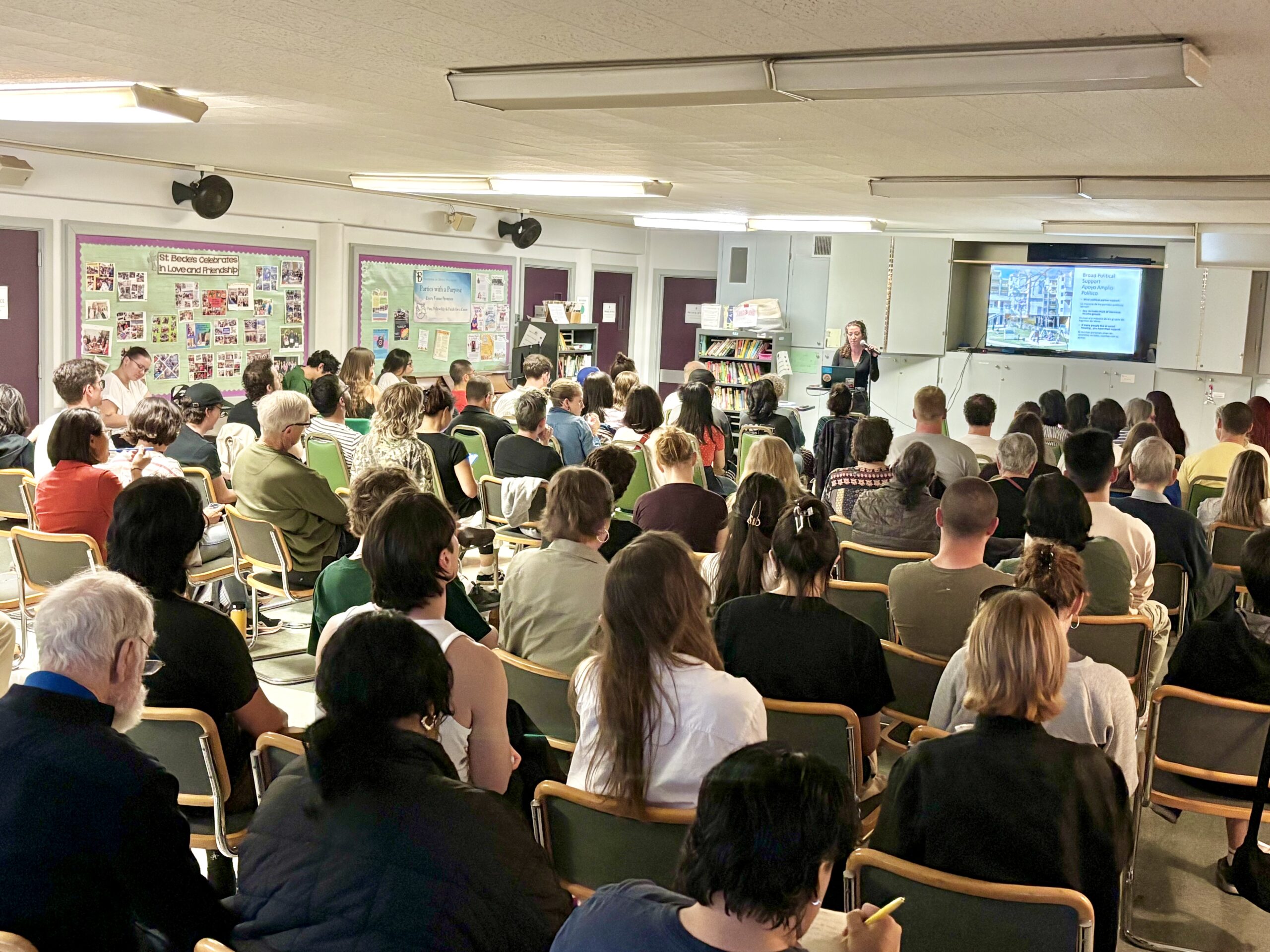
This past Monday, Mar Vista Voice, POWER-LA, and the Rent Brigade proudly held a teach-in on Vienna’s social housing system at Saint Bede’s Church in Mar Vista. The presentation was led by housing researcher Bea Stambuk-Torres, who lives in a housing co-operative in Vienna, leads educational experiences in Vienna for housing practitioners, and is studying their system for her PhD. She presented stark contrasts between LA’s housing supply and Vienna’s. The horizons of possibility between our system as it currently exists and the possibilities of what could be were electrifying.
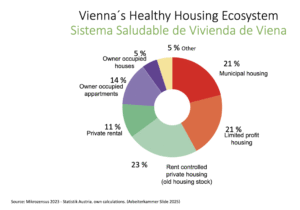
As much as people might squirm and try to say that LA could never be like a European city, when you dig into the commonsense practicalities of how Vienna’s system works, it’s impossible to deny that something like it would be far better for us than our current reality. Yes, we have double the population of Vienna, and we are more geographically spread out. But that doesn’t change the reality that only 5% of our housing is below market rate, compared to Vienna’s 43%. Vienna has 22% of its housing municipally owned, and another 19% owned by limited profit corporations. The effect is that even rents in the for-profit market have to compete with much more affordable public and social housing, resulting in lower average rents overall. Stambuk-Torres calls this a “healthy housing ecosystem,” as demonstrated below.
By contrast, LA’s housing ecosystem is on life support. 59% of renters in LA County are rent-burdened, meaning we spend more than 30% of our income on rent. In Vienna, roughly 90% of the population qualifies for social housing thanks to broad eligibility and flexible income requirements, and these apartments can cost roughly half of what comparable private market rentals do. Vienna is also constantly building new housing; the city builds about 7,000 units per year compared to LA’s 2,000 to 3,000. In 2023, Vienna saw 10,000 people receive eviction notices in social housing, and only 1,000 were ultimately evicted after rounds of support from service workers. By contrast, the city of LA saw 245,599 evictions filed between 2023 and 2025. An estimated 2,000 people are homeless in Vienna, compared to 43,699 in the city of LA.
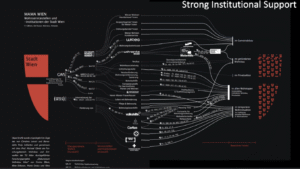
Part of why Vienna is so successful is that its housing system is designed to be perpetually affordable for generations, not just for the next few years. It is also built to meet the needs of different communities, from young people moving out of their parents’ homes for the first time to elderly people needing support and community. Their housing is also built with plans for integrating whole communities, from always building near transit and parks to creating spaces with shared amenities like gardens, childcare centers, fitness facilities, and community rooms. The idea is to also integrate people of different income levels so that they’re living shoulder to shoulder, not segregated by income, while using social housing at scale to prevent private market rents from rising to unaffordable levels in the first place. The city uses a land bank system to buy up parcels of land and then receives proposals from both for-profit and limited-profit developers, meaning the for-profit developers have to compete to prove they will provide socially beneficial housing. A vast web of municipal agencies is funded to make this system possible thanks to a 1% income tax that raises €450 million a year.
It’s easy to feel disheartened comparing Vienna and LA. But we should still study it, because it’s a real system built by human beings who made choices thinking about the long-term social well-being of their city. 100 years ago, Vienna had all the same problems large cities in the early 20th century had: homelessness, squalid and cramped living conditions, widespread tuberculosis. The period of “red Vienna,” of democratic socialists coming into power and dramatically reimagining the city’s housing, led to the flourishing system we see today. It may still feel like we’re a long way away from realizing something like this here, but this is precisely why it’s important to defend Measure ULA, the seed of funding our own social housing system capable of ensuring everyone’s housing needs are met. What’s particularly great about ULA is that it’s entirely in our hands as a city; we don’t have to depend on Sacramento or DC for funding to protect tenants and build housing. A vast city like LA may feel too chaotic and unwieldy, but cities are ultimately collections of human beings, and humans can always make better choices if we can find the collective will to do so.