
Republished from Carter Moon’s Substack. Subscribe here!
Why do Americans love fantasizing about the end of the world so much?
Last Sunday I was walking through the jam-packed Brentwood farmer’s market in search of a perfect loaf of sourdough bread for my wife and I. As I was debating which artisanal pastry maker to support, I was listening to emergency reporting from Democracy Now covering the US and Israel’s sudden bombing of Iran, in particular the horrifying bombing of a girl’s school. I paused the show, bought my bread, and switched over to the last few moments of the audiobook for Cormac McCarthy’s The Road. I listened as the boy from the book meets a small tribe of “good guys” and seemingly gets an opportunity to continue to live, despite the apocalyptic wasteland that surrounds him. I thought about the little girls in Minab who weren’t so lucky.
American media in the 21st century has been utterly obsessed with the apocalypse. Zombies, nuclear fallout, pandemic, natural disaster … We have been awash in images of calamity and people surviving in wastelands. The problem with much of this fiction is that it begins after the collapse has already happened. The rolling mass death occurs off screen, the total societal collapse is alluded to rather than depicted, and our protagonists ultimately get to be one of the few scrappy survivors in an anarchic Hobbesian wasteland. This can make for some extremely entertaining stories; I’ve played The Last of Us games all the way through multiple times and have wasted hundreds of hours in the Fallout games. But having lived through a few true calamities myself now, the frequency of cataclysmic events around the world accelerating on a seemingly daily basis, I find it increasingly difficult to find these stories wholly satisfying. Even The Road, elegantly written as it is, exists in a fantasy world where the calamity has already happened and the father and son duo luckily find the cans of peaches and corn meal they need just in the nick of time.
The apocalyptic fiction I’ve found myself gravitating towards more over the last few years are stories that actually take you through the process of collapse itself. As the pandemic caused the air to turn black in my neighborhood from so many bodies being cremated at once and last year’s wildfires transformed LA County forever, I’ve gotten way too familiar with the feeling of living through true calamity. And I’ve also become aware of the eerie feeling of when things approach a semblance of the old normal. The bizarre thing of living through a collapse, of living through a fascist takeover of a government, is how often you find yourself still living in the world as you remember it from before. There’s a very troubling dissonance between knowing in your bones that things are collapsing beneath your feet but watching life go on more or less like usual day by day.
This is why I find myself constantly thinking about Kim Stanley Robinson’s Ministry for the Future. Published in 2020, the book is a brutally honest but ultimately hopeful exploration of what it might take for humanity to survive the climate crisis in the 21st century. The book has many flaws, but it does force the reader to imagine how the next few decades of climate collapse might unfold. It begins in India in 2023 during a massive heat wave. A million people die in a single day from the heat, but a white NGO worker manages to survive by hoarding the last bit of water for himself. He’s ravaged by guilt over this and it’s the catalyzing event for him to take action to fight the climate crisis. It’s a perfect metaphor for how Western white people are approaching the climate crisis: We have the resources where we may survive, while people from the third world will die from a crisis they did not cause. From there, the book takes you through one possible future of our species surviving the crisis.
Another pair of books I haven’t been able to shake are the Parable books by Octavia Butler. Published in 1993, they follow Lauren Oya Olamina as she lives through the total breakdown of the United States due to climate change, inequality, and corporate greed. The president is a religious fanatic who runs on the slogan “Make America Great Again.” Butler was prophetic; the books begin in 2024 in a town modeled after Butler’s home of Pasadena. Lauren is forced to flee her neighborhood when it burns down, uncanily similar to what happened to Altadena last year. Lauren’s journey through a devastated California that has largely run out of water and where many, many people are homeless might be slightly more dire than the actual present we find ourselves in, but Butler’s overall prescience in predicting our world is breath-taking. What’s great about her work is she takes you through both the raw, in-the-moment feeling of living through collapse, but she also takes you into the future. An imperfect one, to be sure, but one where life has gotten infinitely better.
Parable and Ministry are the antithesis of the post-apocalyptic fiction that’s been so popularized in American culture. I’ve come to see a lot of the zombie and wasteland fiction as a way for Americans to imagine themselves as noble cowboys again. Walton Goggins’ Ghoul in the Fallout TV series dresses like an old outlaw; The Last of Us series constantly invokes Western imagery as our protagonists endure the wilderness. Hordes of zombies and cannibals are savages to be mowed down, much like Westerns glorified the slaughter of indigenous people. The Last of Us takes this further in the second game; Israeli creator Neil Druckmann pitted the hyper-militarized WLF (modeled after the IDF) against the religious cult the Scars (a stand-in for Palestinians). The story is meant to be about the endless cycle of seeking revenge and it being impossible to know who is ultimately to blame when two groups of people are constantly killing each other. Of course, having now lived through the genocide of the Palestinian people and the total destruction of Gaza, this portrayal of factions who are equally at fault becomes perverse and absurd.
These stories skip over the actual process of societal breakdown and collapse to jump straight to the romanticized “fun” of heroic lone individuals bravely enduring against the odds. It’s a strange form of fantasy, of living in a world where most of humanity died off screen, leaving the audience to imagine ruggedly surviving in the ruins. In these stories characters are often haunted by the cataclysmic collapse, but the audience doesn’t have to actually endure it. Don’t worry, the mass death will happen to other people elsewhere, you’ll be shielded and survive. Much like a majority of Americans don’t have to endure actually seeing the consequences of the bombs we drop on Iran, our apocalyptic fiction absolves us of having to meaningfully consider the horrors of an apocalypse America is primarily responsible for. We are the ones stockpiling nuclear weapons, we are the ones keeping the world dependent on burning fossil fuels and hastening our own demise, and we know that on a certain level. We’re so drawn to stories of wastelands because we know in the back of our minds that that’s the future we’re creating, but our fantasies rarely motivate us to change our present.
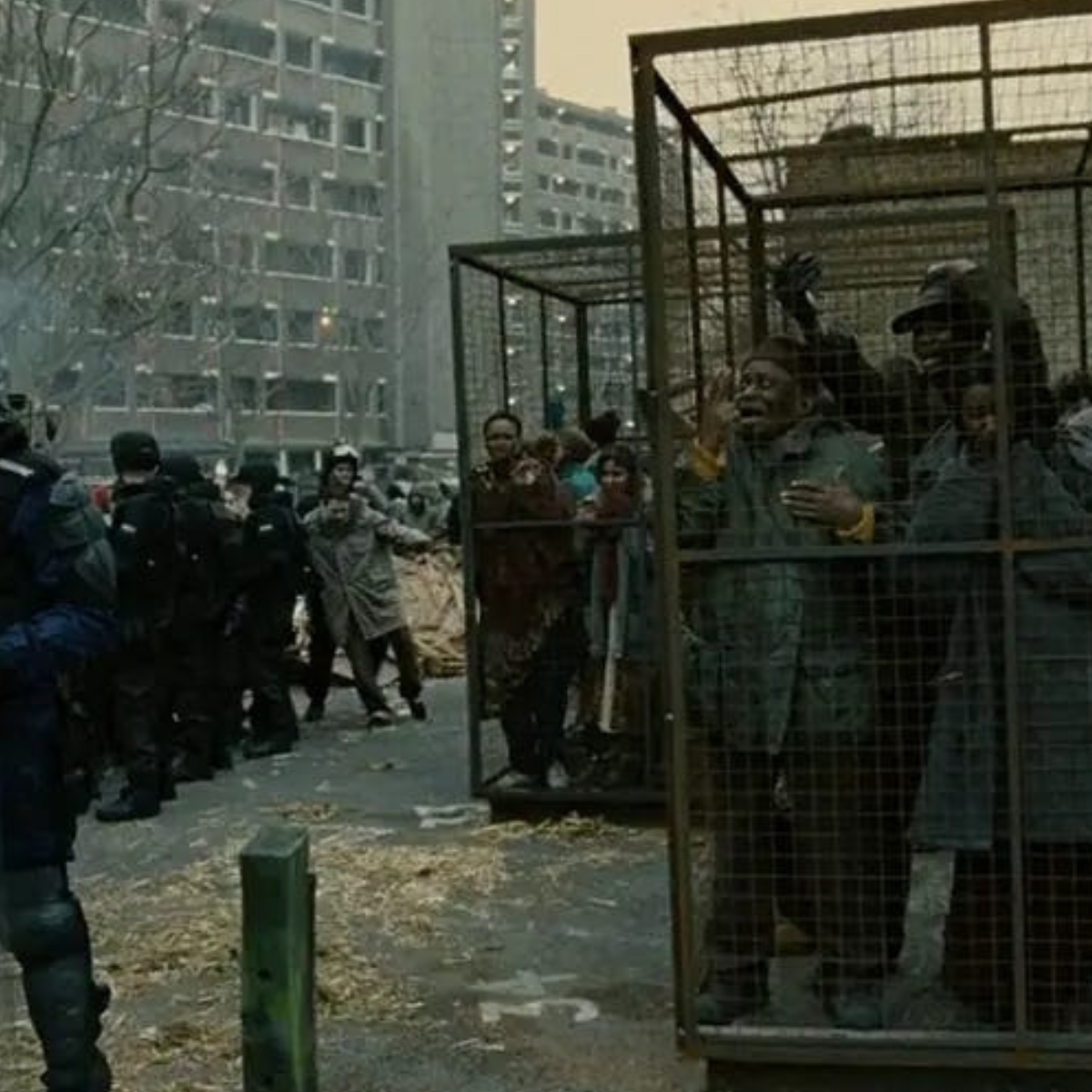
Fredric Jameson and Slavoj Zizek famously wrote, “It’s easier to imagine the end of the world than it is to imagine the end of capitalism.” Marxist cultural theorist Mark Fisher used this phrase to explain his concept of “capitalist realism”: “the widespread sense that not only is capitalism the only viable political and economic system, but also that it is now impossible even to imagine a coherent alternative to it.” He praises the movie Children of Men (in my opinion one of the greatest films of this century), because: “The catastrophe … is neither waiting down the road, nor has it already happened. Rather, it is being lived through. There is no punctual moment of disaster; the world doesn’t end with a bang, it winks out, unravels, gradually falls apart.” Every year for the last six years has felt like this, not one singular apocalyptic event that cleanly cleaves the world into something completely unrecognizable to us, but a slow, steady decline further into horror.
Of course, what makes Children of Men so remarkable, and what also makes the Parable books and Ministry for the Future so good, is that they do offer a glimmer of hope. All of them are brutally honest about the horrors their authors can see on the horizon, but they also show the audience a light at the end of the tunnel. In Children, our protagonist gets the last pregnant woman on Earth to safety despite sacrificing himself. Parable ends with the Earthseed religion Lauren created sending humanity to explore space. Ministry charts a future where we do manage to adapt and make sure life carries on. These stories are brave enough to tell a truth that our power structure rarely likes to hear: There was a world that existed before capitalism, and there will be a world that exists after.
We are actually a remarkably adaptable species; when material conditions hit a breaking point, we can collectively change course for our own survival. Nothing about our future is inevitable or written in stone. Part of how we start to change is by pointing out the things that are choices that our ruling elite treat as inevitabilities. Trump and Pete Hegseth chose to kill 175 school girls; there was not a law of physics or the crushing momentum of history that forced them to do that. The powerful choose to let our neighbors die on the street rather than providing housing. Insurance companies let people die without healthcare to boost their profitability. Investment firms are choosing to fund the detention centers that warehouse and torture immigrants. These are calamities we have the power to prevent, they are systemic disasters we could choose to avoid. So much apocalyptic fiction revels in stripping the audience of any agency, of acting as though we as atomized individuals just have to endure whatever fate throws at us. But the reality is, we can always turn the clock back on the worst of what we do to each other.