
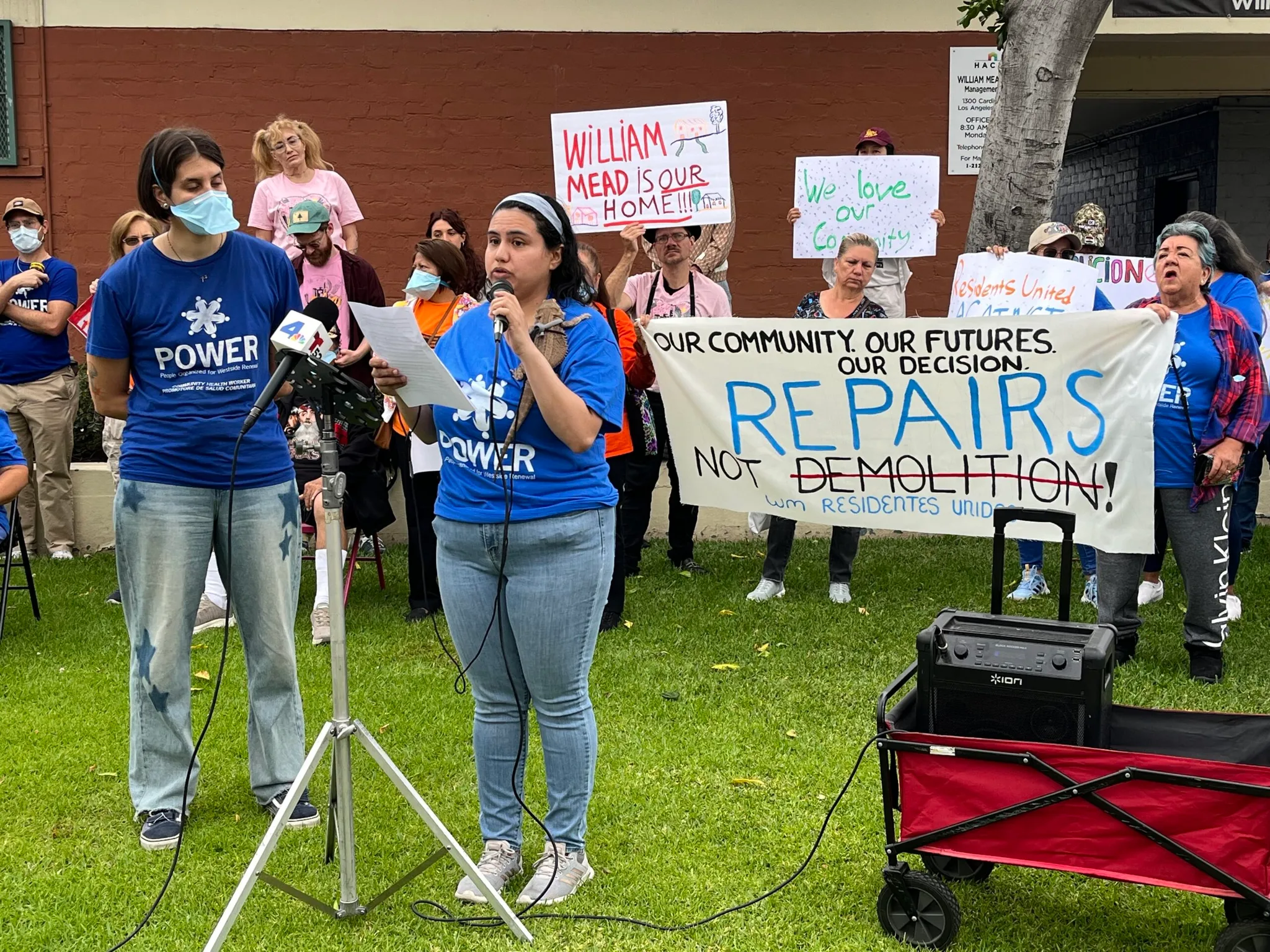
Residents of William Mead Homes are organizing to stop the Housing Authority of the City of Los Angeles from demolishing the Chinatown public housing community where generations of families have built their lives.
William Mead is a 415-unit public housing community near Chinatown, the Los Angeles River and downtown. Its two- and three-story brick buildings are arranged around lawns, walkways and sheltered courtyards. The community includes an elementary school, playgrounds, a health clinic and a Boys and Girls Club.
HACLA’s transformation plan calls for demolishing the entire development and replacing it with as many as 1,600 mixed-income rental and homeownership units. The agency has promised one-for-one replacement of the 415 existing public housing units and a right to return for tenants in good standing.
Even if every public housing unit is replaced, public housing would no longer define the site. The 415 replacement units would account for only about one-quarter of the new development. The rest would serve households at other income levels, including market-rate residents. For tenants, the numbers do not capture what would be lost. Many William Mead families have lived there for decades. Neighbors care for one another’s children, bring food when someone is sick and check on elderly residents. These relationships cannot be packed into boxes and recreated years later in a new development.
“We’re living in peace right now,” 72-year-old Antonia Alvarez, a resident since 1984, told LA Public Press.
Ramona Ayala, who has lived at William Mead since she was born in 1966, described how neighbors brought her dinner and took her children to school while she underwent treatment for breast cancer. “If they demolish these apartments, that’s my whole history,” she said.
HACLA says the existing buildings are outdated, lack insulation, air conditioning and heating, and do not meet current earthquake or accessibility standards. The agency also cites contaminated soil and the need to create more housing. A HACLA spokesperson told LA Public Press that demolition is not expected for at least two or three years and described the proposal as a “resident-first, zero-displacement strategy.”
Residents and organizers dispute the idea that these problems require demolition. They say contaminated soil can be remediated and the buildings can be repaired and modernized without destroying the community. Organizers also point to William Mead’s 2024 inspection score of 96 out of 100 as evidence that the development is not a collection of buildings beyond repair.
Temporary relocation is not a minor inconvenience. Under the plan, residents could be moved to another HACLA development or given Section 8 vouchers to rent on the private market during years of construction. For elderly residents, families with children and people whose support networks are concentrated at William Mead, relocation could mean losing far more than an apartment.
Vouchers also do not provide the same security as public housing. Public housing is publicly owned and permanently dedicated to serving low-income residents. Tenants generally pay no more than 30 percent of their adjusted income. A voucher requires a family to find a private landlord willing to accept it in a city where rents routinely exceed what the subsidy will cover.
The Rent Brigade describes the William Mead proposal as the transfer of a public asset into a privatized ownership model. HACLA says it hopes to manage the replacement units directly, but has left open the possibility of choosing an outside management agent.
William Mead exists because an earlier generation fought to build public housing despite sustained resistance at City Hall. Newspaper clippings from 1940 and 1941 show the City Council repeatedly delaying and rejecting what was then called the Ann Street housing project. Councilmembers argued over the cost of acquiring part of the site from Consolidated Steel Corporation and tried to move the project elsewhere.
The Council ultimately approved William Mead by a bare majority of eight votes in January 1941. The original $2.069 million project placed 449 homes on 15 acres. It was named for William G. Mead, who was described at the time as the “father of public housing in Los Angeles” because of his role in creating the city’s first Housing Commission.
The development was completed in 1941 and 1942 and became one of Los Angeles’ earliest public housing communities. The Los Angeles Conservancy describes it as a remarkably intact example of modern garden apartment design that continues to provide a thoughtfully designed living environment.
Los Angeles should be preserving the small amount of public housing it still has, not treating these communities as reservoirs of developable land. We have an example right here on the Westside in Mar Vista Gardens. Completed in 1954, Mar Vista Gardens is HACLA’s westernmost public housing property. Its 601 homes sit across 43 acres with open yards, athletic fields, a gymnasium and a community center. When it opened, it was considered the highest-quality public housing development in Los Angeles.
Mar Vista Gardens shows what public housing can provide when it is treated as a lasting public good. It offers deeply affordable homes in a part of Los Angeles where low-income families are otherwise increasingly excluded. But the rationale HACLA is using at William Mead could eventually be applied to any aging public housing community. If decades of government disinvestment can be cited as proof that demolition is necessary, no development is truly safe.
That makes the composition of HACLA’s Board of Commissioners especially consequential. Commissioners oversee the agency’s public land and housing and help determine whether communities like William Mead and Mar Vista Gardens are repaired and preserved or demolished and restructured through private development arrangements. This became especially clear this week, when the City Council prepared to consider Mayor Karen Bass’s appointment of a major landlord and longtime California Apartment Association leader to the HACLA board while William Mead organizers were going door to door to document residents’ views on the proposed demolition.
Bass nominated Daniel Tenenbaum on August 11 for a term ending in 2030. According to the résumé submitted with his appointment, Tenenbaum owns Pacific Crest Realty, has acquired and sold more than $200 million in multifamily properties and has managed more than 1,300 apartments. He previously served as a HACLA commissioner from 2016 to 2023 and has served on the Los Angeles and statewide boards of the California Apartment Association since 2007.
Tenant organizations quickly mobilized against his return. Strategic Actions for a Just Economy and the Rent Brigade submitted letters warning that Tenenbaum’s continuing relationship with one of California’s most influential landlord lobbying organizations raises serious questions about whether his private industry commitments are compatible with governing public housing. An Action Network campaign urges residents to oppose the appointment.
The nomination was placed on the August 26 City Council agenda as Item 42 with consideration by the Housing and Homelessness Committee waived. Councilmember Ysabel Jurado called the item special, preventing it from being approved as part of a larger consent vote. During public comment, Tabatha Yelos, an organizing director with Ground Game LA who works with Section 8 and Section 9 residents, urged the Council to reject Tenenbaum.
“We should have more community voices and HACLA tenants on the board,” Yelos told councilmembers. “We demand that the Council vote no on Item 42.”
The Council did not vote to confirm Tenenbaum. After public comment, Councilmember Hugo Soto-Martínez said, “I am requesting that we assign 42 to committee.”
Council President Marqueece Harris-Dawson seconded the motion. The Council then voted unanimously to refer the nomination to the Housing and Homelessness Committee. The vote does not defeat Tenenbaum’s appointment, but it reverses the attempt to bypass committee scrutiny and gives HACLA residents and housing advocates another opportunity to question him publicly. The committee can now examine his relationship with the California Apartment Association, his approach to tenant protections and relocation, and how he would handle decisions involving the demolition and privatization of public housing.