
This article by Liz Chou originally appeared in The LA Reporter and is republished here with permission.
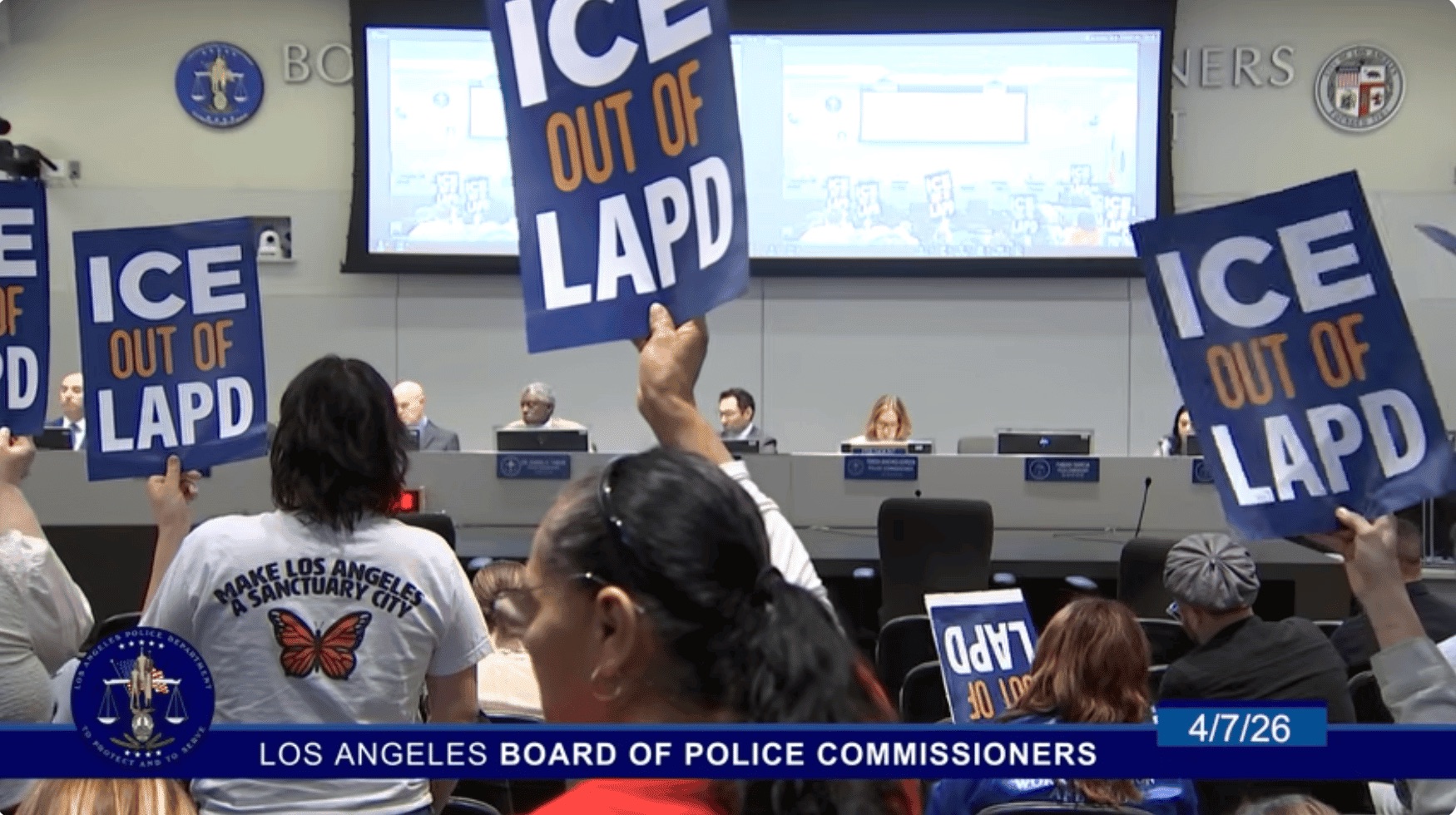
Immigrant rights groups were set to present to the Los Angeles Board of Police Commissioners this past Tuesday, April 7, on policies to limit LAPD involvement in ICE activity. But those plans got pulled at the last minute, and presenters said they weren’t given a reason why.
Representatives of the LA Sanctuary Coalition told The LA Reporter the proposal they planned to discuss with the Board of Police Commissioners had been laid out in a motion that the Los Angeles City Council had approved last July 1. In the nine months since, there has yet to be any visible movement on the motion, which calls for limiting LAPD’s response to 911 calls made by ICE and other federal immigration officials. Their presentation would have taken place amid concerns nationally that local police could be aiding federal officials as they attack, kill and kidnap immigrants and other community members.
At Tuesday’s meeting, members of the coalition questioned the decision to pull the presentation, and demanded better leadership from the board, which is comprised of five members appointed by the mayor.
“Why are we not allowed to speak to this decision-making body?” asked Nancy Meza, an organizer with the National Day Laborer Organizing Network (NDLON) and member of the LA Sanctuary Ordinance. “We know that the people of LA have spoken every day, right? Once the siege [on Los Angeles by federal immigration officials] started in June, protests began at the federal building, and they never stopped. Every day, every night, there are people there … So we need leadership.”
Andrés Kwon, a lawyer with ACLU SoCal and a member of the LA Sanctuary Coalition, told The LA Reporter in an interview after the meeting that they had gotten word their presentation was pulled shortly before the agenda was posted on Friday, April 3. No reason was given, and there was no discussion of rescheduling, Kwon said.
“We’ve had this date in our calendars for a few weeks, two to three weeks,” Kwon said.
Kwon was set to present, along with representatives from two other LA Sanctuary Coalition groups, LA Voice and CARECEN.
The Board of Police Commissioners is supposed to be a key player in this process because unlike in other jurisdictions, such as San Diego where their City Council this week approved a law to address police response to federal agents calling 911, the Los Angeles City Council isn’t the ultimate authority setting LAPD policy. The 15-member elected body can only request that the Board of Police Commissioners — which is the body designated in the city charter to have policy-setting authority over the police department — to adopt such policies.
The Los Angeles City Council’s motion asks the police commission to set a policy “limiting and narrowing LAPD’s response to calls for support from federal agencies performing immigration enforcement beyond what is required under the existing Sanctuary City Ordinance.”
And the motion asked that the commission consider policies in which the LAPD would only respond to “calls for support from federal immigration operations only if, and only if, upon the receipt of a verified judicial warrant.” Other things the City Council wanted the board to consider adopting was restrictions on LAPD activity that would “directly or indirectly enable civil federal immigration enforcement to access public or private property for the purposes of carrying out immigration enforcement.” The motion also requested a policy that would call for the “verification of [the] identity of agents on site once LAPD has arrived on the scene, including their names, agency they work for, and badge numbers.”
Kwon said the proposed policies described in the motion would go further than existing policies in place at the city that are aimed at preventing collusion between the LAPD and federal immigration enforcement officials such as ICE. The city adopted its sanctuary ordinance in 2024, and Mayor Karen Bass signed Executive Directive 17 in early February. Kwon said the mayor’s executive directive “deals with certain processes and transparency for when they respond. But it does not limit the circumstances in which they can respond.“
At Tuesday’s meeting, Carlos Amador, an organizer with CLEAN Carwash Worker Center and member of the LA Sanctuary Coalition, told commissioners that they needed to ensure that the LAPD properly vets 911 calls from federal immigration officials such as ICE and Border Patrol agents, before “blindly” responding to them.
“We have witnessed that LAPD effectively has been helping mass immigration agents responding to so-called mutual aid,” Amador said. “LAPD has been seen establishing perimeters, conducting so-called crowd control during and following immigration raids, which the courts have found were based on racial and identity profiling.”
The LA Reporter reached out to the LAPD’s public information office about the LA Sanctuary Coalition’s demands. They provided a statement saying that the department “is aware of the concerns and respects the right of community members to share their perspectives.”
“LAPD remains committed to serving all communities while adhering to applicable laws and City policies,” the statement continued. “We will continue working with the Police Commission and our community partners to ensure transparency, trust, and public safety.”
Many of those who spoke at public comment also called on Police Chief Jim McDonnell to “follow the law,” referencing the city’s sanctuary ordinance, which the City Council had passed back in December 2024, when Donald Trump was elected to his second and current term.
The push for the city to adopt that sanctuary ordinance was made not just with the incoming presidential administration in mind. It was also in reaction to the nomination of McDonnell by Mayor Karen Bass to be the city’s next police chief, a selection that stunned many Los Angeles immigrant rights advocates.
During his tenure as Sheriff, an elected position in Los Angeles County, McDonnell was a leading opponent of the state’s “sanctuary” legislation to protect immigrants. It was that stance that caused McDonnell to lose his re-election as Sheriff, the organizer from NDLON, Meza, told the commissioners. And in a letter signed by 88 community groups and sent to the City Council in November 2024, they pointed to McDonnell as someone who “actively lobbied against our efforts to pass the California Values Act (SB 54), ultimately weakening the bill that became law.”
“We’re seeking leadership from this police commission,” Meza said during Tuesday’s Board of Police Commission meeting. “Hold Jim McDonnell … accountable to the people of Los Angeles, who again, rejected his re-election bid for Sheriff and want Los Angeles to be a place where every immigrant can feel safe.”
But some police commissioners on Tuesday also were awaiting answers as to why the LA Sanctuary Coalition’s presentation was abruptly pulled. One police commissioner, Jeffrey Skobin, told The LA Reporter, just before heading into closed session at Tuesday’s meeting, that he hadn’t yet been briefed on why the presentation was pulled. He said the agenda is put together by the executive director. The LA Reporter reached out to the Police Commission office, and its director, Django Sibley, but did not hear back.
The subject of the immigration raids, and LAPD’s role in it has been a touchy subject at the Police Commission, and that was on display at last month’s meeting on March 3, during which commissioners received their first monthly update on LAPD interactions with with federal immigration officials. The police commander who was presenting a series of such incidences was suddenly stopped by a department official sitting next to him who then whisper something into his ear. The presenter than halted his report on those incidents. Reporter Eric Leonard of NBC highlighted this moment in a story published last month.
At that March 3 meeting, Skobin had pressed the department officials a bit, asking how often the public would be getting such reports, and at what level of detail they could expect to get. Police department officials said they would be doing monthly reports, and that “anything that would risk the safety or future effectiveness of the officers, or of victims — anything like that — that shouldn’t be disclosed.”
Skobin then pushed back on the department officials a bit more, saying that he thinks they should “push” themselves to get such reports out to the public more frequently “and we should hopefully get as much information, the public should get as much information as possible [as long as it’s] safe and legal, for the sake of transparency.”
The call for police commissioners to lead comes even as many over the years have questioned whether this body — whose members are appointed by the mayor — is able to effectively exercise its authorities as “head” of the LAPD. Meanwhile, some members of the City Council have raised concerns, especially in the wake of the federal immigration raids that began in Los Angeles last June, about their own inability as elected official to directly set LAPD policy as their constituents demand that they take action to protect them from ICE.
And the earlier 2024 decision by the mayor to appoint McDonnell, and the City Council’s decision to give that appointment their stamp of approval, is one that looms over the Board of Police Commissioners’ ability to lead the police department.
“Why our mayor appointed him [as police chief] is a struggle we’re still working through with with her and her office,” Meza, who was among those who spoke out against Bass’s nomination of McDonnell told the commission.
Rob Quan, a City Hall watchdog and close observer of the city’s politics, says that out of the city’s elected officials, the mayor has more power than others in influencing what happens at the Los Angeles Police Department.
“In the context of the charter, the mayor appoints all five of the police commissioners and appoints the chief who are all subject to council confirmation,” Quan said. “It’s very much an entity that our electeds have limited authority and role in, and our mayor plays a dominant role in.”
As to why the LA Sanctuary Coalition’s presentation was pulled, Quan said the “powers that be,” whoever they may be, “tend to treat things like these as delicate matters.
“They might not be trying to kill the conversation, but they do try to control the conversation,” he said. “And they may want to get their ducks in a row before that happens.”