
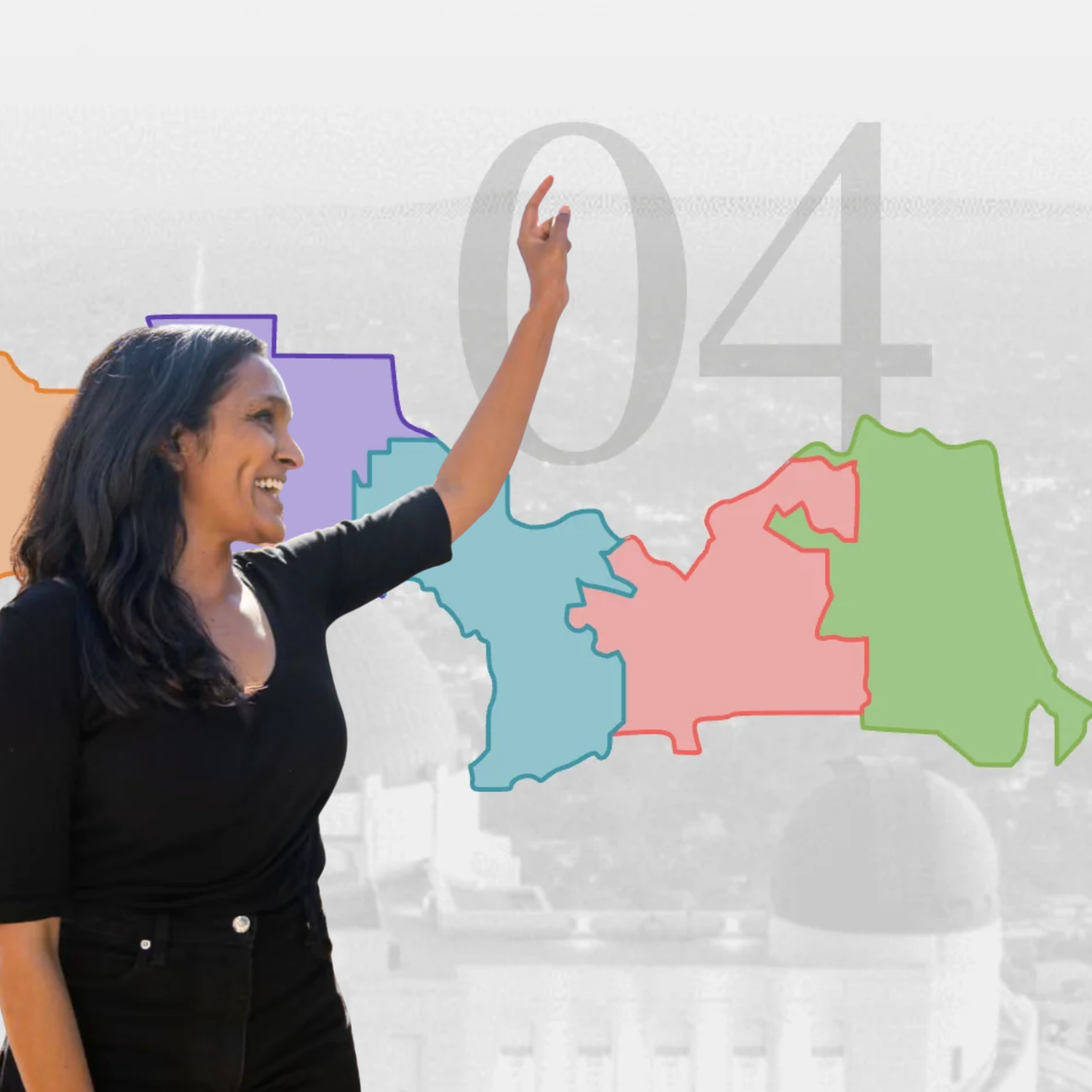
Under Section 409 of the Los Angeles City Charter, the Council has a lot of discretion in determining how to fill a vacancy among its own ranks. Councilmembers can call a special election, appoint someone to serve until a special election is held, or dispense with an election altogether and appoint someone to serve out the remainder of the departing councilmember’s term.
On Tuesday, Councilmember Monica Rodriguez introduced a motion directing the City Clerk, in consultation with the City Attorney, to report back on the timeline and legal requirements for conducting a special election in CD4. The motion was co-signed by Councilmembers Bob Blumenfield, Marqueece Harris-Dawson, Tim McOsker, Adrin Nazarian, Imelda Padilla and Katy Yaroslavsky. CD11 Councilmember Traci Park was not among the signatories.
Raman herself voiced support for holding a special election on Tuesday, as a coalition of neighborhood councils and homeowners associations gathered outside her Sherman Oaks district office to demand that voters be allowed to choose her successor.
Even before Raman won the mayoral election, a race to succeed her was beginning to take shape. Jimmy Biblarz, a senior adviser and campaign counsel to Raman’s mayoral campaign, and Ethan Weaver, the deputy city attorney who unsuccessfully challenged Raman in 2024 with the backing of the police union, have both expressed their intention to run if a special election is called. Other potential contenders include Hollywood Hills community leader Sheila Irani and Encino community activist Roy Nwaisser.
For Westside residents, Biblarz may be a familiar name. In 2022, he ran for the open CD5 seat, competing with longtime neighborhood council leader Scott Epstein for the district’s progressive voters. Both candidates opposed 41.18 and advocated care-first approaches to public safety and homelessness. Together, they captured more than 21% of the vote, but neither advanced to the runoff between Katy Yaroslavsky and Sam Yebri. Biblarz has since moved to Hollywood and become a close political ally of Raman.
The electoral landscape in CD4 is considerably less favorable to progressive candidates than it was when Raman first ran for office in 2020. In the secretly recorded conversation at the LA Fed headquarters that rocked City Hall in October 2022, then-Council President Nury Martinez explicitly discussed diluting the political power of renters in Raman’s district. Maintaining the district’s existing boundaries, Martinez said, “solidifies her renters’ district, and that is not a good thing for any of us.” Councilmember Kevin de León spoke of putting CD4 in a blender.
When the new district boundaries took effect in January 2022, CD4 lost several renter-heavy neighborhoods and extended considerably farther into the San Fernando Valley, incorporating communities with higher rates of homeownership. By the time Raman ran for reelection in 2024, approximately 40% of eligible voters were new to the district. Despite these changes, Raman narrowly secured an outright victory in the March primary, receiving just over 50% of the vote. A progressive candidate seeking to succeed her will have to assemble a similar electoral coalition without the benefit of incumbency.
Raman’s election as mayor thus comes at a cost for the progressive movement in Los Angeles. Over the past six years, progressives have made incremental gains on City Council, beginning with Raman’s election in 2020, followed by those of Eunisses Hernandez and Hugo Soto-Martínez in 2022 and Ysabel Jurado in 2024. While all three backed Karen Bass over Raman in the mayoral election, they remain more closely aligned with Raman on substantive policy issues than with Bass or their more conservative colleagues on Council.
Raman’s departure will reduce the ranks of that four-member bloc to three at a time when electing another progressive in CD4 is pretty unlikely. In the absence of a progressive successor to Raman, retaining four progressive seats on the City Council will depend on the outcome of the CD9 race, where democratic socialist Estuardo Mazariegos trails Jose Ugarte by just 87 votes as of the November 19 ballot count. While the race remains too close to call, recent ballot updates have favored Ugarte. What could have been an expansion of the progressive bloc to five members may instead amount to a struggle to retain the ground it has gained over the past six years, with the possibility of shrinking to three even as a progressive takes the mayor’s office.
And whether progressives will even have the opportunity to contest the CD4 seat remains in the hands of sitting councilmembers. The City Council has taken markedly different approaches to filling vacancies in recent years. When Councilmember Mitchell Englander resigned in 2019, the Council appointed former Councilmember Greig Smith to temporarily represent CD12 until a special election could be held. In 2023, following Councilmember Mark Ridley-Thomas’s conviction on federal corruption charges, the Council appointed Heather Hutt to serve out the remainder of his term without holding a special election.
In May 2024, Rodriguez and Padilla introduced a motion proposing a Charter amendment that would require a special election whenever a council vacancy occurs with at least 12 months remaining in the term. The motion languished in committee for two years before expiring in May 2026.
In November 2024, in response to the scandal surrounding the 2021 redistricting process, Angelenos voted overwhelmingly to strip councilmembers of their power to redraw their own districts by establishing an independent redistricting commission. Yet councilmembers retain the power to choose who represents an entire district when a vacancy arises. How the Council chooses to fill the CD4 vacancy will be an early test of its appetite for democratic reform.