
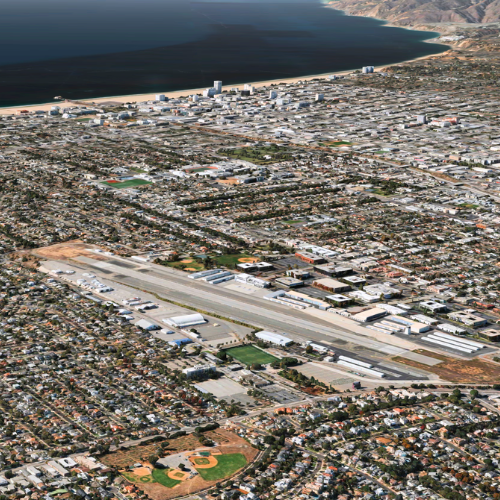
With Santa Monica Airport set to close at the end of 2028, the City of Santa Monica finds itself with a once-in-a-lifetime opportunity to repurpose 192 acres of land into affordable housing. For a city that is behind on its goals of building 6,000 homes by 2029, one could not think of a better chance to catch up to those goals and use a portion of the land to build build affordable housing that local residents of Santa Monica can actually afford; the Cloverfield Commons project aims to do exactly that.
Cloverfield Commons is, according to their website, “a proposed development of homes serving valued Santa Monicans who cannot compete in today’s real estate market. It is envisioned as a modestly scaled community that occupies only a portion of the Santa Monica airport land, complimenting civic amenities and the largest public park on the westside.” The proposal aims to use just 25% of the land and build affordable, below-market-rate housing, and leave the other 75% for development of a large park. The housing and park would be woven together, modeling “the open, forward-looking spirit of our city, supporting a vibrant mix of people who live a neighborly life closely connected to work and leisure, in harmony with the land.”
Because of the results of a 2014 referendum on Measure LC, the City of Santa Monica was prohibited from building “new development[s] on airport land, except for parks, public open spaces and public recreational facilities” without a vote of the people. The Cloverfield Commons initiative aimed to expand the ability of the city to include housing in its redevelopment plans by placing an initiative on the ballot for this November. The proposed ballot initiative would have allocated half of the 3,000 apartments for renters who earn up to 80% of the median income in Santa Monica, and the other half for workers earning up to 120% of the median income. Unfortunately, this ballot initiative was halted back in August after not gathering enough signatures to place it on the ballot in time. This begs the question, what’s next for Cloverfield Commons? Is affordable housing on the Santa Monica Airport dead?
Thankfully, the project is certainly not dead. While certainly a setback, the supporters of the Cloverfield Commons initiative have already changed course and are set on moving the project through the Santa Monica City Council. Joan Ling, one of the leaders of the Cloverfield Commons initiative who has worked in affordable housing as a developer, a policy analyst, and an advocate for 40 years, described the group’s next steps. “In the next year, a couple years, what we’re going to be doing is to keep this idea alive by engaging the public and the voters in terms of having conversation about what it will look like, how it could work, why below market rate housing is so important for the city… the city has been pushing to start the environmental review process, and in order for the housing to be a viable option, it has to be studied in the environmental process.” Essentially, for the affordable housing to be included in the redevelopment plans, it has to be included in the city’s environmental review before any development even begins.
The road ahead for the project is, admittedly, difficult. Vivian Rothstein, one of the founders of Cloverfield Commons, lamented how “politicized” the project had become. With the upcoming Santa Monica City Council elections, the last thing they wanted was their goal of building affordable housing to become a highly charged, political cudgel, leading in part to their decision to move the ballot process to 2028 instead of this year and focus on lobbying the City Council to include the plan in the environmental review process. Barrie Levy, an active member of the Cloverfield Commons leadership team and a resident of Mar Vista who lives near the airport, highlighted how a remarkable 73% of Santa Monica residents are renters. The Cloverfield Commons, she noted, would help build out the “missing middle” of starter homes that are nowhere to be found in Santa Monica.
Cloverfield Commons would also address past racial injustices. Levy explained that “There is a community of African American Santa Monica residents who’ve been here since the turn of the century. The whole Pico area was totally segregated. The Pico area was a historically Black, African American, thriving community with its own businesses. When the civic center and the freeway were built in the ‘50s, all of those people were displaced with eminent domain; they were not given their property values. Those businesses were shut down. People were forced to move, and part of our goal is to allow for housing as reparations for those families, some of whom still are in Santa Monica but have never been able to recapture the wealth that they lost.”
For a project that would not only provide affordable housing during a historic cost of living crisis, but also serve as reparations for marginalized communities, it is “mind-boggling,” as Levy put it, that the development would be so controversial. Indeed, a survey conducted by Unite Here 11 found that “two in three Santa Monica voters recognize that the Airport site is big enough for both housing and for parks/open space after it closes in 2028, and support both uses.” So who are the opponents of such a widely supported initiative?
Enter the Santa Monica Great Park coalition. It might strike you as odd that the biggest organized opponent to the Cloverfield Commons project is a pro-parks group. After all, who doesn’t like parks? Yet, the organization’s name is an attempt to hijack pro-parks language for what is, ultimately, NIMBY rhetoric. The Santa Monica Great Park coalition is opposed to any plan that does not turn 100% of the airport land into a park, and only a park. In fact, Frank Gruber, the spokesperson for the group, declared that “Somebody could say to me, we need 20 acres to build a laboratory that will guarantee that we will cure cancer — we’d still be opposed to it.” Not only is this statement bizarre, it’s just flat-out cruel. Ostensibly, the Great Park coalition seeks to turn the airport into Santa Monica’s version of New York City’s Central Park. However, there’s a significant difference between their proposed park and Central Park: the housing. Central Park is surrounded on all sides by housing, and lots of it in fact. If anything, the Cloverfield Commons proposal is much more representative of Central Park; a large park effectively integrated with the community of affordable housing around it.
With such an incredible opportunity to make the West Side more affordable at stake, you might be wondering how you can help. Does your voice even matter if you don’t live in Santa Monica? Absolutely, says Barrie Levy. “We need people to speak to the Santa Monica City Council. We need people in Mar Vista and all over the West Side to join this. It’s a regional issue, and keeping the pressure from Los Angeles on Santa Monica will help… there’s a lot we can do to educate Santa Monica voters. We need help. We actually need the support of the whole movement, because this is a once-in-a-lifetime opportunity for the city of Los Angeles, for the whole region, the county of Los Angeles.” So regardless if you live in Santa Monica, West LA, or even anywhere in the county, raising your voice and spreading awareness is critical. With your help, we can spread the word, build affordable housing, and get us one step closer to a West Side that works for working people.