
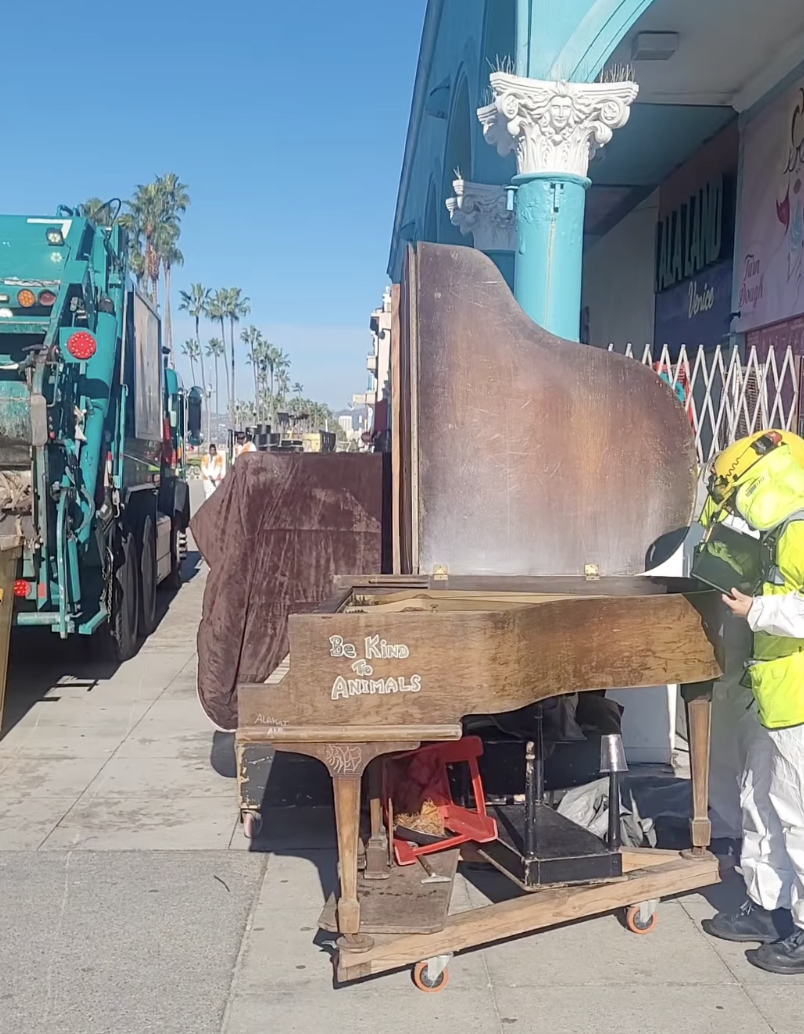
Venice residents witnessed an unsettling scene on the boardwalk this week when city crews removed and destroyed the belongings of longtime street musician Nathan Pino, known locally as the Venice Piano Man. Pino was not present when the city’s Homeless Cleanup team arrived, and by the time he returned, one of his pianos had been crushed in a garbage truck and another taken away. Videos posted to social media show workers in protective suits and hard hats surrounding the wooden piano he had played for years. The footage circulated widely, prompting public frustration and questions about why the instruments were destroyed and why a familiar musician’s belongings were handled as trash.
In the comment sections, people said what so many who grew up on the Westside already feel. That Nathan is part of Venice. That he has been playing out there for decades. That the words he painted on his piano be kind to animals made them smile on hard days. That he once played in goth and punk bands, that he loved his dogs, that he slept under his piano when he had nowhere else to go. And that what happened was cruel, unnecessary, and entirely avoidable. One commenter said out loud what many have been whispering for months: they are tearing the soul out of Venice.
Councilmember Traci Park has spent the last year framing the boardwalk as a problem to be cleaned up, leaning heavily on policing, enforcement, and public safety language as the Olympics approach. Her office has repeatedly promised to restore order and crack down on what she calls hazards and clutter on Ocean Front Walk. Under that political direction, the city has ramped up sweeps, stepped-up patrols, and now the aggressive use of a long dormant law to clear people out of public space.
LAPD and city agencies began handing out warning notices on the boardwalk a few weeks ago and only recently started enforcing them. The rule they are using is LAMC 42.15, a Villaraigosa-era law that technically bans almost all vending on the beach and the boardwalk. The only exception is for true First Amendment art, defined so narrowly that almost nothing qualifies. If an item has any practical use at all, it can be confiscated and destroyed. The law has been ignored for years because enforcing it consistently would erase the character, creativity, and economy that make Venice what it is. But now, with the Olympics coming and election season underway, the city has dusted it off and is using it as a pretext to push out people who do not fit a sanitized image of the neighborhood.
To understand how a law like this became a tool for removing long-time vendors, it helps to revisit the debate on the day the ordinance passed. On December 13, 2011, vendors, artists, and unhoused workers warned the City Council exactly who this ordinance would be used against. A longtime Westside vendor told councilmembers the law wrongly blamed vendors for issues rooted in the lack of city services. “Commercial vending is not responsible for the excessive drug use, the homelessness, the lawlessness,” she said, arguing that enforcement was already targeting the wrong people and that criminalizing vendors would address the city’s stated concerns .
Kenneth Jenkins, a T-shirt designer who created all of his own work, called the ordinance “a sin and a travesty for a few people to decide the life and survival of working persons who are trying to just make a living for their families,” adding that vendors were unfairly blamed as “vagrants” and scapegoated for violence they did not cause. Even veteran free-speech activists warned the Council they were repeating the same legal mistakes that had resulted in past Venice vending laws being struck down. One speaker reminded them that federal judges had already said the city must “leave open ample alternative” locations for free expression, warning that the new law was likely to trigger more lawsuits.
These are the voices that predicted precisely what enforcement would look like a decade later. A law written vaguely enough to outlaw everyday survival strategies and expressive work combined with broad police discretion was always going to be used to target poor people–and especially poor Black and Brown people. The ordinance’s narrow definition of expressive activity was designed in a way that allows the city to decide who is “legitimate” and who deserves to be pushed out of sight.
While there may be some concerns about unregulated vending and spillover from Santa Monica, the people hit first by sudden enforcement are the legacy artists, craftspeople, and performers who have shaped Venice for decades. Instead of thoughtful policy or support, the city is using an old ordinance as an all purpose justification to sweep out whoever does not match the sanitized image officials want to present to cameras and voters.