
When UCLA Health ended a longstanding contract to provide specialty care to thousands of low-income patients this summer, 35-year-old Lola lost access to the 18 UCLA specialists treating their complex genetic disorder. In July, Lola was hospitalized for two weeks at Cedars-Sinai, where they say doctors struggled to develop a safe discharge plan because the physicians responsible for their ongoing treatment were no longer accessible.
Lola is among approximately 9,000 medically frail patients affected by UCLA Health’s decision not to renew its contract with Health Care LA, an association of nonprofit community clinics serving Medi-Cal patients. The agreement, in place since 2009, expired June 30 and had provided access to specialized treatments for patients with cancer, infectious diseases, high-risk pregnancies, organ transplants, and other complex medical needs.
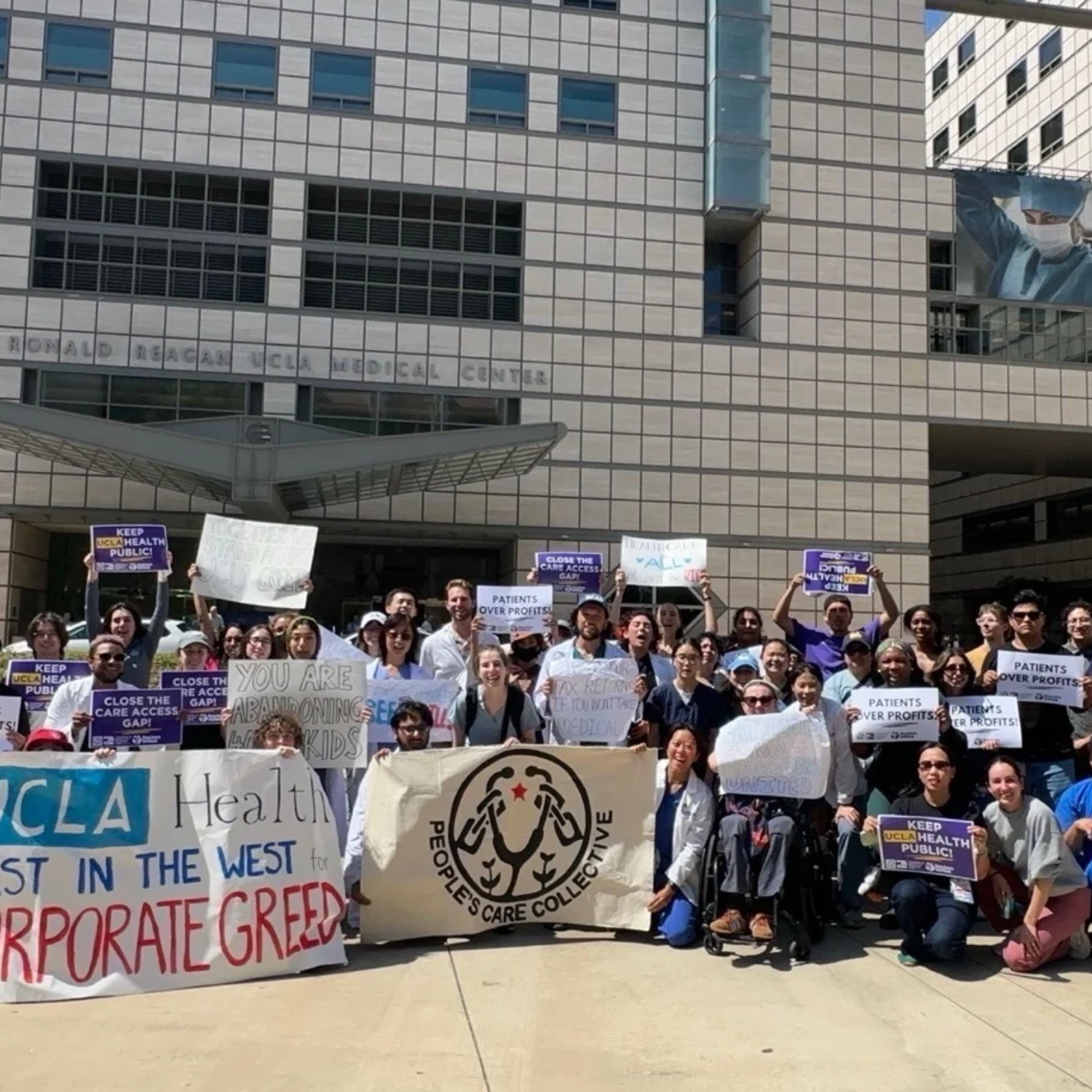
The decision has prompted protests by UCLA medical residents, students, healthcare workers, and patients, who are questioning why a public university health system is reducing access to care for low-income residents while continuing to expand across Southern California.
As the Los Angeles Times reported in September, UCLA Health now operates nearly 300 locations, including facilities in affluent communities such as Malibu, Montecito, and Westlake Village. Yet only about 15% of UCLA’s net patient service revenue came from Medi-Cal last year, compared with roughly 22% at each of the other four University of California health systems. Meanwhile, approximately 40% of Los Angeles County residents are covered by Medi-Cal, according to the California Health Care Foundation.
UCLA disputes the comparison, arguing that revenue figures do not adequately reflect differences in reimbursement rates or the complexity of its care. University spokesperson Phil Hampton told the Times that Medi-Cal patients accounted for 26% of inpatient days and 34% of emergency department visits during the most recent fiscal year. He also said UCLA provides more than $270 million annually in unreimbursed care for low-income patients and maintains other Medi-Cal contracts.
UCLA has cited overcrowded emergency departments, long waits for specialty appointments, and inadequate Medi-Cal reimbursement as reasons for limiting new referrals. But Health Care LA CEO Sabra Matovsky told the Times that UCLA had declined to renegotiate the contract and had not requested higher payments. UCLA maintains that it offered to extend the agreement and that Health Care LA rejected the offer.
Following public criticism in September, the two organizations announced a tentative agreement allowing established patients, those with existing appointments, and certain others to continue receiving care while patients transition to other providers over the following year. But interviews with affected patients and UCLA physicians suggest that the arrangements have left considerable confusion about who qualifies and how patients are supposed to navigate the process.
Dr. Patrick Samones, a UCLA fellow and representative of the Committee of Interns and Residents, described medically complex patients who discovered they could no longer schedule appointments and struggled to arrange replacement care. He said residents and fellows had not received clear guidance about the transition, and although certain patients could qualify for exceptions, it remained unclear how those exceptions were being implemented.
“I constantly wonder how they are doing today as I do not know how they are accessing care or if they have the knowledge or ability to navigate and advocate for their needs within the system,” Samones said.
For Lola, who has Ehlers-Danlos syndrome, a group of inherited connective tissue disorders, navigating Medi-Cal was already an enormous undertaking before the contract ended. Patients seeking care outside their assigned medical networks often must obtain referrals and insurance authorizations, sometimes demonstrating that no available in-network physician can provide the necessary treatment. Denials can mean lengthy appeals, even when the requested care is ultimately approved.
After losing access to their UCLA physicians, Lola eventually discovered that UCLA still accepted patients through another LA Care medical group. Switching networks allowed them to preserve access to their specialists, but required leaving their previous primary care network, which had provided services tailored to LGBTQ+ patients. Lola, who is nonbinary and receives gender-affirming care, says their new primary care physician has not adequately managed their complex medical needs or referrals.
“Now my nine-to-five is managing Medi-Cal, because it’s not a system that properly supports us on a practical level, especially with rare, marginalized diseases,” Lola said.
Lola says UCLA and insurers have also failed to provide clear information about which medical groups remain contracted with the health system. They identified an alternative arrangement only after researching insurance networks themselves, a process many patients would struggle to navigate. Even continuity-of-care protections, which can allow patients to continue treatment with physicians outside their insurance network, require additional applications and authorizations.
The experiences described by Lola and Samones raise questions about whether UCLA’s transition arrangements adequately protect patients who depend on ongoing specialty care. For patients with rare or complicated conditions, transferring treatment is not simply a matter of finding another available physician. It can mean losing specialists familiar with years of medical history, established treatment plans, and procedures few other providers are equipped to perform.
UCLA’s capacity explanation has also drawn skepticism from its own medical residents. One resident questioned whether excluding Health Care LA patients would meaningfully address emergency department overcrowding or long waits for specialty appointments. Removing patients from appointment waitlists may shorten waits for those who remain, but it does not increase the system’s capacity to provide care. Patients who lose access to preventive or ongoing treatment may also develop complications requiring emergency care.
The decision may also be affecting medical training. The same resident described a sharp decline in patient volume at a UCLA pediatric urgent care clinic, where interns were reportedly told not to come to work and two residents saw only three patients over an entire day. She also identified rheumatology and complex gynecological care as potentially affected specialties. Although the reported changes have not been independently confirmed, they raise questions about the consequences for both patients and future physicians.
For some UCLA medical students, the decision has prompted broader concerns about the institution’s public mission. A medical student organizer with UCLA’s Health Equity Hub, a student-run collective focused on health justice, described anger and frustration among classmates who entered medicine to serve patients but now see their university restricting access to care. The student, who requested anonymity because of concerns about retaliation, argued that UCLA benefits from its public university identity while increasingly operating according to the financial priorities of private hospital systems.
The organizer also questioned UCLA’s financial relationship with Los Angeles County’s safety-net hospitals. UCLA participates in medical training and care at county facilities, including Olive View and Harbor-UCLA, but the student argued that the county bears much of the financial burden while UCLA receives professional and institutional benefits. The student also claimed that UCLA provides the smallest share of charity care among UC hospitals despite having unusually strong operating margins. Those financial comparisons have not been independently verified, but they underscore the questions organizers are raising about UCLA’s use of its resources and its obligations to the communities it serves.
The dispute also reflects broader problems with Medi-Cal reimbursement. Lola, a former business owner who now runs the Southern California Ehlers-Danlos Support Group, believes increasing reimbursement rates is essential to ensuring providers are willing to treat medically complex Medi-Cal patients. Their group, which has approximately 2,500 members, maintains a directory of roughly 300 Southern California physicians who treat the disorder.
But UCLA’s resources and public responsibilities distinguish it from many of the community clinics serving these patients. While the health system points to inadequate reimbursement and capacity constraints, it continues expanding its network and investing in new facilities. The question is not simply whether Medi-Cal pays enough to cover complex treatment, but how a public academic medical center allocates its resources and who bears the consequences when it reduces services.
On September 15, UCLA medical residents, students, healthcare workers, and patients protested the contract termination as part of the Patients Over Profit campaign. Organizers are calling for greater transparency, protections for affected patients, and accountability from UCLA leadership. The coalition is continuing its organizing efforts, including a town hall scheduled for October 28 at Ronald Reagan UCLA Medical Center.
For affected patients, the immediate needs are more concrete. They are demanding clear information about which insurance networks UCLA continues to accept, accessible procedures for maintaining existing treatment relationships, and reliable alternatives when specialized care cannot be transferred. For Lola and others with complex medical conditions, the transition agreement has not resolved those problems, leaving patients to navigate an already complicated healthcare system largely on their own.
Patients affected by the contract termination can share their experiences and learn more about the Patients Over Profit campaign.