
Residents who have spent months trying to preserve mature Italian stone pine trees on Warren Avenue say recent construction one block away has raised new questions about how the City decides when trees must be removed and when they can be preserved.
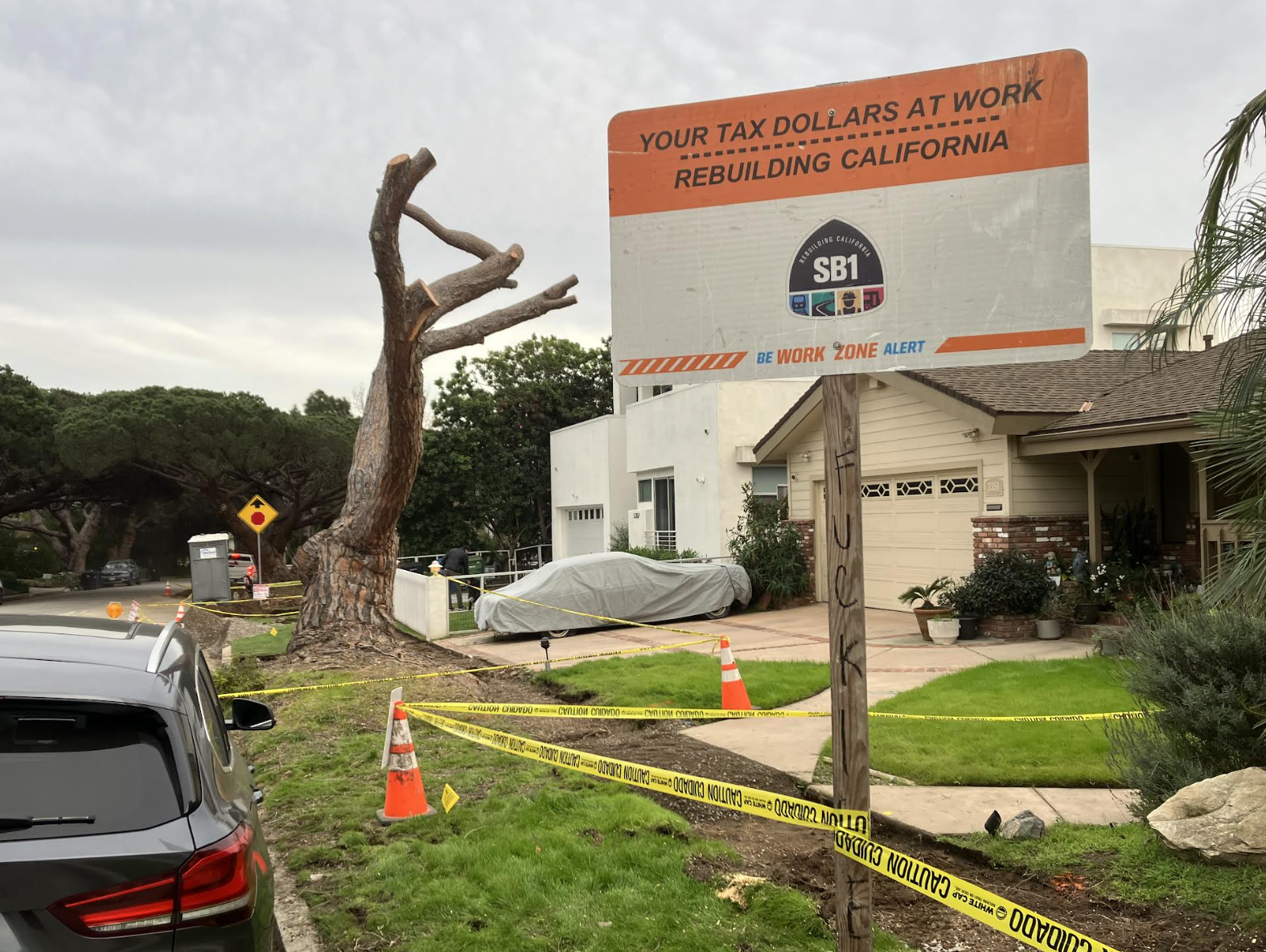
In early February, crews began sidewalk reconstruction on the 3300 block of Moore Street, which becomes Warren one block west. At first, some neighbors feared that mature trees were being cut down. But residents who visited the site found something different: sidewalks were being rebuilt while most of the large Italian stone pines remained standing.
Photos from the site show trenches dug along the parkway, exposed roots, and newly poured sidewalks that curve and narrow to work around the trunks of mature trees. In several locations, concrete has been removed and replaced in ways that preserve existing canopy rather than remove it. A sign posted at the site indicates the work is funded through SB1, California’s transportation infrastructure program.
For residents involved in the Warren Avenue discussions, the contrast was striking. For months, the City has maintained that repairing Warren’s road requires removing three mature Italian stone pines, citing infrastructure damage and liability concerns. Yet on Moore, repairs appear to be moving forward while preserving trees that are similar in size and age, even where roots are clearly interacting with sidewalks.
Neighbors emphasize that they are not opposed to repairing streets or sidewalks. Many have repeatedly said the pavement conditions on Warren are poor and need attention. The dispute has centered on whether mature trees must be sacrificed to complete that work, or whether engineering and arboricultural solutions can allow repairs while preserving canopy.
The Moore project has intensified skepticism about the City’s position.
A board member of the Gregory Ain Mar Vista Tract HPOZ who has been deeply involved in months of discussions about the proposed Warren Avenue tree removals contacted state officials seeking clarification after being unable to get answers locally. According to residents, staff in Councilmember Traci Park’s office said they were not aware of the Moore Street work, even though it was taking place immediately adjacent to Warren while the council office was actively meeting with neighbors about tree removals in the same corridor. For residents who have attended meetings, gathered arborist opinions, and tried to negotiate alternatives for months, the explanation that the council office was unaware of nearby work has been difficult to reconcile with the level of prior engagement.
The way the Moore work unfolded has also raised questions about transparency. Residents on that block report that notices about sidewalk repairs were issued roughly two years ago, but little information circulated afterward until construction vehicles arrived and work began. Several neighbors say they are still trying to determine what agencies approved the project, what alternatives were evaluated, and how decisions were made about tree preservation.
At the same time, residents working to preserve the Warren trees say they are still waiting for a public hearing date and clearer documentation about the cyclist lawsuit that has been cited as justification for urgency. Meetings with the council office have continued, including a planned on-site discussion intended to provide updates and answer questions, but many residents say the process has felt slow and uncertain.
The events on Moore have shifted the tone of those conversations. What once felt like a technical debate about arborist assessments and liability is now being viewed by some residents as a broader question of priorities and consistency. If sidewalks can be redesigned to preserve mature trees on one block, they ask, why is the same approach not being pursued more aggressively on the next.
Mature Italian stone pines provide environmental benefits that cannot be quickly replaced. Large canopy trees reduce street temperatures, improve air quality, and manage stormwater in ways that newly planted saplings cannot match for decades. Arborists who have examined trees along Warren have previously indicated that several of the trees marked for removal appear healthy and could potentially survive less destructive repair methods. Residents say they plan to continue pressing city departments and elected officials for documentation explaining how decisions are being made, what alternatives were considered, and whether additional trees in the corridor may be at risk.