
As votes are tallied on Prop 40, many are asking how California, of all states, failed to pass a wealth tax. Even Jensen Huang (worth over $200 billion) said he’d happily pay it. Yet a lot of voters who celebrated the “blue tsunami” rejected the measure, in part because they believed billionaires would flee the state. The explanation has less to do with economics than with psychology. To help me explain, let’s go back a few decades.
Earth Day. 1971.
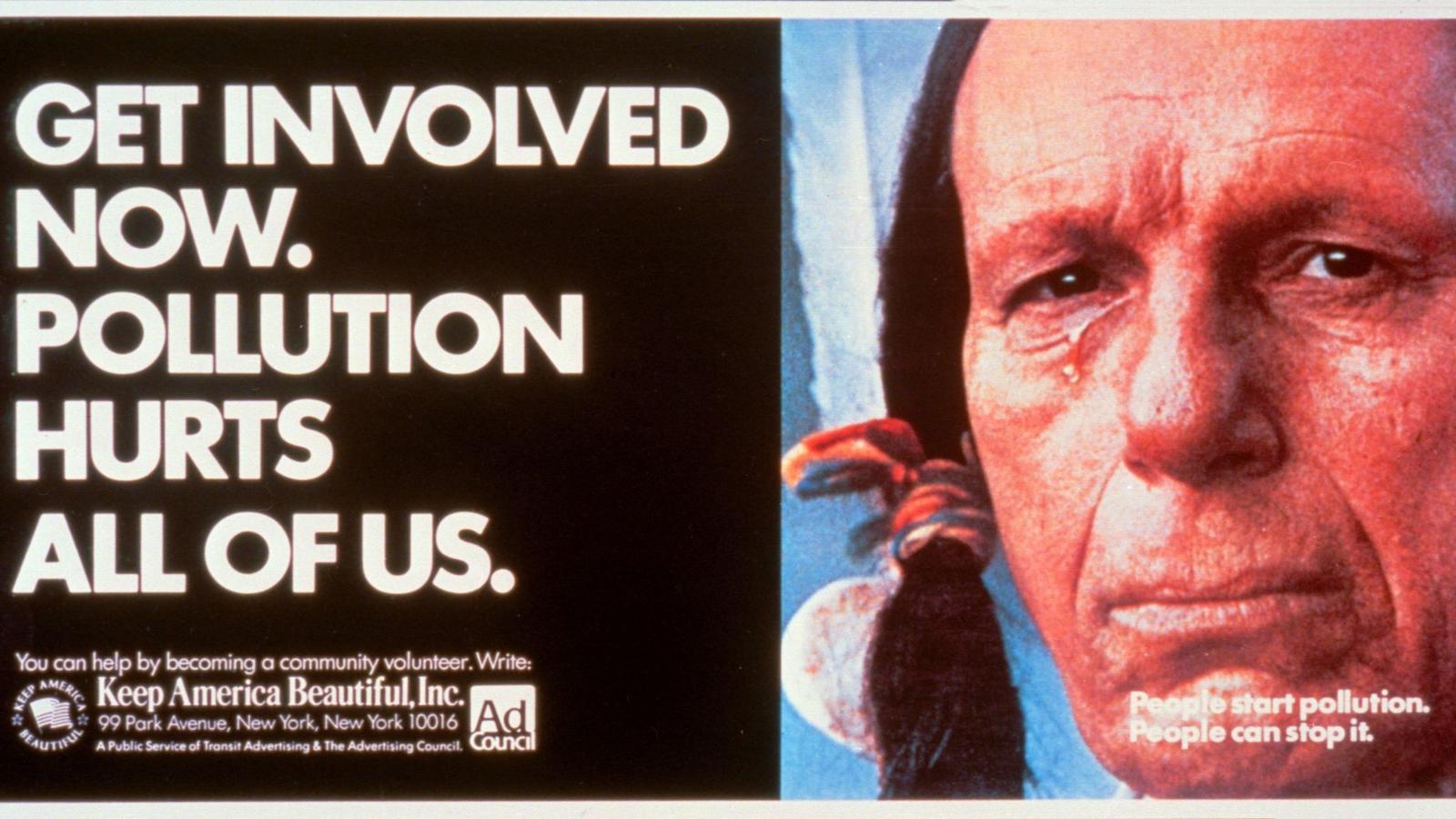
A public service announcement commercial showed an Indigenous man in buckskin paddling a canoe past floating garbage, stepping onto a highway shoulder, and shedding a single tear as a bag of trash landed at his feet. “People start pollution,” the ad told us. “People can stop it.” The message felt pure. It wasn’t. Keep America Beautiful, the nonprofit behind the ad, was funded by Coca-Cola, PepsiCo, Philip Morris, and Anheuser-Busch, companies that spent the same years fighting bottle bills that would have forced them to sell their drinks in reusable containers. The nonprofit was founded in the 1950s partly in response to Vermont’s attempted mandatory deposit law. The ad became famous as the ‘Crying Indian,’ a name that flattened living Native nations into a single mascot. The actor was an Italian American man named Espera de Corti. The campaign didn’t just discourage littering. It quietly redefined pollution itself, from something industries produce into something individuals choose, so that the only solution left was you.
In that short ad space, this is the sequence of how they changed the issue:
- Litter and pollution are the same thing.
- Littering was a choice made by individuals.
- All people are guilty of pollution if they litter.
The question they didn’t want you to ask: Who produces the pollution?
2016. The United Kingdom.
“Take back control” was the clarion call of the Brexit campaign, and it was repeatedly criticized for vagueness on what leaving would specifically look like. Boris Johnson himself brushed off specifics during the campaign. But the slogan did its rhetorical work precisely (particularly the word “back”) because it framed control of laws, borders, and money as something taken from voters, positioning any benefits of EU membership as the cost of reclaiming what was rightfully theirs.
The question they didn’t want you to ask: What are we giving up to get this control back?
Both campaigns installed a feeling (guilt, loss) and let the feeling answer the question. When a PROBABLE outcome gets sold as a CERTAIN one, people stop calculating and start defending. In one of the bluest states in America, it happened again, with mountains of economic evidence sitting right in front of us.
So here we are, back in the present day.
Raise your hand if you read the 63-page National Bureau of Economic Research Working Paper breaking down the Billionaire Tax Act.
Heck, raise your hand if you at least read the December 2025 10-page report. Ten full pages of questions and answers written by:
- a prominent legal scholar who helped draft state-level wealth tax legislation (Brian Galle, UC Berkeley)
- a leading expert on tax law design who co-developed the ULTRA method for valuing extreme wealth (David Gamage, University of Missouri)
- a respected law professor who literally helped write the initiative itself (Darien Shanske, UC Davis)
- oh, and one of the most cited economists in the world on inequality and tax policy, who co-developed the top-1% income-share methodology and advised Bernie Sanders, Elizabeth Warren, and governments around the globe (Emmanuel Saez, UC Berkeley).
These two reports are as close to the source as you can get.
Meanwhile, a January 2026 CNBC article stated that nearly half of voters treat billionaire flight and court challenges as near certainties, and believe billionaires “account for much of state tax revenue”. The issue with that statement is that, according to the study, California billionaires contributed approximately 2.5% of total personal income tax receipts. So if my math is mathing, in 2024–2025 the total California income tax receipts were $104.3 billion, meaning ~$2.6 billion in income tax revenue that year was from billionaires. The article discussed a feeling of how much billionaires contributed; the report gave the percentage.
Here’s the part of that article that should bother you. The Mellman Group was the company that polled 800 Californians about Prop 40. They were hired by Republican strategist Mike Murphy on behalf of interested parties, including some of the very high-net-worth individuals the tax would target. Then they gave voters their selected arguments from both sides, positive and negative. Support dropped from 48% to 46% and opposition jumped from 38% to 44%. “There’s no love for billionaires,” Murphy admitted, “but there are severe doubts among voters about whether this measure will deliver what it promises.” The opposition strategist was himself confirming that the contest was never about fairness. It was about doubt manufactured into certainty.
Seventy-three total pages of data, reasoning, verifiable references, tables, and figures from experts in this field of study. A poll conducted by a company hired by the opposition reporting that a percentage of people felt billionaires may leave. People take the small, digestible poll at face value because it hands them a ready-made answer and lets them move on with their decision feeling certain.
THE ANSWER TO THE ULTIMATE QUESTION OF LIFE, THE UNIVERSE, AND EVERYTHING
Now that you have been sufficiently supplied with examples, effects, data, and long explanations, I will use an extreme simplification so you can forget all the rest.
In each example, choose between A and B:
Example 1
A. A sure gain of $2 billion
B. An 80% chance of gaining $10 billion and a 20% chance of gaining nothing
Example 2
A. A sure loss of $2 billion
B. An 80% chance of losing $10 billion and a 20% chance of losing nothing
This is what’s called the Certainty Effect. It is a quirk of human psychology that comes from Kahneman and Tversky’s 1979 paper on prospect theory (arguably the most cited paper in psychology). It states that we value certainty much more than we should, and we are irrationally afraid of losing it.
Simply put: We act like the difference between “certain” and “probable” is HUGE, but the difference between “probable” and “unlikely” feels so much smaller to us.
So if you chose A in Example 1 and B in Example 2, congratulations, you’re human. You took the sure thing when it was framed as a win, then rolled the dice the instant the same numbers were assigned to the word “loss”. The change in the wording changed your behavior.
The opposition never proved billionaires would leave. They just stopped treating it as a probability and started saying it as a fact, so when voters weighed the sure revenue against a gamble framed as certainty, choosing the tax felt like signing up for a guaranteed loss.
Their frame was:
- Vote No, a sure bet to keep what you have.
- Vote Yes, a gamble where the billionaires all leave and everyone loses.
Our frame needed to be:
- Vote No, a guaranteed $19 billion deficit affecting the hospitals, schools, and food assistance.
- Vote Yes, save all the programs with $20 billion a year from 250 people who can afford it, and a small chance some billionaires leave.
So here is where we sit at this moment. We watched the polls slowly go from supporting the idea to underwater. As of today, the proposition looks to have been defeated. A groundbreaking attempt at equality failed to break any ground. Representative Khanna has already promised to fight for another wealth tax in 2028. The identical cycle starts again.
BUT IT DOESN’T HAVE TO BE THIS WAY
We are all aware that when these issues are on the ballot, we start from a position of deficit. The money behind fighting these issues is real. The silent circles they run in may even include your representative. There are so many other behavioral “nudges” that can be used (hence the entire subject of behavioral economics). But there is no monopoly on the science. How you frame something can also remove the power of the opposition while empowering the voter.
You will not win a person over with a 63-page paper. They didn’t arrive at their belief by reading 63 pages, and they will not leave it that way either. The power is not in correcting the belief; it is in reopening the question.
So here is a toolkit to cut through the influence using the “billionaires leaving” example. The great thing about this toolkit is that its only goal is to help facilitate healthy debate. It is not a tool for manipulation; it is a tool for cutting through it.
1. Don’t attack the conclusion. Audit the certainty.
The vulnerable point is not that billionaires will leave California; it is how sure they are. “You sound really certain they’d all leave. Where did that come from?” Then just listen. Rarely will there be a better answer than “everyone says so” or “Gavin Newsom said so”. Hearing themselves say that out loud does more work than any statistic you could supply.
2. Ask for the number, don’t give it.
If they say “billionaires pay so much of the taxes here”, the worst response is “actually they pay 2.5%”. That turns into a fact-fight you lose even if you win technically. Instead, ask, “Do you know roughly what share that is?” And let them guess. Any gap between their guess and the reality is their discovery. And self-generated beliefs stick way more.
3. Compare the claim to the behavior.
“Did you see Meta restructured Zuckerberg’s stock so he could pay the tax and stay? Why would they do that if leaving was a certainty?” You’re not saying they are wrong; you are pointing at a public fact and asking them to reconcile it. Reconciliation attempts are where manufactured certainty cracks.
4. Name the feeling, not the falsehood.
“It makes sense you would worry about the state losing money. Everyone would.” We all relax a bit and are more open to discussion when our feelings are validated. Certainty was installed with a feeling, so it’s displaced by a competing feeling, not a counterargument.
5. Offer the better question as a gift.
This is where your question is repositioned and left behind like a bookmark. “The thing I keep asking myself lately is: …” People adopt questions they use themselves far more readily than questions used as weapons against them.
6. Price their sure thing.
The opposition’s “vote no” only feels safe because nobody’s asked what it costs. “How much exactly would the state lose if they all actually left?” It converts their certainty back into the unknown. Manufactured certainty can’t survive being priced.
Your patience needs to mirror the manipulator’s patience. The pollution campaign didn’t take root in a single broadcast. It ran for decades. But breaking it can take one question and a willingness to wait for the answer to come from them, not from you. Kahneman and Tversky weren’t writing about politics. They mapped a machine. The certainty effect, loss aversion, prospect theory, etc. are features of the human mind, not weapons someone forged. In California, one side has held them since long before any of us started paying attention. They’ll run the machine on every ballot yet to come. Let’s finally run our own.
Sources
The full NBER Working Paper:
Boll, Jasper, et al. California Billionaires: Wealth, Taxes, and Wealth Tax Revenue Estimates. NBER Working Paper no. 35218, May 2026, rev. Aug. 2026.
https://eml.berkeley.edu/~saez/BSZ26CAbillionaires.pdf
10-Page Report:
Galle, Brian, et al. Expert Report On The California 2026 Billionaire Tax: Revenue, Economic, and Constitutional Analysis. 31 Dec. 2025.
https://eml.berkeley.edu/~saez/galle-gamage-saez-shanskeCAbillionairetaxDec25.pdf
“California billionaire tax faces potential ‘uphill battle,’ new poll finds.” CNBC, 20 Jan. 2026.
https://www.cnbc.com/2026/01/20/california-billionaire-tax-faces-uphill-battle-new-poll-finds.html
Kahneman, Daniel, and Amos Tversky. “Prospect Theory: An Analysis of Decision under Risk.” Econometrica, vol. 47, no. 2, 1979, pp. 263–91. JSTOR.
https://doi.org/10.2307/1914185
“Mark Zuckerberg’s Creative Plan to Pay California’s Proposed Billionaire Tax Without Losing Control of Meta.” TechCrunch, 22 Oct. 2026.