

At the first major mayoral debate this week hosted by the Housing Action Coalition and Streets For All, one of the central ideas driving Los Angeles housing policy was laid out in unusually clear terms. The moderator opened the exchange by articulating the core supply-side argument as cleanly as it is usually presented in policy circles, stating that academic researchers have found that new market-rate housing creates “chains of moves” through the market, with higher-income renters moving into new units and freeing up older ones, ultimately “driving down rents overall.” It was a textbook description of filtering, the idea that affordability can emerge indirectly through market dynamics rather than being built directly.
Rae Huang responded just as plainly: “It doesn’t trickle down. Trickle down theory has not been working.” Nithya Raman did not engage that claim directly, instead pivoting to a broader “abundance” framing, emphasizing that LA needs “a lot more housing . . . everything from market rate housing to . . . affordable housing” and that the city should “encourage the construction of all kinds of housing,” reinforcing the urgency of building without addressing the question Huang had raised about who actually benefits from that construction.
That exchange captures a persistent divide within progressive housing politics. Supply-side advocates, now embraced by leaders like Nithya Raman, argue that building more housing at all levels will eventually ease affordability pressures through filtering. But critics like Rae Huang are increasingly pushing back, arguing that this trickle-down logic does not reach the people most at risk of displacement and homelessness.
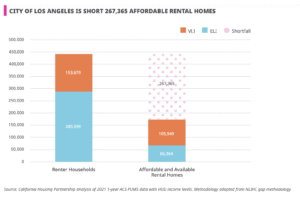
At the center of that divide is the filtering theory itself. It provides the bridge between new market-rate construction and the promise of affordability for everyone. To be clear, there is real research showing that this mechanism exists at the margins. New market-rate construction can reduce rent pressure in nearby areas and create vacancy chains that allow some households to move into lower-cost units over time. But that effect is often overstated, and it is not the same as saying that market-rate development will produce housing that is affordable to low-income or extremely low-income renters.
Cities like Austin are often cited as proof that building large amounts of housing can bring rents down. In recent years, Austin added tens of thousands of new units at a pace far exceeding most U.S. cities, and overall rents declined as supply surged. At a broad level, this reinforces the basic point that supply matters. But the nature and limits of those gains are important. The reductions came largely through increased vacancies and marginal rent declines, not through the creation of housing affordable to the lowest-income renters. Even where rents fall, they do so from price points that remain far out of reach for households earning the least.
A 2026 analysis of high-growth metropolitan areas found that even in places that have added significant amounts of housing, the gains have been concentrated at the top. In Phoenix, rents for extremely low-income households rose by 26.7 percent between 2015 and 2023, while rents for higher-income households declined over the same period. Across the six metros studied, lower-income households experienced faster rent growth than higher-income households in most cases, despite above-average levels of construction. So even where filtering may be occurring, its benefits are uneven and do not reach the bottom of the market.
One reason is that housing markets are not a single ladder where units simply move downward from rich to poor. They are segmented by income, household type, and housing product. Much of the housing being built today is concentrated in studios and one-bedroom units aimed at higher-income, single renters, not the larger, more affordable units that many low-income families actually need. Even before filtering enters the picture, there is a mismatch between what is being produced and who is experiencing the greatest housing instability. At the same time, higher-income renters do not simply vacate older units as new ones are built. They continue to compete for older housing, particularly in high-demand cities like Los Angeles, limiting the availability of lower-cost units even as supply increases.
Another problem is that filtering is neither guaranteed nor one-directional. In tight housing markets, the process can stall or even reverse, with older units “filtering up” as they are renovated, repositioned, or rented to higher-income tenants. Meanwhile, the stock of low-cost housing is steadily shrinking. Older units are being demolished, converted, or upgraded to command higher rents, offsetting whatever affordability gains new construction might produce. The result is what researchers describe as a “leaky bucket,” where new supply is continually offset by the loss of existing affordable housing.
Even when rents decline at the margins, those reductions are not large enough to reach extremely low-income renters. A unit that drops from $3,000 to $2,700 or even $2,400 is still far out of reach for a household earning $25,000 or $30,000 a year. The math simply does not work. The private market can only deliver housing at price points that cover land, construction, financing, and operating costs while generating profit, and those price points sit far above what the lowest-income renters can afford. That gap is structural, not temporary. It cannot be closed through filtering alone, especially on the timeline of a crisis already displacing thousands of Angelenos.
Another structural issue that often goes unaddressed in supply-side arguments is that upzoning and increased development capacity can raise land values. This creates windfalls for property owners unless that value is captured for public benefit. Tools like Enhanced Infrastructure Financing Districts (EIFDs), including proposals tied to projects like high-speed rail, are designed to capture some of that value by reinvesting future property tax increases into infrastructure and related improvements. But because EIFDs rely on future tax increments and only capture a portion of the total value created, much of the upfront gain from rising land prices still goes to private landowners. They also do not guarantee that funds are directed toward deeply affordable housing.
Capturing that value more fully would require mechanisms that act earlier and more directly, such as taxing land value increases at the point of upzoning, expanding public land ownership and land banking. Or better yet, using long-term public ground leases and social housing models to take land out of the speculative market altogether. Without those stronger tools, the gains from increased density are largely privatized, while affordability remains out of reach for those with the least ability to absorb rising costs.
At the same time, it’s important to understand why supply-side arguments have gained so much traction in the first place. In LA, decades of entrenched NIMBYism have made it extraordinarily difficult to build any housing at all, particularly multifamily housing. That resistance is rarely framed in terms of equity. It shows up instead as concerns about parking, traffic, height, or neighborhood character. This stubborn resistance to new housing has created a real and persistent supply constraint, making the argument “we need to build more” both intuitive and difficult to dispute. This has shaped the politics of the debate in a more subtle way, so that the fight against NIMBYism has become a kind of reflexive support for development itself, regardless of what is actually being built or who it is for.
A recent Mar Vista Community Council case illustrates this dynamic. An 81-unit, 100 percent affordable housing project proposed along Venice Boulevard became the subject of organized opposition, with residents urging the city to reject it over issues like parking, setback, and its proximity to single-family homes. The pushback was not about whether the housing was needed, but about how it might impact the surrounding neighborhood, reflecting the same patterns of resistance that have long constrained housing production across the Westside. Even here, “affordable” is doing a lot of work. The proposed units are for households earning 80 to 100 percent of area median income, roughly $75,000 to over $100,000 a year, leaving out many of the workers who make far less and are most at risk of displacement.
The fierce debate at MVCC is emblematic of a broader pattern. When opposition to housing is this absolute, the counter-response can become just as blunt, a push to approve projects precisely because they are being opposed. But that dynamic risks collapsing important distinctions between different kinds of housing. Not all housing serves the same populations, and not all “affordable” housing reaches those with the greatest need. As the mayoral debate made clear, building more housing is necessary, but not sufficient. Without tenant protections, rent regulation, and a significant expansion of deeply affordable and non-market housing, the city risks producing more units while still failing to house those most at risk of displacement.