
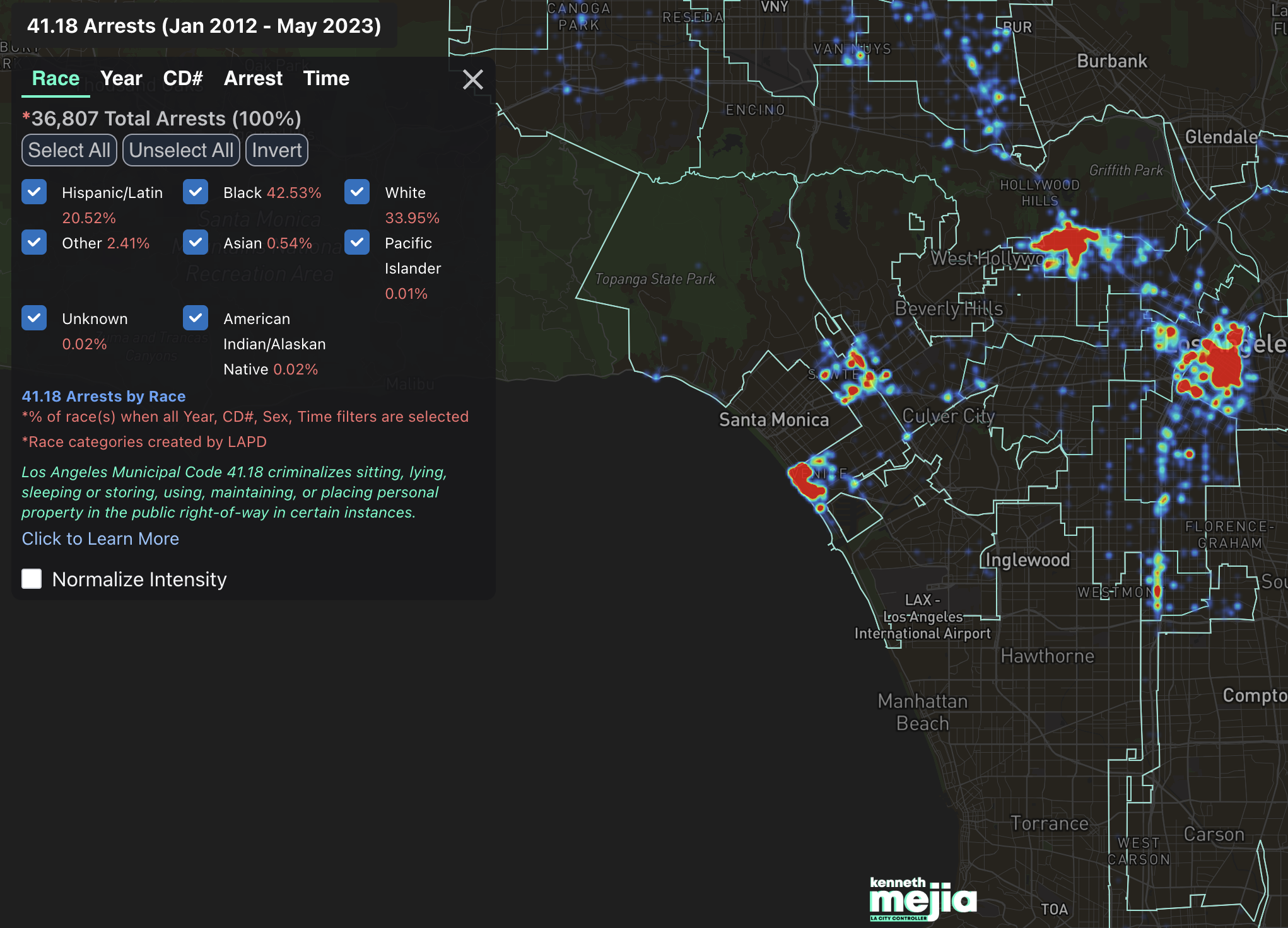
Council voted 11-4 Tuesday to dramatically expand anti-camping enforcement in Council District 6, approving Council File 26-4118-S5 and creating 26 new LAMC 41.18 enforcement zones across parks, underpasses, washes, recreation centers, rail corridors, and other public spaces. The vote came despite years of mounting evidence showing that criminalization simply moves visible suffering from one neighborhood to another without reducing homelessness.
The motion, introduced by Councilmember Imelda Padilla and seconded by Councilmember Traci Park, passed over opposition from Councilmembers Eunisses Hernandez, Ysabel Jurado, Nithya Raman, and Hugo Soto-Martinez. Voting in favor were Bob Blumenfield, Marqueece Harris-Dawson, Heather Hutt, John Lee, Tim McOsker, Adrin Nazarian, Imelda Padilla, Traci Park, Curren Price, Monica Rodriguez, and Katy Yaroslavsky.
The expansion applies to LAMC 41.18, the law used by City Hall to prohibit sitting, sleeping, lying down, or storing belongings in designated public spaces. Supporters frame the approach as necessary public space management. Critics argue it has become the centerpiece of an enforcement strategy that consumes enormous public resources while failing to address the underlying conditions driving homelessness, such as housing costs, displacement, inadequate shelter capacity, mental health infrastructure gaps, stagnant wages, and decades of housing underproduction.
Following the Grants Pass decision by Trump’s right-wing Supreme Court, which granted cities sweeping authority to punish sleeping in public without offering shelter, some jurisdictions have responded with housing investments, prevention efforts, and diversion programs explicitly designed to reduce criminalization. Others have concluded that enforcement-first approaches fail because people without housing do not disappear. They just suffer more harm and become harder to reach.
Los Angeles has chosen a different path, following Trump’s lead and doubling down on criminalization. Our elected officials are expanding sanitation operations, police involvement, and exclusion zones while homelessness remains at crisis levels. Encampments disappear from one block only to reappear elsewhere because the underlying conditions producing homelessness remain unchanged. Housing advocates and service providers argue that sweeps disrupt outreach relationships, destroy medications and identification documents, interrupt housing navigation, and make long-term exits from homelessness harder to achieve.
The racial disparities surrounding 41.18 enforcement are well documented. According to City Controller Kenneth Mejia’s analysis of LAPD arrest data, Black Angelenos account for nearly 43 percent of all 41.18 arrests recorded between 2012 and 2023, despite making up roughly 8 percent of the city’s population. That disparity is not a proxy drawn from broader crime statistics. It is specific to homelessness enforcement. Civil rights advocates argue 41.18 enforcement reproduces the same inequities that produced the crisis in the first place. Redlining, displacement, over-policing, and economic exclusion pushed Black residents disproportionately into homelessness. The law then criminalizes them for it.
The racial dimension of 41.18 enforcement made Tuesday’s vote especially striking given what had happened just two weeks earlier.
City Council voted to curtail LAPD pretextual traffic stops after Black and Latino residents packed chambers describing racial profiling, surveillance, and over-policing. A South Central community organizer addressed the council directly: “Will you look at me, what do you see? Do you see a dad? Do you see someone who has integrity? Do you see a community organizer or do you see a criminal?” Councilmember Heather Hutt, one of the strongest voices for the reform, warned that pretextual stops had “continued the history of oppression in our community” and that officers failed to find contraband in roughly 91 to 97 percent of those stops. “It does not get the bad guy,” she said. “Instead it gets mom on the way to school or your brother trying to pick up your niece from school.” Council President Marqueece Harris-Dawson, who co-authored the pretextual stops motion six years ago, framed the practice as something more systemic than traffic enforcement, “a way to manage public space, to get people to move from one public space to another that somebody has decided is more suitable to them.”
Days later, many of those same officials voted to expand another enforcement system that researchers and advocates have argued raises identical concerns. When racial disparities emerge through traffic enforcement, City Hall acknowledges structural racism and the dangers of over-policing. When racial disparities emerge through homelessness enforcement, City Hall expands it.
The contradiction reflects a broader political transformation. Visible homelessness increasingly gets framed not as evidence of housing failure but as disorder requiring enforcement. Public frustration becomes political pressure, political pressure drives exclusion zones, and exclusion zones become routine governance, rubber-stamped week after week at City Hall.