
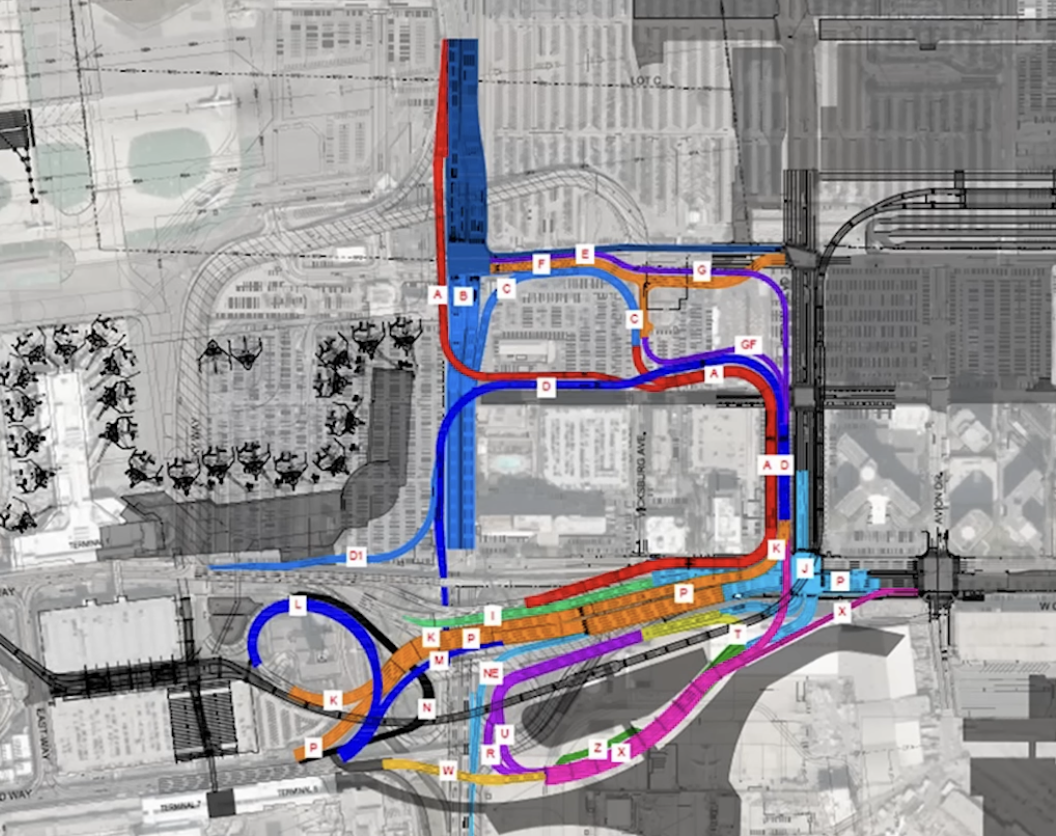
Los Angeles World Airports plans to spend $1.5 billion on a new tangle of ramps, overpasses, and flyovers at LAX, a project critics have started calling the LAX-pressway. The agency insists this expansion of 5.8 lane-miles through Westchester is essential to “modernize” airport access. In reality, it risks becoming the city’s next transportation fiasco: an outdated, car-centric plan that will make traffic worse, undermine climate goals, and divert billions from the transit system Angelenos were promised.
When Metro opened the new LAX Transit Center this summer, city leaders called it the start of a car-free era for airport access. The People Mover, now three years late, was supposed to complete that transformation by connecting travelers directly from the Metro lines and consolidated rental-car facility into the terminals. Instead, before the People Mover even opens, the airport is preparing to build what looks like a ten-lane freeway into its front door. As Alissa Walker wrote in Torched, “LAX is basically building a brand-new freeway into the airport”.
A recent analysis video from a local transportation channel lays out the absurdity in detail. The host explains that the two terminal projects that once justified this road expansion, Concourse 0 and Terminal 9, have both been scrapped due to lower passenger forecasts. Yet the road project continues anyway, “a zombie plan carried forward solely by inertia”. The video calls it “a New Jersey-style spaghetti mess,” warning that it will raise emissions, snarl traffic for years during construction, and prioritize cars over people.
The contradictions are striking. LAWA’s own studies concede the expansion will “induce additional vehicle miles traveled” with “no feasible mitigation measures” to offset the resulting pollution. Passenger volumes at LAX have dropped from projections of 110 million to 90 million travelers per year, making the case for more car lanes even weaker. At the same time, the People Mover’s contractors, already billions over budget, have been handed another major contract to build the roadways despite years of cost overruns and delays.
For residents of Westchester, the consequences will be immediate. Traffic at major intersections such as Sepulveda and 96th Street is expected to worsen significantly. The demolition of the 96th Street Bridge would remove the only safe route for cyclists and airport workers who bike to their jobs, effectively turning the airport into “a brick wall for anyone outside of a car”. Even LAWA’s own construction schedule admits that most of the project will not be finished before the 2028 Olympics, guaranteeing years of gridlock during the city’s largest events.
The larger question is why Los Angeles keeps repeating the same pattern. The city widened the 405 Freeway a decade ago, endured years of disruption, and ended up with more congestion. LAX is now preparing to make the same mistake on a local scale. Critics point out that the money could instead fund electric FlyAway shuttles every ten minutes, new bike and pedestrian routes, and real transit improvements that serve both travelers and employees.
Opponents of the project are calling for a pause, arguing that the city should finish the People Mover first, open the Metro connection, and see how many travelers still need to drive. Only then should the city decide whether expanding car access makes sense. Until that data is available, building a billion-dollar freeway to a supposedly car-free airport is indefensible.