
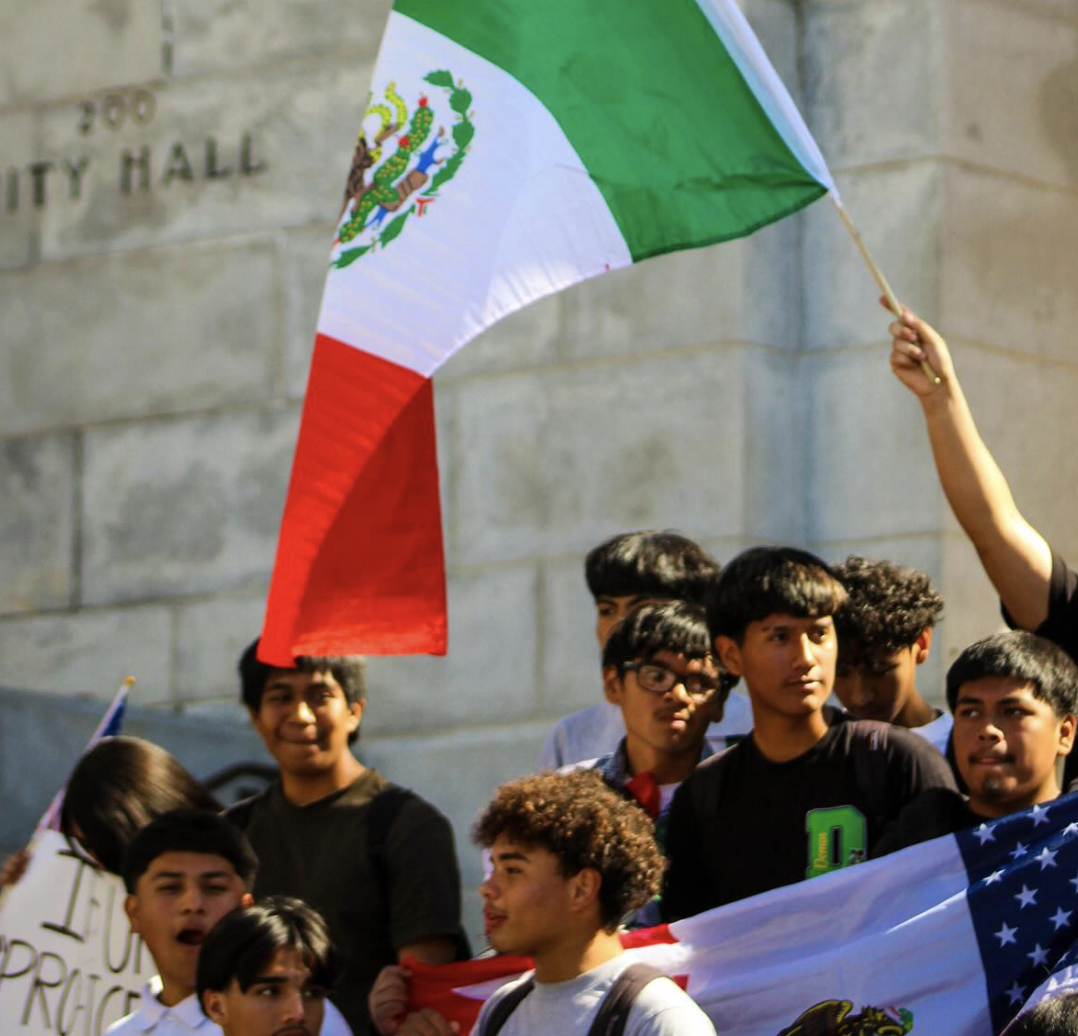
Thousands of Los Angeles students walked out of school this month to protest immigration raids affecting their families and communities, drawing an aggressive police response that has triggered growing concern among educators, civil liberties advocates, and city officials.
City Council has already moved to acknowledge that concern. A recent unanimous motion calls for the Los Angeles Police Department to report on its crowd management tactics, coordination with outside agencies, and interactions with minors during demonstrations, signaling heightened scrutiny of how youth protests are being handled. Critics, however, note that similar oversight requests have historically produced limited structural change.
Student demonstrations throughout early February drew large crowds marching from City Hall to the Metropolitan Detention Center and other downtown locations. At least six people were arrested in connection with the protests, including five on suspicion of felony vandalism and one on suspicion of battery on a police officer. Police have not clarified whether those arrested were minors or adults.
As the walkouts continued, LAPD issued a formal warning of potential legal consequences for students and families. The department stated that minors under 18 are generally prohibited from being in public during school hours and warned that violations of daytime curfew laws could lead to consequences. The statement also cautioned that any adult who transports minors to participate in unlawful activity could face arrest for contributing to the delinquency of a minor.
The warning followed demonstrations in which students encountered heavy police deployments, rapid dispersal orders, and aggressive enforcement tactics that treated student protest as a public order problem to be contained. Federal officials amplified that framing, with a senior prosecutor warning that juveniles could face criminal prosecution connected to protest activity. The rhetoric reflects a broader convergence between local policing and federal immigration enforcement priorities that has intensified under Chief Jim McDonnell. McDonnell, whose appointment drew scrutiny because of his history of cooperation with federal immigration authorities, recently said LAPD would refuse to enforce a statewide mask ban for federal agents, reinforcing concerns about the department’s posture toward immigration enforcement. Against that backdrop, LAPD’s warning about student walkouts adopts a parallel enforcement narrative that treats youth protesters as potential criminals rather than participants in protected speech. Civil rights attorneys argue that publicly targeting minors in this way undermines youth protections and risks dragging students into the criminal system for exercising civic expression.
For many students, the walkouts were not symbolic acts but responses to fear already present in their daily lives. Immigration enforcement is not an abstract policy debate inside their classrooms. It is something that shapes whether classmates show up to school, whether parents return home from work, and whether families feel safe in their own neighborhoods. The contrast between that reality and a policing response centered on deterrence has intensified questions about whose safety is being prioritized and what civic participation is allowed to look like for young people.
Student walkouts are likely to continue as immigration enforcement remains a defining reality for many Los Angeles families. The more urgent question is not whether young people will protest, but whether any institution in the city is willing or able to restrain the policing response that meets them. City Council’s recent motion calling on LAPD to explain its protest tactics suggests rising concern, but the department’s history with oversight raises doubts about whether that scrutiny will translate into consequences. The motion asks for answers but as always, stops short of creating any limits.
Chief Jim McDonnell may be called in to testify, but past oversight moments have followed a familiar pattern. LAPD exceeds its budget and receives additional funding. Hiring expands despite fiscal warnings. Reporting requirements related to force and crowd control lapse without penalty. Efforts to restrict powerful protest weapons are debated, delayed, or voted down. Accountability is discussed publicly while operational authority remains largely intact.