
When the Mar Vista Community Council voted earlier this year to oppose automated license plate reader cameras and call for their removal, residents raised familiar questions: Do the cameras improve public safety? Could the data be used for immigration enforcement? And who can access it?
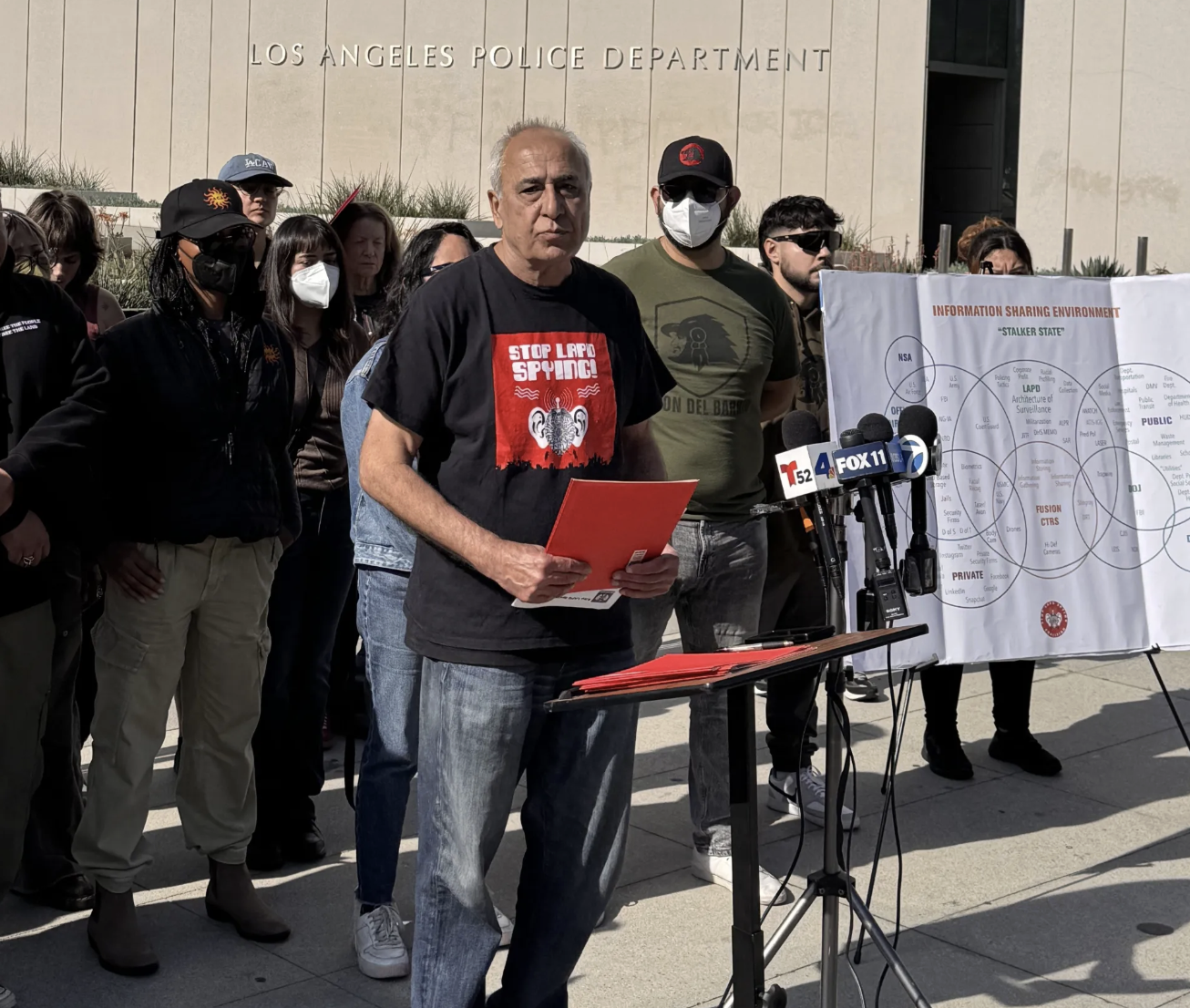
Months later, many of those questions remain unanswered. In April, the Stop LAPD Spying Coalition sued the City of Los Angeles, arguing that LAPD has refused to release contracts, data-sharing agreements, and other records that would reveal how the city’s growing license plate reader network operates. According to the lawsuit, the coalition spent two months requesting documents before LAPD produced a single expired memorandum from January 2025 and stopped responding.
The dispute comes as license plate readers face growing scrutiny across California. A federal class-action lawsuit alleges that Flock Safety, one of the nation’s largest license plate reader companies, allowed federal and out-of-state agencies, including Immigration and Customs Enforcement, to search California license plate data more than a million times in seven months. According to the complaint, a single California Highway Patrol search conducted on behalf of ICE in April 2025 reached the databases of 845 agencies statewide. Los Angeles has been named in related litigation.
At the heart of the Stop LAPD Spying lawsuit is a simple question: can the public evaluate how LAPD’s system works if the agreements governing it remain secret? The contrast with San Francisco suggests disclosure is possible. On June 17, the San Francisco Police Department released an audit of its license plate reader network, including records showing when outside agencies accessed the system and how those searches occurred.
The audit found that federal and out-of-state agencies searched San Francisco’s data 299 times over roughly a year through the Northern California Regional Intelligence Center, a state fusion center with access to the system. After the findings became public, Police Chief Derrick Lew revoked the center’s access and launched a review.
The comparison matters because LAPD participates in its own regional fusion center, the Joint Regional Intelligence Center (JRIC), which facilitates information-sharing among local, state, and federal agencies. There is no public evidence that JRIC used LAPD data in the same way. But without access to the underlying agreements, the public has no way to assess what safeguards exist or how information-sharing is governed.
What LAPD has released is its annual technology report. According to the department, its license plate reader network recorded more than 1.1 billion plate detections in 2024. Of those, 301,655 generated a “hit,” meaning an alert associated with a license plate. LAPD notes that a hit is not a solved case, an arrest, or even necessarily a lead.
The report also states that LAPD shares license plate data with several law enforcement agencies, including Huntington Park, La Mesa, Livermore, West Covina, the San Luis Obispo County Sheriff’s Office, and Los Angeles Port Police. The department says it shares data only with local law enforcement and does not cooperate with immigration enforcement through the system. But without the underlying agreements, the public cannot independently verify those claims.
Questions about oversight are not new. In 2020, the California State Auditor found that LAPD had operated license plate readers for years without a formal policy governing their use or protecting the resulting data. By then, hundreds of millions of scans had already been collected, and database access was broadly available within the department. LAPD adopted its first formal policy later that year.
Today, the debate is no longer about whether LAPD has a policy. It is about whether the public can review the agreements that determine where the data goes once it leaves the department.
Flock Safety may be the public face of the controversy, but it is only one piece of Los Angeles’ much larger surveillance network. The city’s primary system is operated by Motorola Solutions through its acquisition of Vigilant Solutions. Under a 2022 contract, Los Angeles agreed to spend more than $2 million over five years on Motorola’s license plate reader technology. By the end of 2024, LAPD had deployed 84 mobile Vigilant cameras and 160 fixed cameras citywide. More than 1,500 patrol vehicles are also equipped with Axon in-car video systems that include license plate reading capability.
Much of the network was built with Department of Homeland Security grants. Since 2006, LAPD has received federal funding to expand the program, including support for hundreds of reader-equipped vehicles. Private donations have also fueled growth, with the Los Angeles Police Foundation providing hundreds of thousands of dollars in camera equipment. In January 2025, the City Council approved $450,000 in discretionary funding for additional license plate cameras in Council District 11. The measure passed 10-3, with Councilmembers Eunisses Hernandez, Hugo Soto-Martínez, and Ysabel Jurado voting no.
The questions raised by Mar Vista residents remain largely unresolved: who can search the data, how long it is retained, and whether information collected in Los Angeles can ultimately be accessed by agencies far beyond the city. LAPD says the system is governed by policies and safeguards. But until the agreements themselves are made public, Angelenos are being asked to take the department’s word for it.