
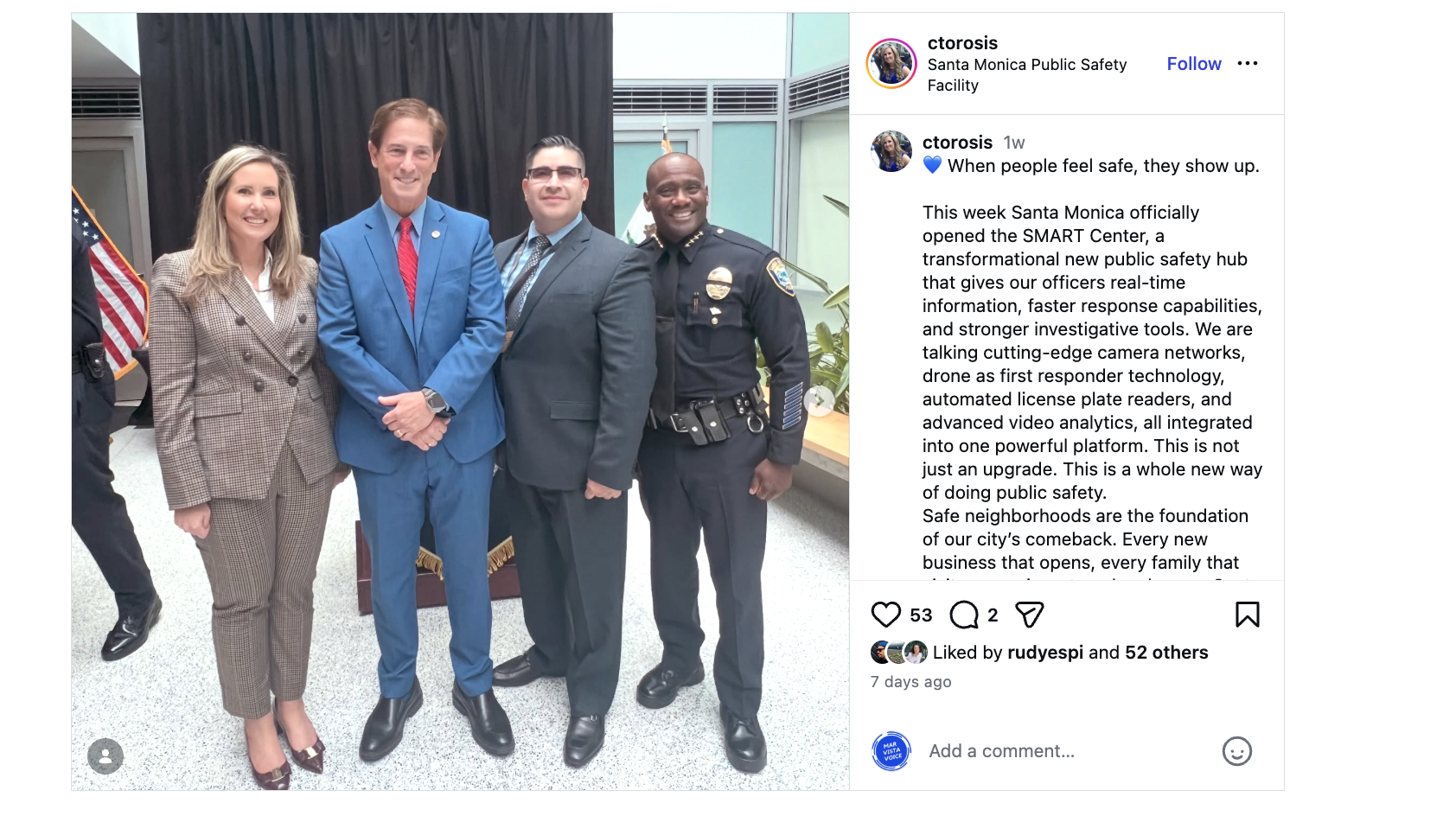
Santa Monica officials are celebrating the launch of a new high tech policing hub they say will transform how the city responds to crime. The Santa Monica Police Department’s newly opened SMART Center, described as a “real time crime center,” brings together live camera feeds, automated license plate reader data, drone technology, and advanced analytics into a single platform designed to give officers faster information and more coordinated response capabilities.
City leaders framed the center as a major step forward in public safety. According to the city’s announcement, the SMART Center integrates multiple surveillance tools into one system, allowing officers to track incidents as they unfold and deploy resources more quickly. Officials emphasized that the technology will improve investigations and help prevent crime, positioning the center as a cornerstone of Santa Monica’s broader strategy to support economic recovery and neighborhood stability.
Local coverage echoed that message, highlighting the scale and ambition of the project. Reports described a centralized command room where analysts monitor real time data streams and coordinate with officers in the field. The system reportedly includes networks of public safety cameras, access to automated license plate readers, and the ability to deploy drones as first responders in certain situations. Officials argued that bringing these tools together will reduce response times and give officers a more complete picture of incidents in progress.
But the rollout also reflects a broader shift toward expanded surveillance infrastructure across the Westside, raising questions that extend beyond Santa Monica. Civil liberties advocates and community organizers have pointed to the rapid growth of interconnected camera systems and data sharing networks, warning that these tools often outpace public oversight. Concerns focus not only on how data is collected, but how it is stored, shared, and potentially accessed by outside agencies.
Reporting across LA has documented how local surveillance systems can feed into larger regional and federal networks, sometimes with limited transparency. Automated license plate reader data, in particular, has drawn scrutiny for its potential to be accessed by agencies far beyond the jurisdiction where it was collected.
The SMART Center appears to build on that same model of integration, consolidating multiple streams of information into a single operational platform. While officials describe this as a tool for efficiency, critics argue it also increases the scale and scope of monitoring, making it easier to track movement, identify individuals, and retain large amounts of data over time. Without clear guardrails, they warn, systems designed for public safety can become tools of broad, persistent surveillance.
The timing of the launch is also notable. Across the region, debates over surveillance technology have intensified, with neighborhood councils and community groups weighing restrictions on new camera installations and data sharing practices. In Los Angeles, proposals to expand license plate reader networks and other monitoring tools have faced growing pushback, particularly as residents demand clearer policies on privacy, oversight, and accountability.
Santa Monica’s new center places it firmly within that regional trend. By investing in a centralized, technology driven approach to policing, the city is aligning itself with a model that prioritizes real time data and rapid response over privacy. So far, public discussion of the SMART Center has focused largely on its capabilities rather than its constraints. Key details remain unclear, including how long data will be retained, what specific safeguards govern access, and how information may be shared with outside agencies. These are the same questions that have surfaced repeatedly in Los Angeles as similar systems expand.
Of course, surveillance infrastructure does not stop at city boundaries, and systems like the SMART Center are most powerful when they connect with neighboring jurisdictions . As Santa Monica builds out its network, it becomes part of a larger ecosystem of data collection that spans the Los Angeles region.
Supporters argue that this is exactly the point. They see integrated systems as essential to modern policing, particularly in densely populated urban areas where incidents can cross jurisdictions quickly. Critics counter that without clear limits, the same integration can erode privacy and blur the line between targeted policing and generalized monitoring. What is clear is that the SMART Center is part of a broader transformation in how public safety is defined and delivered, one that relies increasingly on data, technology, and continuous observation.