
When Santa Monica Airport closes at the end of 2028, the city will have an extraordinary opportunity to transform 192 acres of publicly owned land. But before breaking ground on gardens, playgrounds, and housing, Santa Monica must determine out what is in the soil.
A new LA Public Press investigation highlights Santa Monica Airport as one of several locations across the County with a persistent lead problem. The reporting does not establish that the airport property is broadly contaminated, but it does lay out why the airport conversion plan must involve comprehensive testing.
Small piston-engine aircraft still commonly use leaded aviation gasoline, decades after lead was eliminated from gasoline used by cars. In 2023, the Environmental Protection Agency formally determined that lead emissions from aircraft using leaded fuel cause or contribute to air pollution that can reasonably be expected to endanger public health. The EPA describes those aircraft as the dominant remaining source of lead emissions into the air in the U.S. There is no known safe level of lead exposure, especially for children, whose developing brains and nervous systems are especially vulnerable.
Santa Monica residents have raised concerns about airport pollution for years, and government agencies have previously studied conditions at and around the airport. Air monitoring conducted by the South Coast Air Quality Management District in 2006 and 2007 found that lead and ultrafine-particle concentrations near the airport were significantly higher than background levels, and that the runway takeoff area was the source of the higher concentrations.
A follow-up study took advantage of a five-day airport closure in 2010 and found that outdoor levels of ultrafine particles and black carbon dropped substantially when airport operations stopped, then rose again after flights resumed. Researchers also documented sharp, short-term pollution spikes immediately before and during takeoff.
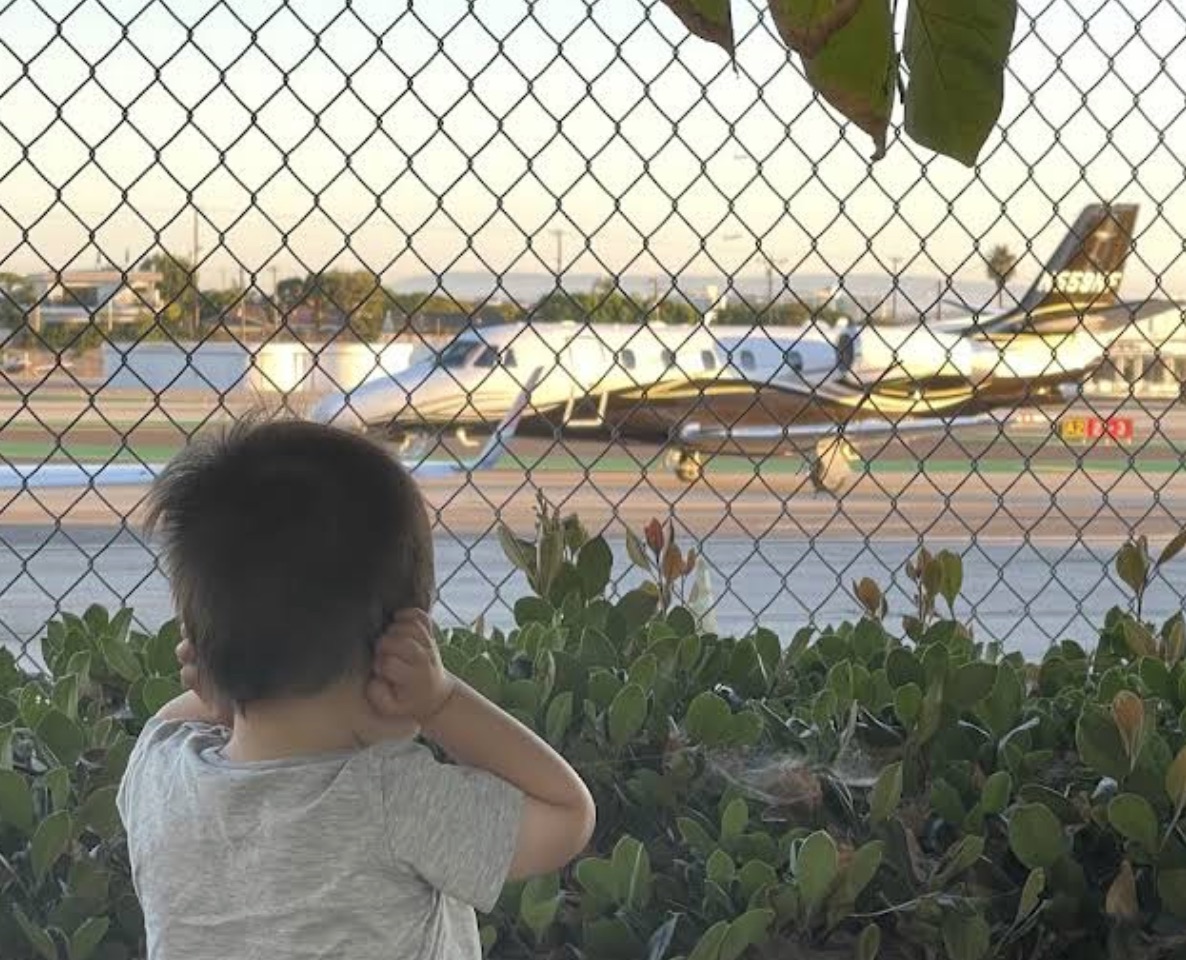
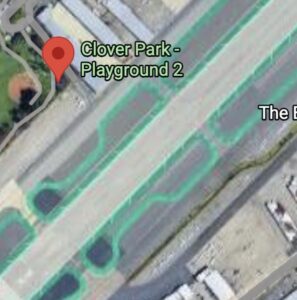
The airport’s proximity to children is especially visible at Clover Park, which directly borders the airport. The park’s smaller playground, intended for toddlers and younger children, is tucked into the corner beside the airport fence. Children climb and play while planes taxi and take off just beyond a chain-link barrier. The placement offers a striking illustration of why airport pollution cannot be treated as something contained within the boundaries of the airport itself.

Flight-school operations can multiply those takeoffs. Student pilots use the airport for “pattern work,” repeatedly taking off, circling nearby neighborhoods, landing and immediately departing again. The Federal Aviation Administration counts each touch-and-go as two airport operations (one landing and one takeoff) even though the plane is not traveling from one destination to another.
Residents in East Venice say those practice circuits have intensified. The neighborhood group Venice Skies reports that small propeller planes have performed touch-and-go maneuvers every few minutes for hours at a time. Based on its review of FAA records and airport noise reports, the group says operations increased by roughly 39 to 43 percent in 2025 compared with 2024, with some months rising much more. The group attributes the increase partly to expanded flight-school activity at Santa Monica Airport and training traffic displaced by runway construction at Van Nuys Airport.
The complaints are not new. In 2012, Santa Monica considered paying flight schools to conduct pattern work at less densely populated airports because repeated practice flights had become a major source of neighborhood complaints. At the time, the owner of one flight school said the primary reason for practicing at Santa Monica was the additional cost of flying students elsewhere.
The recent increase in training traffic does not translate directly into an equivalent increase in lead pollution. Some newer training aircraft use unleaded fuel. But when older piston aircraft still burning leaded aviation gasoline make repeated practice circuits, every additional circuit adds another takeoff and more lead emissions over the surrounding community.
Studies have already shown that airport operations affects nearby air quality, but determining whether contamination accumulated in the ground requires a different kind of investigation. Lead deposited from the air can persist in soil for generations, and airports also have have other potential sources of contamination, such as fuel storage and spills, maintenance operations, solvents, firefighting chemicals, historic industrial uses, imported fill and materials used in runways and buildings. A thorough environmental investigation would therefore include testing for all contaminants, not just lead.
Santa Monica is now moving from broad community input toward a preferred framework for the airport property and an environmental review of that plan. That process should include a comprehensive, publicly accessible assessment of soil and groundwater conditions. The sequencing is important, with testing coming before design plans. If contamination is not fully investigated until after housing and amenities are assigned to different parts of the property, cleanup costs could be used to derail the public’s priorities. Early testing would allow the city to incorporate remediation into its design, budget and construction schedule from the beginning.
Early testing would give residents a clearer picture of what transforming the airport will actually cost. Without reliable environmental data, claims about contamination and cleanup costs remain little more than speculation.