
Better Neighbors Los Angeles has identified 11 short-term rental operators it says are openly violating the city’s Home Sharing Ordinance, in a Major Violators Report delivered June 8 to Council President Marqueece Harris-Dawson and the Los Angeles City Council.
According to the report, the 11 operators could collectively be fined $201 million under existing law, calculated through April 30, 2026. For the month of April 2026 alone, the group’s potential fines total $4.5 million. All 11 were still operating as of the date of the letter, and together they advertise more than 230 listings, many in rent-stabilized buildings.
The report follows BNLA’s earlier analysis, titled Revenue or Housing? Why Not Both?, which calculated that the city could have issued $5.2 billion in citations since enforcement of the Home Sharing Ordinance (HSO) began in November 2019. The city has collected approximately $667,000 in that time, per BNLA, and the group estimates that more than half of LA’s short-term rental market is non-compliant. The new report puts names and addresses to those numbers.
The stakes of non-compliance are measured in a staggering loss of housing, not just revenue. Every illegal whole-home listing is a residence removed from the rental market, and research has consistently found that the majority of short-term rental listings in cities like LA come from commercial operators rather than individual homeowners sharing a spare room. BNLA estimates that the housing Airbnb has taken off LA’s rental market is equivalent to roughly seven years of affordable housing construction in the city. The basic mechanism is not complicated. When commercial operators convert long-term housing into tourist accommodations, the supply of homes shrinks and rents rise for everyone who remains. A study by the Los Angeles Alliance for a New Economy found that neighborhoods with high concentrations of short-term rental listings have rents more than 20 percent above the citywide average, and researchers at McGill University have estimated that short-term rentals have raised rents by an average of roughly $810 per year for each rental unit in the city.
The harm is also concentrated. Just nine LA neighborhoods account for roughly three quarters of the money Airbnb makes in the entire region, and Venice sits at the center of that map. The buildings named in the BNLA report are not a side effect of the model. They are the model, operating in the neighborhoods where the housing crisis is most acute and the tourist dollars are richest.
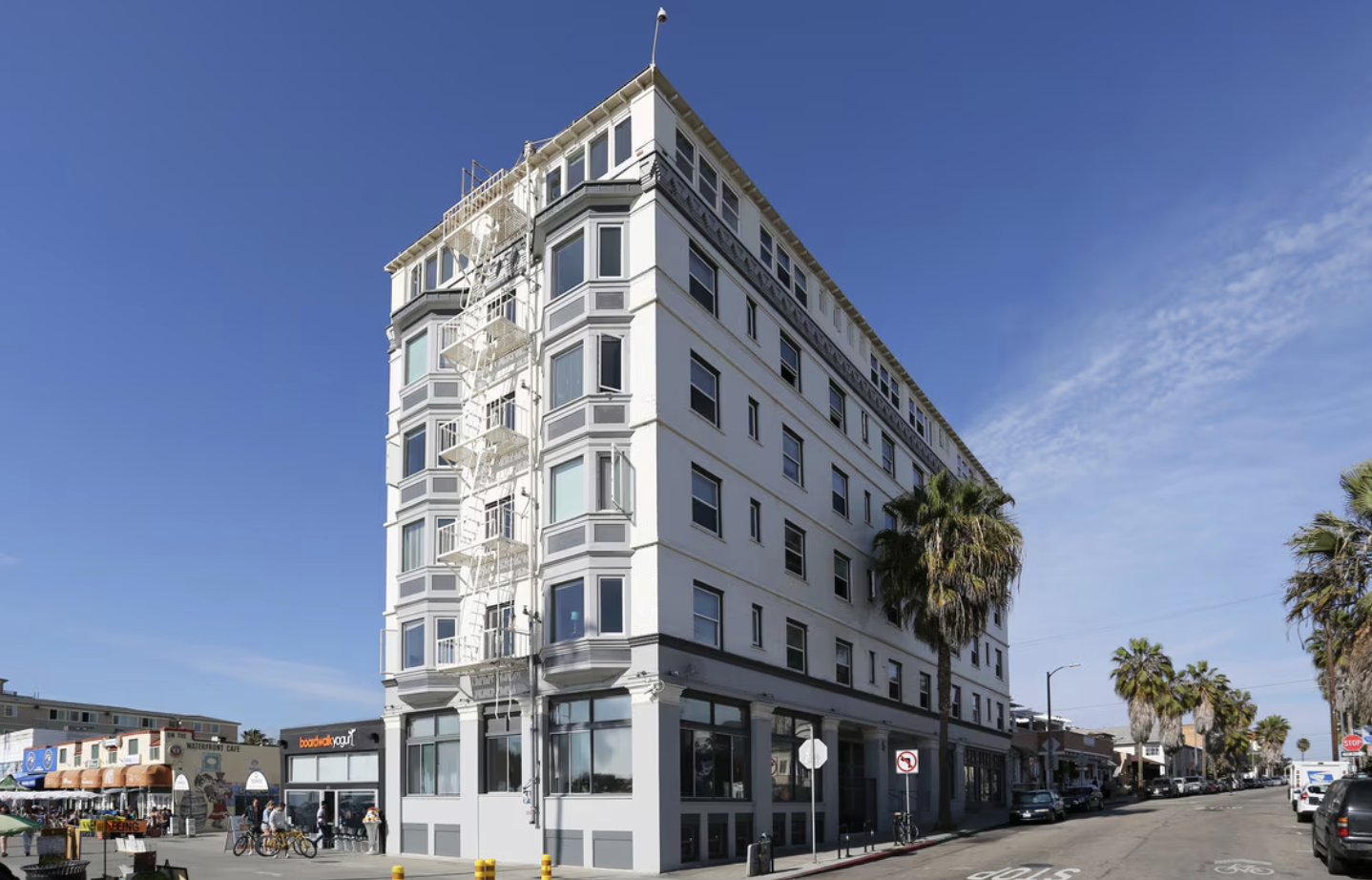
Four of the five brick-and-mortar properties named in the report are in Venice, right here in Council District 11. The HSO exempts hotels, motels, and bed-and-breakfasts that appear on a city exemption list, but none of the four Venice properties appears on that list. The distinction is not bureaucratic. Actual hotels are built, permitted, and inspected to commercial fire and life safety standards. Residential apartment buildings are not, which is one reason housing advocates warn that buildings quietly converted into de facto hotels put both guests and remaining tenants at risk.
The largest potential fine attaches to Air Venice, a 60-unit apartment building at 5 Rose Avenue covered by the Rent Stabilization Ordinance and marketed as an adults-only boutique hotel. Reviews date its short-term rental operation to before the HSO took effect, and the building’s conversion has been public knowledge for nearly a decade. A 2017 Los Angeles Times column documented a tour of converted buildings in Venice organized by housing activists and identified Air Venice as a former rent-stabilized apartment house already operating as a hotel. Nine years later, the property has received two warning letters, from November and December of 2019, and a $500 citation in March 2020, which remained open and unpaid as of early 2026. BNLA calculates its potential fines at $79.6 million.
The Venice V Hotel, a 32-unit rent-stabilized building at 5 Westminster Avenue on the Venice Boardwalk, markets itself as a lifestyle hotel. The Department of City Planning issued a warning letter in July 2021 and a $4,000 citation that September. The City Attorney’s office later rescinded the fine, and the report says no explanation was given. BNLA puts the property’s potential fines at $32.6 million.
Su Casa, a 14-unit property at 431 Ocean Front Walk whose web presence and reviews predate HSO enforcement, was issued a $500 citation in February 2020 that was closed without payment and a $5,000 citation in July 2021 that remains open. Its potential fines total $18.6 million. Gjelina Hotel, a 27-room property at 15 Rose Avenue operating since mid-2023, is classified by the city as an apartment-hotel, a designation that does not exempt it from the HSO. Its potential fines total $16.3 million.
The fifth named property is Pads on Pasadena, a 19-room rent-stabilized rooming house in Lincoln Heights with potential fines of $25.2 million. Public records cited in the report connect its ownership to Logan Altman, former owner of the Ramona Motel in South Los Angeles, who was quoted in a 2023 ProPublica and Capital & Main investigation into LA short-term rental violations.
The remainder of the report profiles six Airbnb host accounts operating between nine and 19 listings each, with combined potential fines of roughly $29 million, and documents the evasion methods behind them. Other hosts claim hotel or transient occupancy exemptions for listings that their own descriptions and guest reviews identify as units in apartment buildings in Koreatown, Little Tokyo, and Downtown.
The citation histories in the report show a consistent pattern. Warning letters are followed by fines of $500 to $5,000 against operations grossing far more than that, and the fines go unpaid, are closed without payment, or in the Venice V case are rescinded by the City Attorney’s office. A ProPublica and Capital & Main investigation found that relatively few property owners have been cited under the ordinance at all, with enforcement cases falling apart as they were passed between city departments.
None of this is new in Venice. The neighborhood was already the epicenter of the city’s fight over short-term rentals before the HSO existed, with landlords clearing rent-stabilized buildings on and near the Boardwalk of long-term tenants to convert them into unpermitted hotels. By 2017, tracking data showed roughly three quarters of Venice’s Airbnb listings were entire homes or apartments rather than spare rooms, meaning the units had effectively been removed from the rental market. And the City Attorney’s office has acted before. In 2016, then-City Attorney Mike Feuer filed civil cases against Venice landlords for illegally operating hotels in buildings that should have been rental housing, committing the office to keeping rent-stabilized units on the market. The HSO that followed in 2018 was supposed to make that kind of enforcement routine.
That office is now in transition. In the June 2 primary, incumbent City Attorney Hydee Feldstein Soto finished third, becoming the first incumbent city attorney eliminated in a primary in nearly a century. Deputy Attorney General Marissa Roy finished first with about 38 percent of the vote and will face Deputy District Attorney John McKinney, who finished second with about 32 percent, in the November runoff.
The two candidates present a sharp contrast on the issue. McKinney’s primary campaign was boosted by substantial spending from Airbnb, and Roy attacked him during the campaign for accepting it. Roy, who works on the tenants’ rights team at the California Department of Justice investigating and suing landlords for illegal rent increases, uninhabitable conditions, and tenant harassment, has said the City Attorney has the duty and authority to enforce the city’s renter protections and has chosen not to use it.
The report arrives as the city considers moving in the opposite direction. The proposed Vacation Rental Ordinance would expand legal short-term rentals beyond primary residences ahead of the 2028 Olympics, and the Mayor’s proposed budget instructs City Planning to develop a limited vacation rental program sunsetting no later than December 2028 while directing the Office of Finance to study allowing pre-payment of Transient Occupancy Tax ahead of the Games. Airbnb has funded the astroturf Save Our Services coalition supporting the VRO. The central argument for the VRO is that expanded short-term rentals would generate needed city revenue, but the BNLA’s reports show that enforcement would generate far more revenue. In fact, enforcing the ordinance would yield $47 million per month in potential fines, and unlike deregulation, enforcement would add housing rather than remove it. Housing advocates have also noted that expanding vacation rentals does not create new tourists. It just redirects existing ones out of hotels and into the housing stock.
In Council District 11, where four of the five named buildings sit, Councilmember Traci Park has received significant Airbnb-linked campaign support, and her office has floated changes to the city’s rent control law that would permit short-term rentals in RSO buildings.
BNLA’s letter to the council closes by noting that the housing matters more than the fines. The 11 operators’ 230-plus listings are more than 230 homes, many of them rent stabilized, housing tourists in the middle of a housing and homelessness crisis. Enforcing the HSO, the group writes, would return that much-needed housing to the residential market. Better Neighbors LA operates a hotline for reporting illegal short-term rentals at 213.336.5900, Monday through Friday, 9 a.m. to 6 p.m. The full Major Violators Report is available at betterneighborsla.org.