
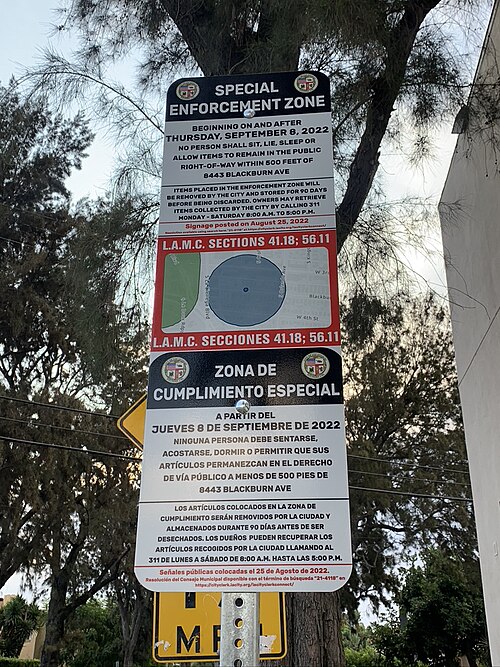
Los Angeles City Councilmember Traci Park has introduced yet another resolution to expand enforcement under Municipal Code Section 41.18, the city’s primary tool for banning unhoused people from sitting, lying, sleeping, or storing personal property in public space. The new resolution designates six additional locations across Council District 11 for enforcement, authorizing city departments to post notices and begin clearing people from these areas once the posting period expires .
The locations named in the resolution include 11357 Venice Boulevard, two addresses on West Manchester Avenue, 8448 Lincoln Boulevard, the intersection of Venice Boulevard and McLaughlin Avenue, and 13477 Beach Avenue. As with prior 41.18 actions, the resolution asserts that sleeping or lodging near these sites is “unhealthy, unsafe, or incompatible with safe passage,” and claims that the circumstances pose an ongoing threat to public health or safety. The documentation supporting those claims is not included in the resolution itself, beyond a blanket assertion that it has been “submitted or posted to the file.”
This marks the latest escalation in what housing advocates describe as a sustained campaign by Park to criminalize homelessness and vehicle dwelling across the Westside. Since taking office, Park has repeatedly used both 41.18 and the City’s oversized vehicle ordinance to clear people from sidewalks, vehicles, and public right of way, often cycling enforcement from one block to the next as unhoused residents are displaced rather than housed. Earlier this year, Park advanced her thirteenth motion targeting people living in vehicles, even as outreach workers and service providers warned that there are nowhere near enough safe parking spaces or housing options to absorb those being pushed out
The new 41.18 motion also arrives amid growing evidence that the City’s enforcement-first approach rests on deeply flawed assumptions about homelessness itself. A RAND longitudinal study found that Los Angeles’s homeless count is missing as many as one third of the people it claims to be helping, particularly those who are intermittently unhoused or pushed from place to place by enforcement. By relying on narrow snapshots and enforcement-based metrics, the City systematically undercounts displacement while overstating progress, creating political cover for policies that worsen instability rather than reduce homelessness.
Park’s resolution follows a familiar pattern. A site is declared a public safety concern, a 41.18 zone is imposed, people are forced to move, and the underlying conditions remain unchanged. In some cases, enforcement has proceeded even when zones appear to conflict with state law or City policy. In Venice, a previously designated 41.18 zone near the Rose Apartments raised serious legal and procedural concerns, with advocates questioning whether the required findings and documentation were ever meaningfully established.
Critics also point to the broader political framing behind these actions. Park has consistently aligned herself with narratives that portray homelessness primarily as a threat to public order rather than a consequence of housing costs, displacement, and systemic failure. That framing closely mirrors national rhetoric popularized during the Trump administration, where visible poverty was treated as a policing problem to be removed from sight. On the Westside, the result has been an expanding patchwork of exclusion zones that function less as safety measures and more as tools of banishment.
What is notably absent from the new resolution is any accompanying commitment to housing, services, or alternatives for the people who will be displaced. There is no requirement that shelter or interim housing be available at or near the time of enforcement, no plan for outreach beyond standard posting and clearing, and no acknowledgment of the well documented harm caused by repeated displacement. Instead, the resolution relies on the same logic that has defined 41.18 enforcement citywide since the Grants Pass decision, that exclusion itself is a sufficient response.