
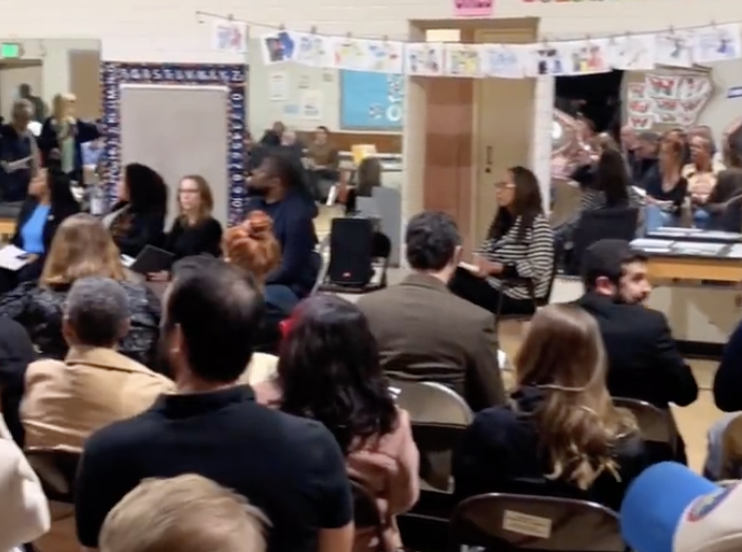
After months of requests from the Venice Neighborhood Council Homelessness Committee, St. Joseph Center and partner agencies appeared before the committee in a packed meeting that stretched nearly three hours and drew well over one hundred attendees, including housed residents, unhoused neighbors, service providers, and community advocates.
The evening opened with a brief scuffle before the meeting began when an unhoused attendee placing small advocacy signs on the walls was confronted by another participant attempting to remove them. The altercation was quickly broken up and did not disrupt the meeting, but it reflected the intensity surrounding a discussion where many participants were directly experiencing the policies being debated.
Once underway, the meeting quickly revealed the depth of concern across the room. Neighbors raised questions about sanitation, safety, and the impact of service site activity, while unhoused residents and advocates described displacement, delayed access to case management, and repeated disruptions to outreach relationships. Several speakers emphasized that these experiences are not isolated conflicts between groups but shared consequences of a system struggling without sufficient housing and service capacity.
One of the evening’s most revealing moments came during discussion of homelessness data. RAND researcher Rick Garvey referenced unsheltered homelessness increasing in Venice between 2024 and 2025, and CD11 District Director Juan Fregoso challenged the characterization, arguing Garvey was misreading his own study. Garvey’s point was specific to rough sleeping, which the RAND report tracks closely and is often the focus of public debate because it reflects what residents see on the street. The same report also cautions that enforcement, vehicle removals, and displacement can shift where people are counted without meaningfully reducing homelessness overall, a dynamic echoed repeatedly during public comment.
Questions about enforcement produced equally revealing responses. When asked why CARE+ operations continue despite little connection to housing outcomes, the explanation centered on accessibility. Venice deputy Sean Silva said the goal is to keep sidewalks and curbs clear and asserted that most residents support the approach. But the accessibility rationale rings hollow for many across the district, where entire public spaces have been fenced off or closed in response to visible poverty, making them inaccessible to everyone rather than addressing underlying needs. In that context, the policy reads less as a genuine effort to preserve access and more as an effort to remove visible poverty from spaces where it generates complaints. People are moved along, areas are shut down, and the question of where displaced residents go next remains largely unanswered.
Human rights advocates and unhoused residents repeatedly described how those policies feel on the ground. One speaker told the committee, “We’re not refusing help. We’re waiting months for a case manager that never comes.” Another resident emphasized the instability created by repeated sweeps, saying, “You lose your things, you lose contact with outreach, and you start over again. That isn’t help. That’s survival.”
Testimony also underscored the scarcity of case management resources across SPA 5, where outreach engagement outpaces the capacity to provide sustained housing navigation. Advocates noted that in some cases a single provider or limited team is expected to cover large geographic areas, creating a bottleneck between initial contact and meaningful housing pathways.
That shortage extends to mental health outreach as well. A representative from the Los Angeles County Department of Mental Health described a single multidisciplinary team responsible for all of Service Planning Area 5. SPA 5 covers Santa Monica, Venice, Mar Vista, Palms, Westchester, Culver City, Malibu, Beverly Hills, and large portions of the Westside. In other words, one team serving an enormous geographic region with thousands of unhoused residents. The scale alone makes consistent follow-up nearly impossible. Advocates said the mismatch between need and staffing helps explain why people cycle through outreach contacts without stabilization, and why a single sweep or tow can unravel months of fragile progress.
At the same time, providers and county representatives consistently acknowledged the central barrier shaping outcomes: the lack of permanent housing. During his remarks, St. Joseph Center Executive Director Ryan Smith confirmed that the organization works with LAPD during nighttime operations at Venice Beach, stating that outreach teams coordinate with law enforcement to clear the area overnight. The acknowledgment reinforced concerns that enforcement partnerships continue to shape service delivery even as housing shortages remain unresolved.
Housing scarcity surfaced again when advocates asked how opposition to new housing like Venice Dell can be reconciled with repeated acknowledgment of need. Hundreds of deeply affordable homes remain stalled after years of litigation, political maneuvering, and public expense opposing the project. At the same time, enforcement strategies including CARE+ sweeps, expanded 41.18 zones, RV targeting policies, and displacement continue moving people across the neighborhood without creating durable exits from homelessness. The RAND findings reinforce the point raised by multiple speakers during public comment: if the policy toolkit is dominated by relocation while housing remains stalled, the most predictable outcome is that homelessness moves, rather than ends.
Throughout the meeting, frustration with unmet expectations came from all directions. Residents described ongoing concerns about conditions near service sites. Unhoused neighbors described broken promises related to housing navigation and case management. Leadership frequently responded by offering to collect contact information and follow up individually, highlighting both a willingness to engage and the limits of addressing structural gaps through one-on-one responses.
The meeting also exposed deeper tensions about whose experiences define neighborhood conversations. After being told that only stakeholders (not board members) could participate in the question period, Venice Neighborhood Council Vice President Gary Pearl responded with a striking display of entitlement, telling the room, “I’m a stakeholder, I have a $6 million house in Venice.” The comment drew visible disbelief in a space where unhoused residents were speaking about basic survival.
Notably absent from the evening was Councilmember Traci Park, whose office plays a central role in the enforcement strategies discussed. Questions about CARE+, displacement, and housing delays were instead directed to staff and providers navigating their consequences. As the meeting made clear, residents are being asked to live with the fallout of decisions that prioritize managing visibility while the permanent housing pipeline remains stuck.