
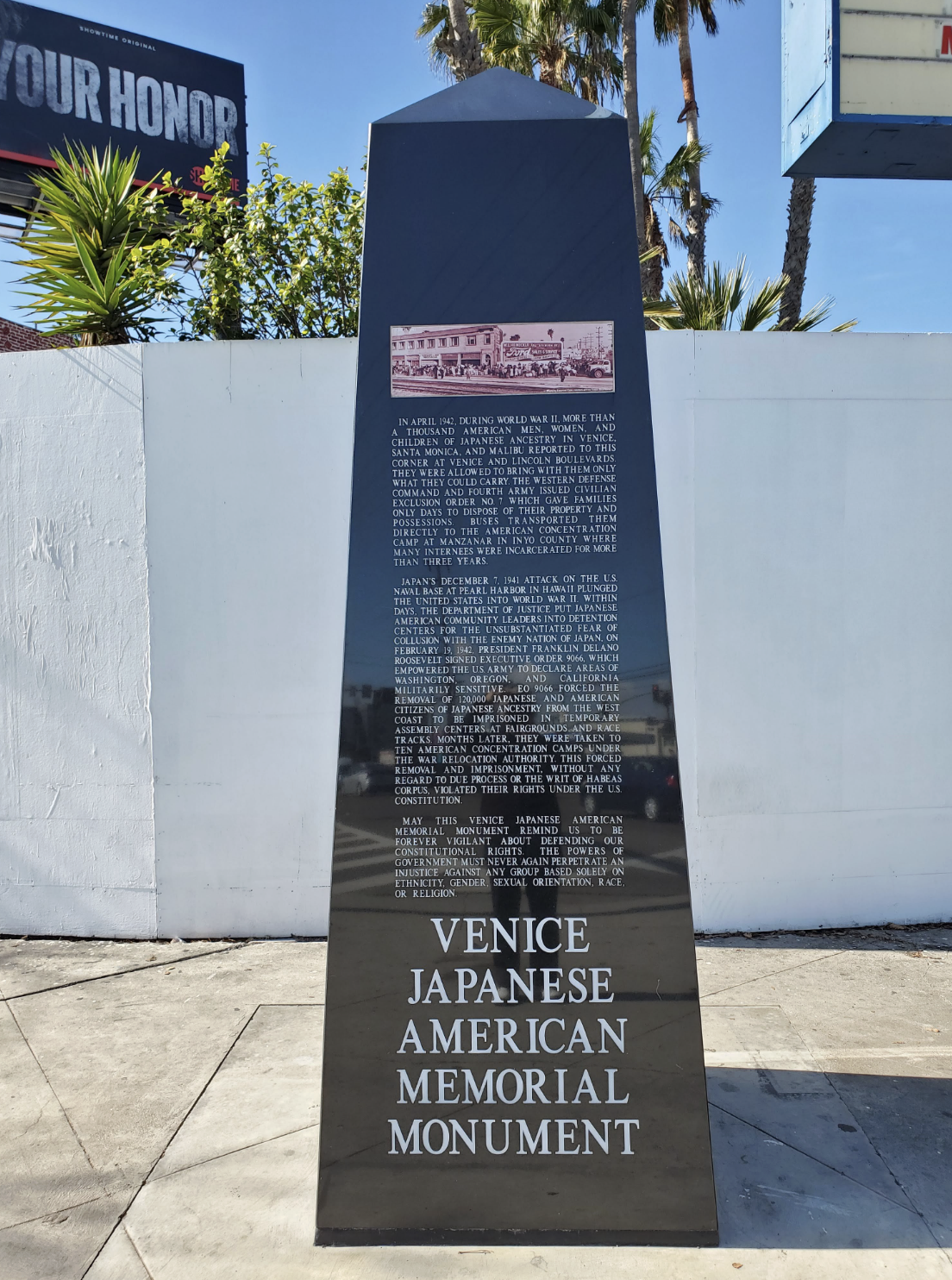
Community members gathered last month at the Venice Japanese American Memorial Monument to commemorate the 84th anniversary of the forced removal and incarceration of Japanese American families from the Westside during World War II. The annual event honors the approximately 1,000 Japanese Americans from Venice, Santa Monica, and Malibu who were ordered to report to the corner of Venice and Lincoln Boulevards in April 1942 before being transported to the Manzanar incarceration camp.
The monument itself stands directly at the historic gathering point where families assembled carrying only what they could take with them. Since its dedication in 2017, the memorial has become an important civic and educational space on the Westside, hosting annual commemorations focused not only on remembering incarceration, but warning against racism, xenophobia, and the erosion of civil liberties.
During this year’s commemoration, community organizer Suzanne Thompson directly raised concerns with Councilmember Traci Park about billboard advertising surrounding the memorial site. According to Thompson’s open letter, she asked Park to commit to keeping the monument “free from future billboard expansion so that its meaning is never diminished.”
Park publicly agreed, stating “you’re right, this monument, this remembrance, this place of importance needs to stand here alone and in primacy and doing what it needs to do for our community. So I will look forward to working with you to ensure into perpetuity that this remains here as the reminder that we need and we deserve.”
But according to Thompson and other organizers, advertising was reinstalled on the walls directly behind the monument the very next day. In her published letter, Thompson also questioned the legality of the walls themselves, noting that they were originally tied to temporary construction activity that has long since ended.
“The signage remains,” Thompson wrote. “Its presence is inappropriate for the VJAMM site, undermines the monument’s integrity, and raises serious concerns about its legality.”
The controversy has drawn renewed attention to the enormous political influence billboard companies wield at Los Angeles City Hall. Campaign finance records show that billboard giant Outfront Meida spent nearly $34,000 on pro-Park billboard advertising as an independent expenditure supporting her campaign. Thompson specifically referenced the expenditure in her letter to Park. Records also show contributions tied to and additional billboard industry money flowing into independent expenditure committees supporting Park.
For critics, the issue goes beyond campaign donations. Billboard companies have long been accused of operating through a business model in which illegal or controversial signage remains profitable even after fines and enforcement actions. Community groups across Los Angeles have spent years arguing that outdoor advertising companies routinely treat city penalties as simply another cost of doing business while relying on political relationships to avoid stronger enforcement.
The conflict surrounding the VJAMM site is not the only recent billboard controversy involving Park. Residents have also raised concerns about large Outfront Media billboards with Park’s face on them, one on Venice Blvd in Palms, and another across from a Kenneth Mejia billboard on Sepulveda between Olympic and Santa Monica Blvd. The Reddit discussion about the billboard on Sepulveda quickly turned into a broader conversation about billboard company influence in local politics.
“A corporation paying for your ad should be red flaggy as hell,” one commenter wrote. Another added: “The fact that the Park billboard is paid for by the billboard company is insane.”
Others pointed directly to Outfront Media’s involvement in Park’s campaign advertising, while multiple commenters described billboard company support for candidates as a warning sign for voters. For organizers connected to the memorial, the issue is especially painful because of what the monument represents. The site exists as a warning about what happens when political power, corporate interests, fear, and government authority converge at the expense of vulnerable communities.
At this year’s commemoration, speakers repeatedly drew parallels between Japanese American incarceration and present day immigration enforcement actions.
“My hope is that people worldwi de can do everything they can to prevent something like this from happening again,” Brian Maeda, who was born inside Manzanar, said during the ceremony.