
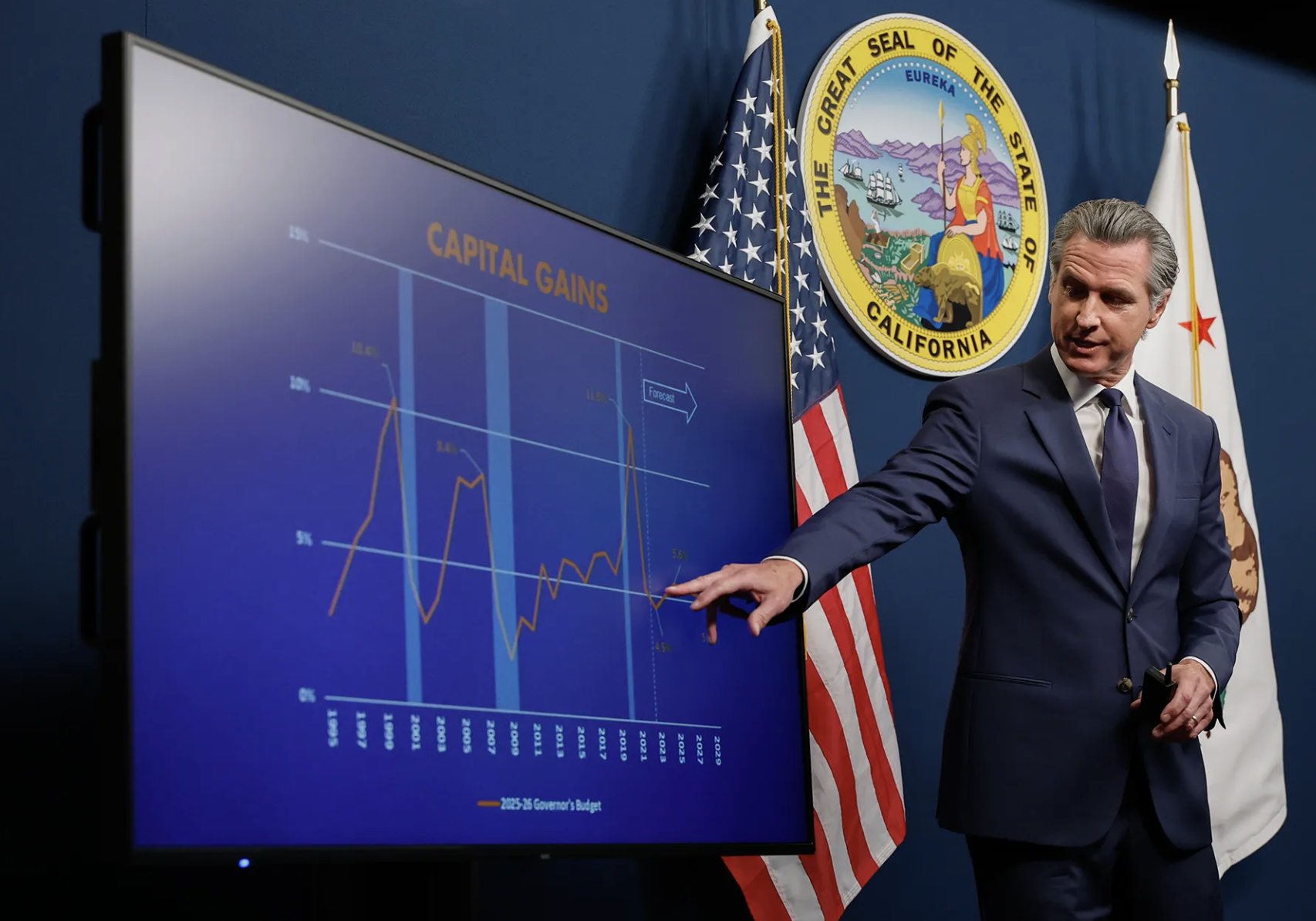
Governor Gavin Newsom’s proposed 2026-27 state budget is built on a confident bet that California’s recent revenue surge will hold, despite federal retrenchment, market volatility and structural deficits. For Los Angeles, the state’s largest city and county system, the budget delivers stability in education while shifting significant risk downward in areas in desperate need of support like healthcare, housing, and social services.
The $348.9 billion proposal includes a projected $3 billion deficit and assumes continued strong revenues driven largely by capital gains and an AI-fueled stock market. That optimism sharply contrasts with warnings from the state’s nonpartisan Legislative Analyst’s Office, which estimates the state could face an $18 billion shortfall if markets cool. The governor has explicitly declined to plan for a downturn, arguing that doing so would unnecessarily constrain spending, and that decision frames the entire budget.
For LA, the clearest upside comes in education. Thanks to higher than expected revenues and Proposition 98 formulas, K through 12 schools and community colleges are slated to receive roughly $22 billion more than previously projected. Per pupil funding would reach historic highs, with major increases for special education, community schools offering wraparound services, and universal transitional kindergarten. Los Angeles Unified and the region’s vast community college system would enjoy rare budgetary stability after years of enrollment declines, staffing shortages, and pandemic disruption.
That education windfall also functions as insulation against federal uncertainty. With Trump signaling cuts to education and social programs, the state’s willingness to fully fund Proposition 98 prevents an immediate fiscal shock to local school districts. At the same time, some of the funding is structured on revenue assumptions, meaning districts still face planning uncertainty if those change.
Outside of education, the budget’s restraint is far more pronounced.
One of the most consequential omissions is healthcare. Newsom’s proposal does not include funding to backfill sweeping Medicaid cuts enacted by the Trump administration and Republican-led Congress. Those federal changes will likely strip healthcare coverage from millions of low income Californians. Los Angeles County, which operates one of the largest public health systems in the nation, is especially at risk. Without state intervention, clinics and hospitals face higher uncompensated care, longer wait times, and mounting pressure on county budgets already under strain.
County leaders have warned that without state action, the consequences will be felt not just in health outcomes but across emergency rooms, behavioral health services, and homelessness response systems. The budget instead assumes local governments can absorb the fallout, a choice that quietly shifts responsibility downward while preserving the appearance of fiscal discipline at the state level.
Housing and homelessness follow a similar pattern. The budget maintains existing funding streams and highlights administrative reorganization through a consolidated housing and homelessness agency, but it does not introduce a major expansion in deeply affordable housing production, rental assistance, or tenant protections. For Los Angeles, where housing costs remain among the highest in the country and homelessness continues to dominate public life, the lack of major new investment stands out. The state preserves the current system without accelerating solutions commensurate with the crisis.
Climate and transportation spending also emphasize continuity over transformation. The budget sustains significant investments in wildfire response and emergency capacity, reinforcing a reactive approach to climate risk. At the same time, it offers a targeted $200 million package for electric vehicle incentives, designed in part to offset the loss of federal EV tax credits and to repair strained relationships with automakers. For Los Angeles, where transportation is a major source of emissions and air pollution, the EV funding could help sustain cleaner vehicle adoption. But the focus on consumer rebates highlights the limits of the state’s approach. The budget does not substantially expand funding for transit operations, bus priority, or active transportation infrastructure. In a region grappling with congestion, unreliable transit service, and ambitious climate targets, the emphasis remains on incremental tools rather than the systemic mobility change needed.
Taken together, the budget reflects a governor governing defensively at the end of his tenure. It protects prior accomplishments, especially in education, rebuilds reserves, and avoids visible cuts. It also avoids committing new ongoing dollars in areas where the need is most acute, relying instead on optimistic revenue assumptions and the hope that federal pullbacks and market volatility will not fully materialize.