
A damning new report delivered to the United States Senate reveals the full extent of the shocking failures in the City of Los Angeles’ response to the January 7, 2025 Pacific Palisades Fire. The report, written by Patrick Butler, current Fire Chief of Redondo Beach and former Assistant Chief of the Los Angeles Fire Department, explicitly states: “Based on my experience, the Palisades Fire was not an inevitable natural disaster. It was a preventable event shaped by decisions made before the wind arrived.” The catastrophic decisions made by the mayor’s office, Los Angeles Fire Chief Crowley, and Council District 11 Councilmember Traci Park are inexcusable.
Butler has “executive-level command experience with 50 wildfires, including direct command of five major Los Angeles wildfires over the last decade.” He states in his report that: “Life-threatening fire-weather forecasts and Red Flag warnings were issued ten days in advance, and the Pacific Palisades’ vulnerabilities, steep terrain, dense vegetation, limited ingress and egress, evacuation constraints, and a documented wildfire history, were long recognized.” The Lachman Fire, the holdover fire from January 1, which reignited when the winds exploded on January 7th, “was never fully extinguished and continued to smolder as a holdover fire without sustained monitoring.” Such conditions during past fires would have “triggered immediate and mandatory escalation of preparedness measures, pre-deployments, and activating the full force of government well before conditions deteriorated.”
The issue of pre-deployment is crucial to understanding the extent of the City’s failures. Pre-deployment is the concentration of firefighters and other resources in an area where a high-risk of fire is likely due to weather forecasts. Butler gives clear examples of pre-deployments in similar conditions to the Palisades Fire, from 2011, 2013, and 2014 which were much more effective in preventing the fires from reaching the levels of destruction of the 2025 fire. Below are simple graphs Butler provides showing that significantly more firefighters were pre-deployed in each of these incidents than were deployed to the Palisades in 2025.
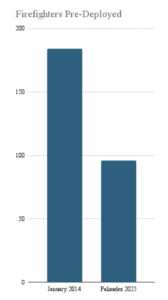
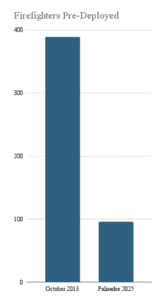
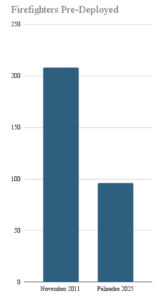
Butler concludes: “The Palisades Fire response represented a clear departure from established preparedness practices, even though forecasted risk indicators matched or exceeded prior events and sufficient resources were available.”
These failures of pre-deployment place enormous responsibility on Mayor Bass and Chief Crowley. But it is clear that Councilmember Traci Park also deserves to be held accountable for her failure to help coordinate pre-deployment. Traci Park appeared on the LA Times’ podcast Rebuilding LA on November 12th, 2025. Reporter Kate Cagle asked the councilmember: “What was your involvement in the emergency preparations leading up to that wind event? Were you aware that they hadn’t pre-deployed to the Palisades?” To which Park replied: “No, no. Unfortunately, those were not conversations that I am a part of or council offices typically are a part of . . . I don’t think that’s ever been a practice in the city.”
This directly contradicts established practice, in which council offices are, in fact, involved in pre-deployment conversations. Traci Park’s predecessor in Council District 11, Mike Bonin, said on an October 13th episode of LA Podcast: “in Palisades and in Brentwood when it’s a red flag day, when conditions were bad and it was likely for heightened risk for fire, I was always on the phone as the councilmember with either the fire chief or the battalion commander asking what the deployment was, pushing for more resources… So one of the questions I got to ask is, where the hell was Traci Park in all of this?” As Butler observed, Traci Park participated in “a clear departure from established preparedness practices,” abandoning approaches used by previous Councilmembers to effectively protect constituents from disaster. If Traci’s office had done more to advocate for pre-deployment, if they had noticed that not enough LAFD resources were being deployed to the area, could more of the Palisades homes have been saved? Could lives have been saved? It certainly seems likely.
Park’s claim that she was not part of these conversations is especially difficult to square with her otherwise close and well-documented working relationship with the Los Angeles Fire Department. Park has worked closely with the department on political campaigns, including her opposition to the safe streets Measure HLA, and the firefighters’ union contributed more than $400,000 to her 2022 City Council campaign. It is therefore implausible that Park lacked either access or opportunity to raise urgent concerns about pre-deployment in the face of a clearly forecast, life-threatening wind event. The notion that she could not, or did not think to, pick up the phone under these circumstances strains credulity.
Traci Park is very plainly on the record confirming that she was not involved in pre-deployment conversations with LAFD in the lead-up to the Palisades Fire. Park has largely been seen as a champion of the Palisades, as a warrior valiantly fighting for a beleaguered community that has been failed by Mayor Bass and Governor Newsom. But where is the accountability for her own failures to carry out her duties?
On the one-year anniversary of the Palisades Fire, Palisades residents held a provocative rally called “They Let Us Burn.” Park spoke at the rally claiming: “It wasn’t an act of nature. It wasn’t some ‘storm of the century.’ And it wasn’t climate change, and don’t let anybody try to tell you otherwise.” This claim is false. Climate change was absolutely a contributing factor to the severity of the fires. But what Park appeared to be arguing was that the fire could have been prevented with proper leadership. Given that Park herself failed to proactively participate in pre-deployment, does she not deserve some of that blame as well?
The political consequences of these failures are already reshaping the District 11 race. A new challenger, Jeremy Wineberg, has entered the contest explicitly in response to the City’s handling of the fire. Wineberg, a Pacific Palisades resident whose home was destroyed on January 7, has framed his candidacy around institutional failure, government incompetence, and the absence of accountability from City leaders. His emergence underscores the extent to which the Palisades Fire has become not only a humanitarian disaster but a defining political reckoning for CD11.
If there are records of Park’s conversations with the fire department and other emergency management officials in the days leading up to the Palisades Fire, she should release them. If there are records of Park’s staff advocating for more resources to be pre-deployed to the area and not getting them, the public deserves to see those as well. We will gladly update this article should those records be made public. Absent those records, we only have her own statement that her office was not working to coordinate pre-deployment.
New reporting further complicates Mayor Bass’s efforts to distance herself from responsibility. According to a Los Angeles Times investigation, multiple sources say Bass personally directed that key findings be removed or softened from the Palisades Fire after-action report out of concern over legal liability. The most significant changes involved the failure to fully staff up and pre-deploy available engines ahead of the wind event, the very issue at the heart of Butler’s Senate report and central to questions about Traci Park’s own accountability. Two sources told the Times they are prepared to testify under oath that Bass played a behind-the-scenes role in watering down the report.
It is clear that Chief Crowley badly mismanaged the life-threatening fire forecast and failed to contain the Lachman Fire. It was a shocking act of hubris that Karen Bass elected to get on a plane to Ghana when the forecast was so obviously dire. And the apparent effort by the mayor’s office to obscure pre-deployment failures only heightens the need for transparency and accountability across City leadership. But to act as though Traci Park has zero culpability in this tragedy is ludicrous. Later in the interview with Kate Cagle, Park stated: “When we know where the culpability lies, fire them all.” Does that mean we should fire Councilmember Park? The voters will decide in the upcoming election in June. Let’s hope they make the right choice.