
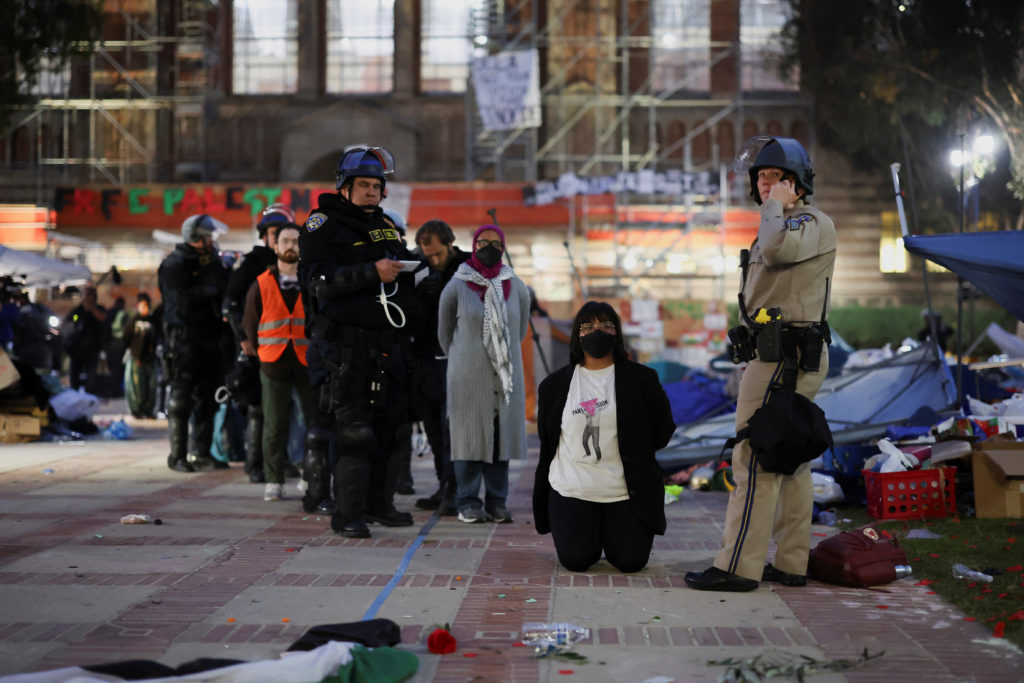
When a mob attacked UCLA’s pro-Palestinian encampment in April 2024, no one from campus police took command of the response, according to a review commissioned by the University of California. The next day, police agencies met to divide up the work of clearing the encampment. California Highway Patrol officers would dismantle it, LAPD officers would guard the perimeter, and UCLA police would make arrests.
The difference between those two nights is central to a report released September 23 by the ACLU and Amnesty International USA. The groups investigated responses to pro-Palestinian activism at 80 colleges and universities and selected UCLA as one of six detailed case studies, finding that its response went well beyond the failure to stop the initial attack.
Students established the Palestine solidarity encampment on April 25, 2024, to protest Israel’s attack on Gaza and demand that UCLA disclose and divest from financial ties connected to it. Benjamin Kersten, a UCLA graduate student and member of Jewish Voice for Peace who later sued the university, described a space with a lending library, medical tent, shared meals and religious observances. UC had already said the encampment violated university policy when counterprotesters attacked it on the night of April 30.
LAPD’s account says UCLA police told an LAPD commander at 11:07 p.m. that they were overwhelmed, but did not formally request mutual aid until 11:31 p.m. The first assisting officers arrived at 12:11 a.m. They waited for more officers before moving through the crowd, and CHP began clearing the courtyard at 2:43 a.m. UCLA’s then-chancellor Gene Block later called the attack on students, faculty and staff advocating for Palestinian rights a “truly despicable act.”
The UC-commissioned review found that administrators lacked clear lines of authority and had not prepared a detailed plan for a foreseeable campus emergency. UCLA police did not take command when other agencies arrived. The review says the resulting confusion left the university unable to respond effectively or protect students from violence. UC says it has since changed its campus safety operations.
By the following afternoon, according to LAPD’s account, UCLA police and six outside agencies had planned an operation to end the encampment. UCLA issued dispersal orders, and officers moved in early on May 2. CHP later reported that 240 of its officers participated in crowd control and that officers fired 33 shotgun rounds and 24 sponge rounds. CHP said its officers encountered assaultive resistance. The ACLU and Amnesty report describes protesters injured by police projectiles and batons, citing accounts from a UCLA task force on anti-Palestinian, anti-Muslim and anti-Arab racism. More than 200 people were arrested.
The Los Angeles City Attorney’s Office later declined to prosecute all 205 mass arrest referrals from the May 1 and 2 UCLA protests, citing insufficient evidence. It also declined all 40 referrals from a May 6 protest. Those 245 referrals do not necessarily represent 245 different people. In separate matters involving alleged conduct at UCLA, the office charged two people and referred one other person to a diversion hearing. Prosecutors also declined all 93 mass arrest referrals from a protest at USC.
Criminal charges were only one possible consequence of an arrest. On May 9, 2024, UC announced a policy requiring a conduct review for university members arrested for unlawful behavior or cited for a policy violation. The ACLU and Amnesty report says UCLA applied that policy to people arrested before it was announced. Two students and two faculty members sued UC, alleging that the dispersal order, arrests and subsequent discipline violated their rights. A judge allowed their claims to proceed in November 2025 without ruling on whether UCLA had violated the law.
UCLA has said it cleared the encampment because of safety concerns and violations of university rules. The university also faced a separate lawsuit from Jewish students who said they had been denied access to parts of campus during the protests. UC settled that case in 2025 and says it has strengthened protections against antisemitism. The ACLU and Amnesty report argues that universities must address discrimination and protect access without treating advocacy for Palestinian rights as grounds to suppress protest.
The consequences are still being contested. The new report documents further restrictions and police responses to pro-Palestinian activity at UCLA after the encampment was removed. It also describes the Trump administration’s later demand that UCLA pay $1 billion to the federal government, contribute $172 million to a claims fund and change policies governing protests and other university activities. UCLA did not agree to those terms, and a federal judge blocked the administration’s funding pressure on UC through a preliminary injunction.