
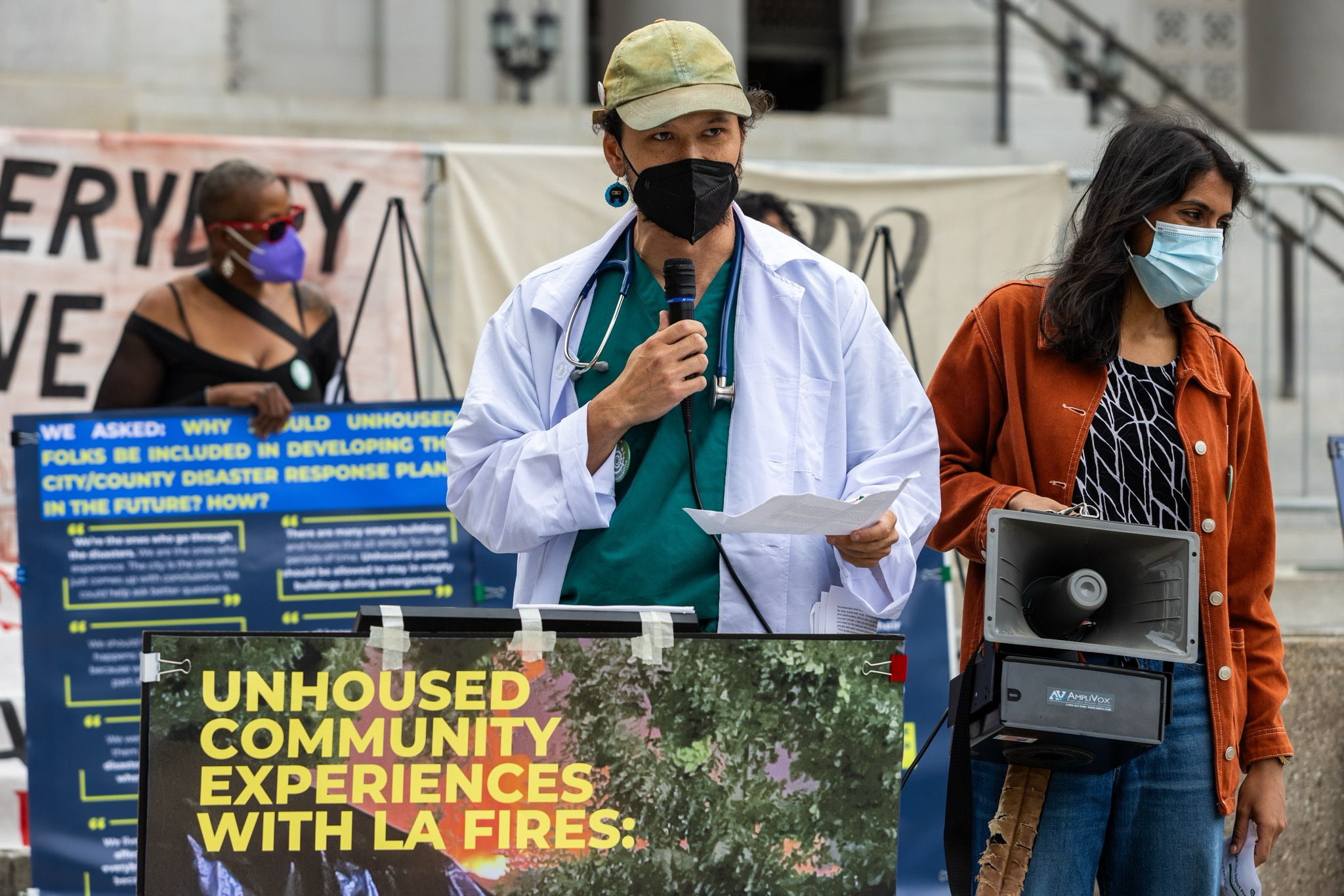
When the Palisades and Eaton fires swept across Los Angeles in January 2025, public officials urged residents to evacuate or shelter indoors, depending on the level of risk. The guidance rested on the assumption that everyone had somewhere to go. But for thousands of Angelenos living outside, those options did not exist.
Like many disasters, the 2025 wildfires exposed vulnerabilities that long predated the first spark. Homeowners may lose homes and tenants may struggle to find temporary housing. But for people already living outside, every new disaster unfolds on top of an emergency that never ended. There is no indoors to retreat to when the air becomes hazardous or hotel room to check into when there’s an evacuation order. And too often, emergency plans don’t account for what happens when an encampment sits directly in the path of advancing fire.
The failure to include unhoused residents in disaster planning sits at the center of a new report released this week by the Mutual Aid Research Collective, or MARC, a Los Angeles-based collective of mutual aid organizers, unhoused community members, and academic researchers. Surveying 57 unhoused people across Los Angeles and combining public health data with community discussions and interviews, the report finds that government assistance was almost entirely absent, leaving mutual aid networks to fill the gap.
The report argues that this reflects more than shortcomings in the city’s wildfire response. It reveals the intersection of two systems that shape the lives of unhoused Angelenos every day. During the fires, the city’s emergency response largely failed to reach many people living outside, while its homelessness response continued to treat those same residents as subjects of enforcement.
During disasters, governments routinely suspend normal operations to protect public health. Evacuation orders override ordinary procedures, and the city opens emergency shelters. Yet according to organizers, Los Angeles continued one of its most routine homelessness enforcement practices. While volunteers were distributing respirators and trying to determine how disabled residents could evacuate if the fire spread, sanitation crews continued dismantling encampments in CARE+ sweeps.
Of the 57 unhoused people surveyed, only one reported receiving government assistance during the fires. More than half said their primary source of support came instead from mutual aid groups, neighbors, friends, or family. One of MARC’s founders said he expected government outreach to unhoused residents to be uneven. What surprised him was how little evidence there was that emergency assistance reached encampments at all.
“These are very surveilled encampments,” he explained. “It’s not like the city doesn’t know where these people are.”
While government systems failed to protect unhoused Angelenos and continued to actively harm them with sweeps and forced displacement, mutual aid networks mobilized almost immediately. Across LA, neighborhood businesses, community spaces, and regular distribution sites became emergency relief hubs. Volunteers gathered respirators, air purifiers, and other essentials before delivering supplies directly to encampments throughout the city. Weekly distributions became daily emergency operations as organizers coordinated transportation, checked on medically vulnerable neighbors, and relayed rapidly changing information through networks that already existed long before the fires began. For many unhoused Angelenos, that informal network became the entire emergency response system.
MARC formally launched earlier this year after organizers concluded that unhoused residents would be largely absent from the official story of one of Los Angeles’ largest natural disasters unless communities documented those experiences themselves. While much of the public conversation focused on destroyed homes, insurance losses, and rebuilding, organizers worried that the health consequences for people living outside would remain largely invisible.
For MARC organizers, the issue was not simply that government agencies failed to collect certain information. It was who gets to decide which questions are worth asking. Rather than waiting for universities or public agencies to study the fires months or years later, organizers built the research themselves.
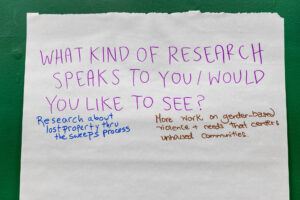
That philosophy shaped the project from the beginning. Survey questions were developed alongside mutual aid groups already working in encampments, asking what they were seeing on the ground and what information would actually help communities responding to the disaster. After the surveys were completed, the collective convened unhoused participants and mutual aid organizations to review the findings together, discuss what stood out, and help determine how the results should be presented publicly.
“The research process itself should be making those tools available,” one MARC organizer said. “You don’t need outside researchers to help you archive what you’re experiencing.”
The report argues that this approach challenges longstanding assumptions about who produces knowledge. Too often, governments, universities, and nonprofits determine how homelessness is understood while remaining removed from the day-to-day realities of living outside. MARC instead argues that people directly experiencing those realities should help shape both the questions and the answers.
The report recommends suspending encampment sweeps during declared emergencies, expanding access to protective equipment such as respirators and air purifiers, and developing evacuation plans in partnership with unhoused communities. Those recommendations reflect a broader conclusion running throughout the report that people living outside are not simply among those most vulnerable to disasters. They also possess firsthand knowledge and expertise about how to survive them.
As Los Angeles prepares for another wildfire season, the report confronts the city with a question that will only become more pressing as climate change brings larger and more frequent disasters: Can emergency planning ever be complete if it continues to overlook the people who are exposed to those emergencies first and longest? For MARC, the answer is a resounding no.