
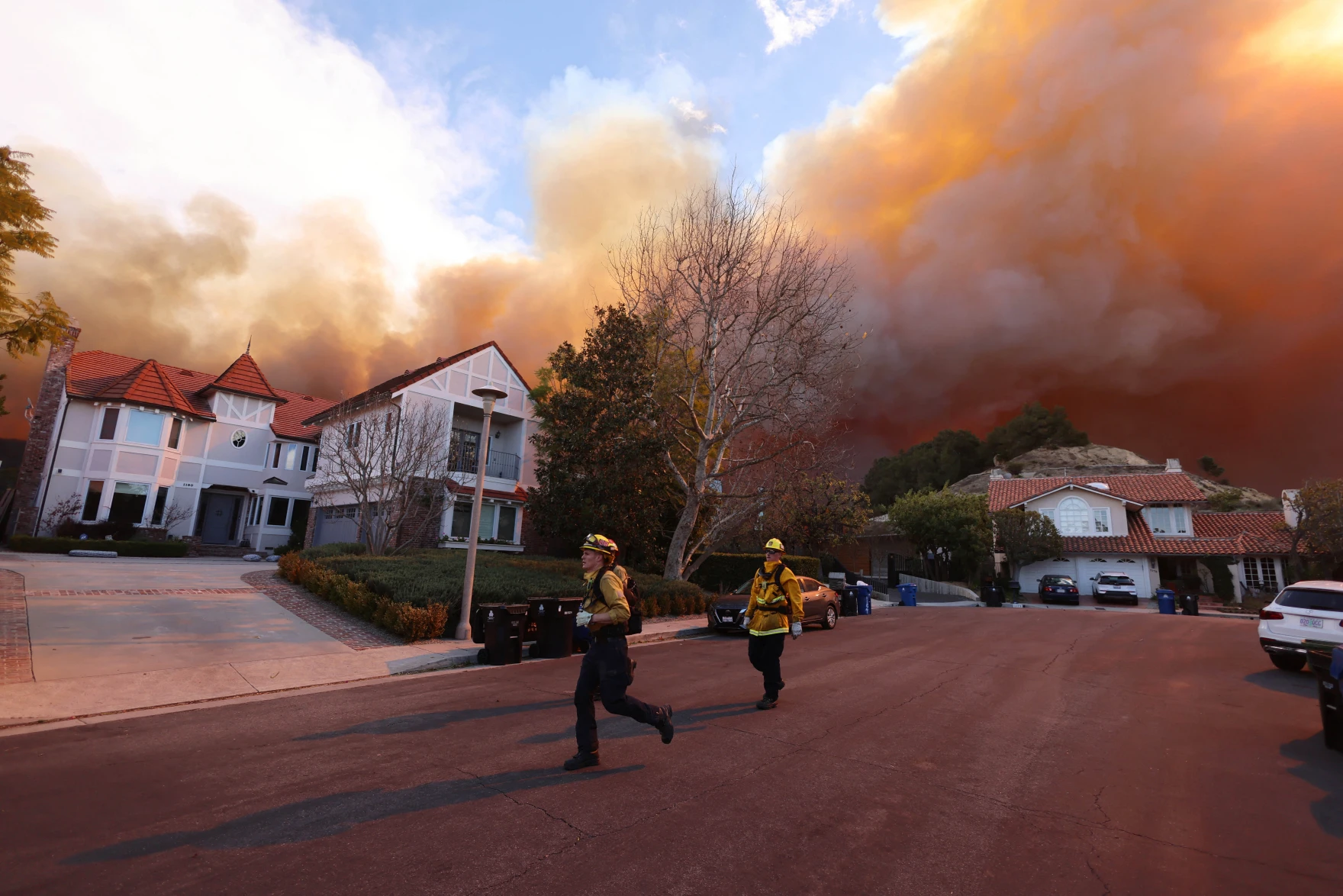
Recent reporting shows that claims blaming dry fire hydrants for last January’s devastating wildfires do not hold up under closer scrutiny and that similar water pressure failures have occurred repeatedly in major urban wildfires across the West.
In the days after the Palisades and Eaton fires tore through Los Angeles County, images of fire engines parked beside low pressure or nonfunctioning hydrants spread rapidly online. Politicians and commentators pointed to those images as evidence that water mismanagement and empty reservoirs caused the destruction. The narrative quickly hardened into a simple explanation for a complex disaster.
But recent reporting and new research from UCLA challenge that framing. An analysis highlighted this month reviewed hydrant performance during major wildfires over the past decade and found that pressure loss and hydrants running dry are common during large, fast moving urban fires, not unique to Los Angeles or the Palisades fire in particular.
Researchers with UCLA’s Luskin Center for Innovation and Sustainable LA Grand Challenge examined media reports, after action reviews, and technical documents from major fires in California, Colorado, Oregon, and Hawaii. They found documented hydrant pressure failures during the Tubbs, Thomas, Woolsey, Camp, Almeda, Marshall, and Lahaina fires, as well as during the Eaton fire that burned at the same time as the Palisades fire in January.
According to the researchers, the Palisades fire “represents the rule rather than the exception.” Hydrant failures reflect overwhelming demand and infrastructure damage during extreme fire conditions, not unusual breakdowns or local mismanagement.
The analysis found that in many previous fires, firefighters reported opening hydrants and finding little or no water, but those failures did not dominate headlines or trigger widespread political outrage. In several cases, similar conditions were treated as expected consequences of large scale fire behavior rather than evidence of system failure.
The researchers also pointed to basic physical limits of urban water systems. Municipal water infrastructure is designed primarily for everyday use and for fighting individual structure fires, not for sustaining massive, simultaneous demand across entire neighborhoods while pipes are breaking, power is failing, and homes are burning. When buildings ignite, water is lost through ruptured pipes while firefighting efforts draw heavily from the same system, rapidly reducing pressure.
State investigations have reached similar conclusions. Even where additional reservoirs existed, officials found that the system could not have delivered enough sustained flow to combat fires of that size and speed under the conditions present in January.
Despite this, public perception has shifted sharply. Survey data included in the UCLA brief shows that a significant share of California residents believe poor water management was one of the leading causes of the 2025 fires. At the same time, many residents reported being unaware that urban water systems are not designed to fight major wildfires.
Experts warn that focusing on hydrants risks obscuring the real drivers of wildfire damage, including extreme wind, prolonged drought, climate change, land use decisions, and the increasing overlap between urban development and fire prone landscapes.
Researchers argue that the more productive policy questions are not why hydrants ran dry, but how communities should adapt infrastructure and emergency planning to a future where urban wildfires are more frequent and more destructive. That includes discussions about backup power, alternative water sources, mobile pumping capacity, and land use decisions that reduce exposure in high risk areas.