
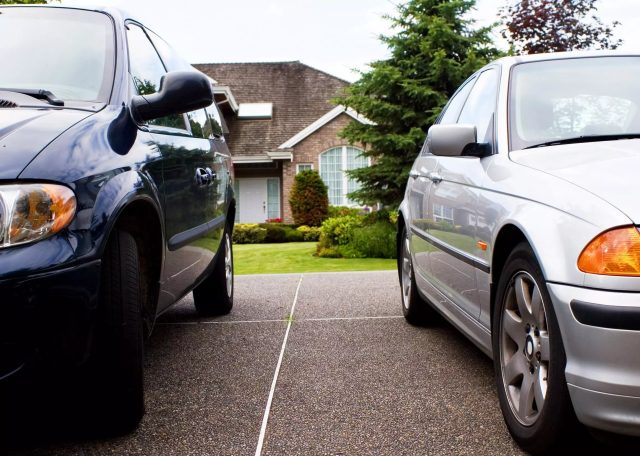
When Metro announced that Los Angeles County residents could earn up to $600 for leaving a car at home, a friend who doesn’t own a car and gets around mostly by bike had an obvious question.
“What if I’m already living like this?”
The answer appears to be that you don’t qualify.
Metro’s expanded One Car Challenge will pay selected households as much as $120 per week for five weeks if they stop using one of their cars and instead walk, bike, carpool or take public transportation. Households with two or more vehicles can participate by leaving one parked. One-car households are also eligible, but only if they agree to stop using their sole vehicle during the program. Households that don’t have a car are excluded.
That means a family with two cars can receive $600 for temporarily living with one. A family that has structured its entire life around having no car receives nothing, even if its members take the bus every day, walk to the grocery store and endure all the difficulties of navigating a region built around driving.
It makes sense that Metro would want to experiment with incentives like this. Transportation is a major source of greenhouse gas emissions, and getting even a portion of LA County’s drivers to replace car trips can reduce pollution and traffic. Metro says its earlier Santa Monica pilot corresponded with an increase in walking, biking and transit use, although a Metro staff report acknowledged that the reduction in vehicle miles traveled was statistically insignificant. The expanded pilot will include as many as 2,000 households and is supported by a $2 million grant from the Southern California Association of Governments.
But the program exposes a recurring problem with incentive-based climate policy. It rewards people for changing their behavior while overlooking those who were already doing the desired thing. Someone who bought a second car can now be paid to park it. Someone who never bought a car, and who has been reducing congestion and emissions all along, is ineligible.
The inequity of this program is hard to ignore. Car ownership is closely tied to income. Nationally, households living below 200 percent of the federal poverty level are nearly four times as likely to lack access to a vehicle as households above that threshold, according to the National Equity Atlas. Research has also found that Black and Latino households are disproportionately represented among car-free households. Although the program technically includes one-car households, its basic structure favors people who begin with a car they can afford not to use.
Living without a car in this city is not a passive lifestyle choice. It can mean longer commutes, missed connections, limited late-night mobility, dangerous street crossings and hours spent waiting for buses that don’t come frequently enough. People without cars already absorb the consequences of the region’s failure to build reliable and comprehensive public transit.
Car-free Angelenos also generate public benefits every day. They take up less road space, produce fewer emissions and reduce demand for parking. But when public agencies distribute rewards for sustainable transportation, those benefits oftentimes only go to people who adopt them temporarily.
Metro describes the challenge as a research pilot, and recruiting people who currently drive makes sense if the question is whether cash can persuade drivers to change. But that doesn’t mean they can’t also reward existing transit riders and car-free households. Metro could provide an equivalent mobility benefit to zero-car households participating in the research, such as cash, free transit passes, or bike purchases and repairs.
Paying people to try driving less may result in some useful information, but an equitable transportation policy should also reward the households that are already doing their part every day, whether by choice or necessity.