
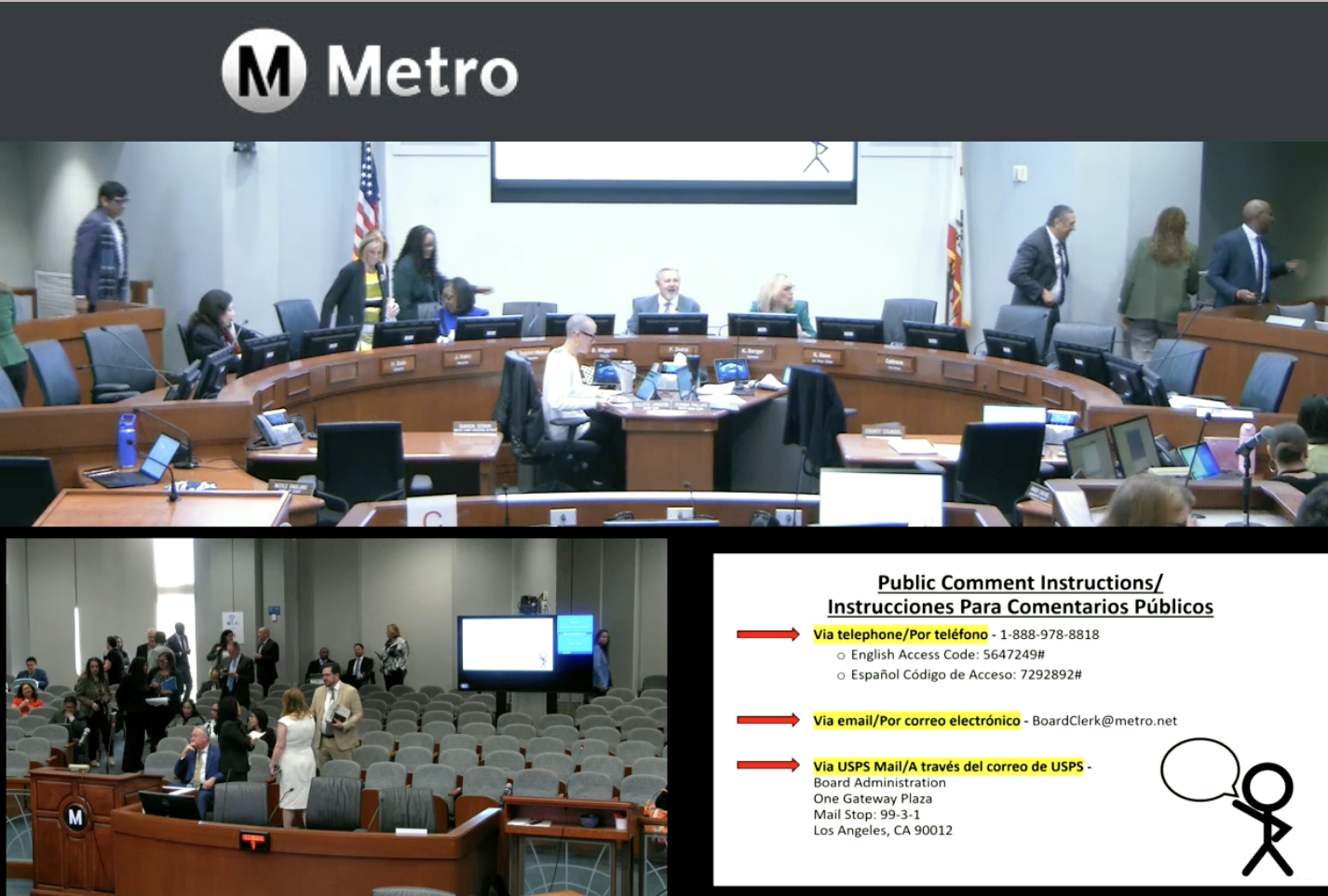
At a January 15 meeting of Metro’s Executive Management Committee, Metro quietly advanced a legislative position that would weaken a state law whose central purpose is to take land use control away from local NIMBY opposition and open up transit-rich areas to housing. The move was first flagged by transit reporter Joe Linton in a Bluesky thread following the meeting.
The issue centers on SB 79, a 2025 state law authored by Senator Scott Wiener that requires cities to allow denser housing within a half-mile of major transit stops. SB 79 was designed to address the fact that entrenched local opposition, often rooted in exclusionary zoning and fear-based politics, has historically kept large swaths of Los Angeles locked in low-density zoning and blocked housing where it is most needed.
Metro staff are now lobbying Sacramento to roll back or delay that law through a follow-up bill, SB 677, arguing that SB 79 has made it harder to build transit in Los Angeles County.
In a formal staff memo and in comments at the meeting, Metro takes an “oppose unless amended” position on SB 677 and lays out a sweeping critique of SB 79. Staff said the law has become a catalyst for local opposition to transit projects and argued that tying new transit investments to state-mandated housing density has turned transit into a political flashpoint rather than a benefit. One staff attorney told the committee that the opposition created by SB 79 is real and is already affecting Metro’s relationships with cities and the delivery of voter-approved projects.
As a remedy, Metro proposed several alternatives. Staff outlined options including delaying SB 79’s application in Los Angeles, limiting it to rail projects already in revenue service, restructuring the law to rely on incentives rather than mandates, piloting SB 79 only in the Bay Area, or exempting Los Angeles County entirely from the law. Board member Jacquelyn Dupont-Walker suggested the Bay Area should test changes first, an idea staff repeatedly returned to during the discussion.
Metro’s argument rests on a narrow conception of success. The memo and meeting discussion focused heavily on keeping capital projects moving, preserving relationships with cities that are hostile to new housing, and reducing political friction that could slow construction. Little attention was given to how housing near transit supports ridership, climate goals, or long-term service viability. This mirrors the same logic that drove the Los Angeles City Council’s controversial vote to oppose SB 79, where opponents framed the bill as a one-size-fits-all mandate despite its limited geographic scope and built-in flexibility.
There is one legitimate technical issue embedded in Metro’s critique. Staff repeatedly cited SB 79’s unclear definitions around light rail transit and whether planned or under-construction rail lines qualify as major transit stops. That ambiguity should be clarified. But rather than pursue that narrow fix, Metro used it to justify broad proposals that would significantly weaken the law’s impact in the region with the most severe housing shortage.
Metro’s own memo undercuts its case. Staff acknowledge that higher density leads to higher transit use and highlight Metro’s joint development program, which aims to deliver 10,000 housing units by 2031, at least half of them affordable. Yet Metro then argues that Los Angeles does not need SB 79, a position that ignores the chronic failure of local control to produce housing at the scale required to address affordability and displacement. That failure is the reason the state enacted SB 79 in the first place.
The political dynamics at the meeting were telling. Supervisor Janice Hahn pushed back on Metro’s framing, calling the proposed amendments way out there and questioning whether weakening SB 79 would actually address the root causes of opposition. Hahn argued that much of the resistance staff described is driven by misinformation, recounting how residents react strongly to SB 79 even when maps show they will not be affected. She ultimately cast the sole no vote when the committee adopted the staff position.
Public comment underscored the stakes. Scott Epstein of Abundant Housing LA, a co-sponsor of SB 79 and SB 677, urged Metro not to weaken the law. He warned that exempting or delaying SB 79 in Los Angeles County would push housing farther from transit, increase commute burdens, and undermine long-term ridership and revenue. Gutting SB 79, he told the committee, would be a nonstarter.
As Joe Linton noted in his reporting, opposition to major Metro projects long predates SB 79. Beverly Hills sued aggressively to block the subway, and Westside cities fought the Expo Line for years. Transit opposition in Los Angeles has always been intertwined with exclusionary land use politics. SB 79 did not create that resistance. The law exists to remove local veto power over housing near stations precisely because that resistance has left critical transit corridors surrounded by low-density development.
What Metro is proposing now is not a technical cleanup. It is a policy choice to accommodate the very local opposition SB 79 was designed to counter. Framed as pragmatism, it represents a retreat from the idea that transportation, housing, and climate policy must move together.
If Los Angeles is exempted from SB 79, the consequences will be clear. Metro will continue building expensive infrastructure through low-density neighborhoods while ridership lags, housing costs soar, and access to homes near transit remains scarce. That is not a transit success story. It is the status quo, reinforced.