
This article has been updated to reflect that the Mar Vista Community Council voted to approve the motion opposing Flock cameras following overwhelming public comment. New reporting from the meeting has been added below.
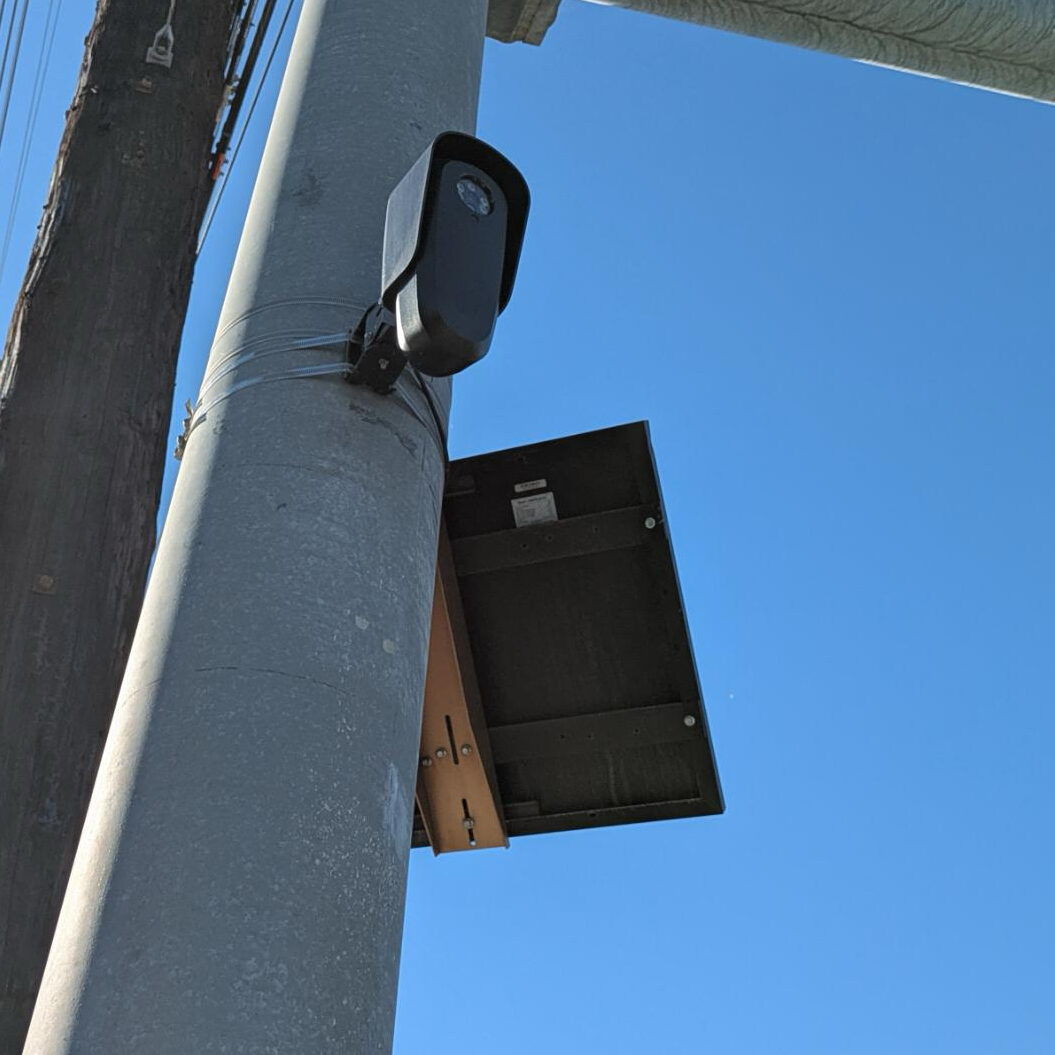
The Mar Vista Community Council met tonight to consider a motion that cuts to the heart of one of the most urgent and controversial issues facing LA right now: surveillance, policing, and what safety actually looks like in our communities. The motion, which had already advanced out of the Transportation, Infrastructure and Sustainability Committee, called on the city to stop installing Flock license plate reader cameras in Mar Vista and to remove the ones already in place. After an overwhelming show of public opposition, the council voted to adopt it.
The committee’s March 3 discussion made clear that this is not simply a question of traffic or crime prevention. It is about how mass surveillance systems can harm communities, particularly when they collect and retain data that can be accessed beyond local purposes. Speakers described how the cameras “capture your license plate as you go by” while operating as part of a system that “passively monitor[s] the passage of cars through the neighborhood and record[s] the movements of residents.” Committee materials emphasized that this data does not stay local, noting it has been “used by ICE and DHS to track people’s movements” across jurisdictions. The result is a system that creates a lasting record of where people travel, well beyond neighborhood boundaries. Those concerns carried through to the full board meeting, with roughly two dozen residents speaking in public comment, every single one opposing the cameras.
The risks outlined in those materials reflect a broader reality. Flock’s network aggregates license plate data into a centralized system that allows law enforcement agencies across the country to track vehicles over time, including through searches conducted on behalf of federal immigration authorities. These systems also tend to expand. Companies like Flock are already moving beyond simple plate readers toward real-time video, AI-powered search tools, and integrations with commercial data brokers that can link vehicles to individuals. That means a system initially sold as a way to identify stolen cars can quickly become infrastructure for tracking people, mapping their movements, and building detailed records of their lives. Once in place, that kind of surveillance is difficult to limit and nearly impossible to roll back.
In a highly unusual move, Councilmember Traci Park’s office intervened ahead of the committee vote, sending a letter urging members to reject the motion and defending the cameras as a law enforcement tool under LAPD policy. In her letter, Park’s office emphasized limits on data access and retention and described Flock as primarily a hardware provider, noting that the data is owned by local agencies like LAPD. But that characterization is incomplete. Flock operates a cloud-based platform that stores, aggregates, and allows law enforcement to search license plate data across jurisdictions, functioning as far more than a passive vendor. Flock data is stored for at least 30 days by default and can be retained longer if flagged, and reporting has documented instances in California where ALPR systems were accessed by ICE and by agencies outside their jurisdiction. Her office also leans heavily on a single high-profile crime in the Venice Canals to justify the technology, despite no evidence that Flock cameras were involved in that case. Presenters at the meeting directly addressed that claim, noting they could not find evidence supporting it. Together, these gaps between official claims and how the system operates in practice are at the center of the concerns now being raised by residents.
Park’s level of involvement in a neighborhood council committee is rare and reflects how politically sensitive this issue has become for her reelection campaign. Opposition to mass surveillance is cutting across the political spectrum, including within typically conservative neighborhood councils like MVCC, posing a direct challenge to an agenda at City Hall where surveillance has been central to her record. She is one of the most consistent proponents of expanding policing and surveillance infrastructure, from license plate readers to real-time crime centers. She has pushed to increase police funding, aligned closely with LAPD leadership, and supported approaches to public safety that prioritize enforcement over community-based alternatives. She has also received $1,730,448.69 in contributions from the Los Angeles Police Protective League, the LAPD’s powerful union. At the same time, she has taken positions that raise concerns about how these systems intersect with immigration enforcement, including opposing sanctuary protections and characterizing individuals detained in ICE raids as violent criminals, echoing federal enforcement narratives.
Her push to install Flock cameras is part of that broader approach. Park directed roughly $450,000 in public funds to LAPD for the acquisition, installation, and maintenance of Flock-style automatic license plate reader cameras across Council District 11 and publicly promoted their expansion. Discretionary funds are public dollars meant to support local priorities and community needs. Instead, these funds were used to build out a districtwide surveillance system for LAPD, a department that already takes up a significant share of the city’s budget.
Despite pressure from Park’s office, the motion passed. The Mar Vista Community Council has now formally opposed the Flock camera program and called for the removal of the cameras already installed. The vote does not directly control whether the cameras will be removed. But it sends a clear signal that Mar Vista residents are joining a growing national backlash against mass surveillance systems.